Dental prostheses are used whenever one or more natural teeth need to be replaced. There are various types of dental prostheses. A distinction is made, for example, between removable and surgically fixed prostheses. The type of prosthesis that is appropriate depends on various factors.
Here you will find further information as well as a selection of specialists and centers for dental prostheses.
Why Get a Dental Prosthesis?
Dental prosthetics may be necessary when a natural tooth needs to be replaced. Unfortunately, teeth are often lost in old age. Other causes of tooth loss include oral diseases and accidents.
It is not always absolutely necessary to have a dental prosthesis fitted. However, a gap in the dentition is particularly noticeable in the front teeth and can significantly reduce the patient’s quality of life. For this reason, people usually opt for a dental prosthesis for aesthetic reasons.
The dentist works with the patient to determine which type of dental prosthesis is right for them. The choice depends
- on age,
- health status,
- the position of the lost tooth, and
- the patient’s lifestyle
.
Types of Dental Prosthetics
The different types of dental prostheses vary in
- appearance,
- care,
- cost, and
- method of placement.
Generally, dental prostheses are classified as either removable or fixed:
- A denture can be easily inserted and removed.
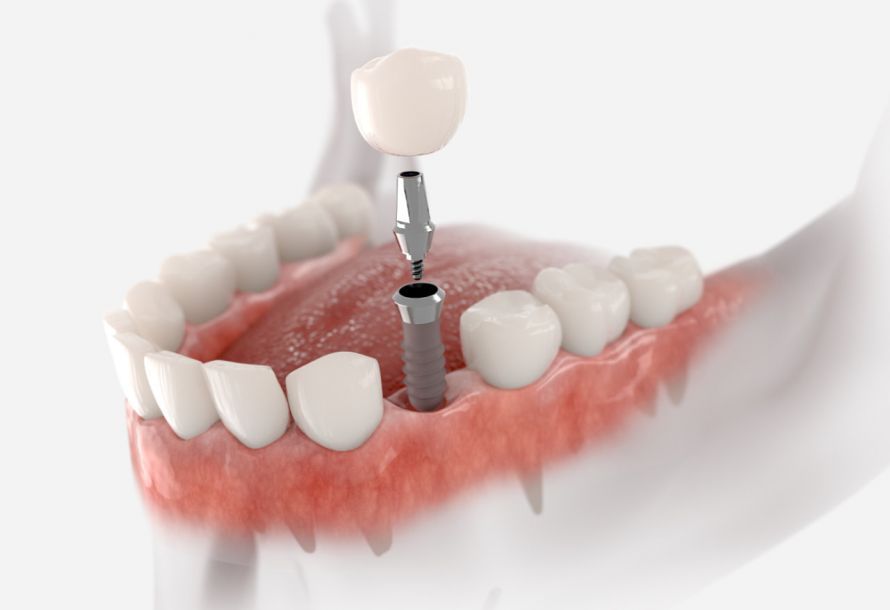
- A dental implant, on the other hand, must be surgically implanted. A dental crown is then attached to it.
For an older man who is missing several molars, a removable partial denture may be sufficient. However, a young woman who is missing a front tooth should consider at least a crown, if not a dental implant, as a replacement.
Every type of artificial tooth replacement is crafted by a dental technician. To do this, the technician takes impressions of the teeth to ensure the replacement fits perfectly into the existing dentition. For a dental implant, an implantologist is also required to surgically place the implant into the jawbone.
Artificial Teeth Through Surgery
Teeth are subjected to heavy stress during chewing. It is therefore of the utmost importance that they are securely anchored in the mouth. This is what a dental implant is for. Essentially, it is an artificial root that is anchored in the jaw like a screw. An artificial crown can then be placed on top of this dental implant.
During the surgical procedure, the specialist first removes the natural tooth structure from the jawbone. After the implant is placed, the wound must first heal for some time before the final dental prosthesis is fitted.
The implant can support a single tooth or serve as an abutment for a larger dental bridge.