The middle layer of the human eye is medically referred to as the uvea. It consists of the iris, the ciliary body, and the choroid.
Inflammation in this area is called uveitis. Depending on its location, this condition can affect different parts of the eye and may be acute or chronic. Anterior uveitis is particularly common; in this form, the iris and adjacent structures are primarily inflamed.
Early treatment is important because inflammation inside the eye can lead to vision loss, increased intraocular pressure, and, in severe cases, permanent vision impairment.
Below you will find further information as well as a selection of specialists in iris disorders.
Definition
The middle layer of the eye is also called the uvea. It consists of the iris, the ciliary body (corpus ciliare), and the choroid. Uveitis is the inflammation of the choroid in this region. Different types are distinguished depending on the part of the eye affected.
Anatomy and Structure of the Middle Eye Layer
The middle layer of the eye consists of:
- The iris
- The ciliary body of the eye (corpus ciliare)
- The choroid of the eye
Essentially, the middle layer of the eye is responsible for supplying nutrients to the retina. It is therefore also called the choroid. The retina is part of the central nervous system. This tissue supplies the inner layer of nerve cells.
It also enables the eyes to focus on objects at different distances (accommodation). By enlarging or constricting the pupil, the eyes can adjust to different lighting conditions (adaptation).
Inflammation of the middle layer of the eye is also called uveitis. Uveitis is classified based on:
- The affected sections of the middle layer of the eye (iritis, choroiditis)
- The region of the eye (anterior, middle, or posterior segment)
- The cause (primary or secondary as a concomitant condition)
You should always have uveitis treated by a specialist, as it can permanently impair vision.
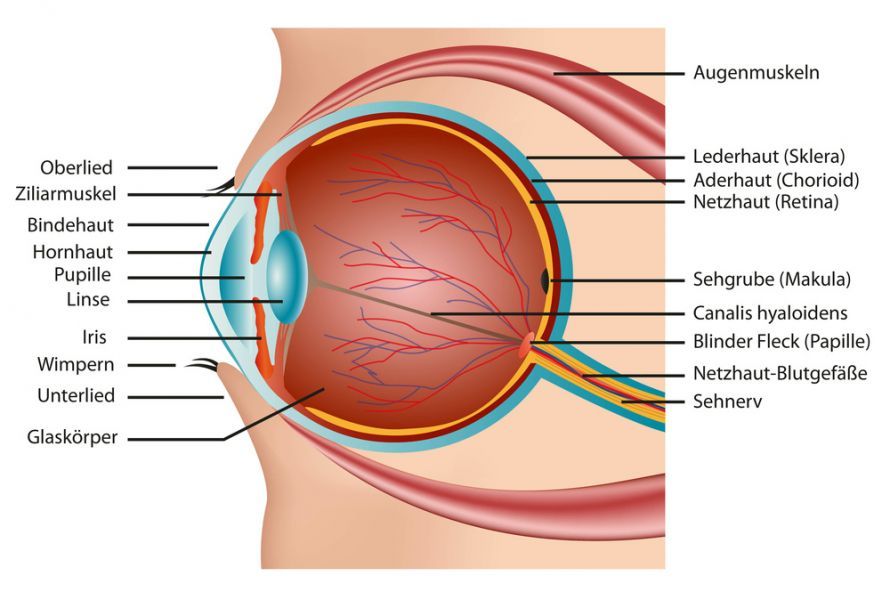 The structure of the human eye @ bilderzwerg /AdobeStock
The iris
In front of the lens lies the iris, which contains pigment (melanin). Its color determines a person’s eye color.
The pigmentation of the iris is not yet fixed at birth but develops during the first year of life or later. A baby’s eyes are almost always blue or gray at first.
The pupil is located in the center of the iris. It is a round opening that can be adjusted by the muscles of the iris.
This allows the eye to respond to different lighting conditions. The iris thus functions as an aperture in a camera.
 Pupillary reflex
We cannot consciously control the size of the pupil. Instead, the autonomic nervous system controls it.
In stressful situations, in dim light, or when looking into the distance, the pupil dilates.
Conversely, the pupil’s diameter decreases in bright light, when we’re tired, or when focusing on nearby objects.
The iris divides the space between the lens and the cornea into a posterior and an anterior chamber.
Diseases of the iris
The iris is sensitive and can become inflamed quickly if the immune system is weakened.
Signs of iritis include:
- Pain caused by exposure to light
- Excessive tearing
- Eyelid spasms accompanied by blurred vision
Inflammation of the iris can be either acute or chronic. Iritis is usually a complication of a rheumatological condition. If the iris is inflamed, the ciliary body is usually affected as well (cyclitis).
Iritis can have various causes, such as:
- Various pathogens (borreliosis—an infection transmitted by ticks)
- Viral infection caused by influenza viruses
In the areas of inflammation, changes occur in the blood vessels of the iris. As a result, proteins or white blood cells may leak out of the anterior chamber of the eye.
This results in impaired vision. Additionally, inflammation of the iris can cause the secretion of fibrin and cells that block the drainage pathways of the aqueous humor. This can lead to adhesion of the cornea, iris, and pupil.
Inflammation of the iris disrupts aqueous humor circulation. As a result, intraocular pressure rises (secondary glaucoma). In extreme cases, this can lead to blindness.
In albinism, the iris lacks pigmentation, so the back of the eye is visible. This results in a reddish eye color. Since the iris serves to reduce glare, it cannot perform this function in albinism. The affected person feels dazzled.
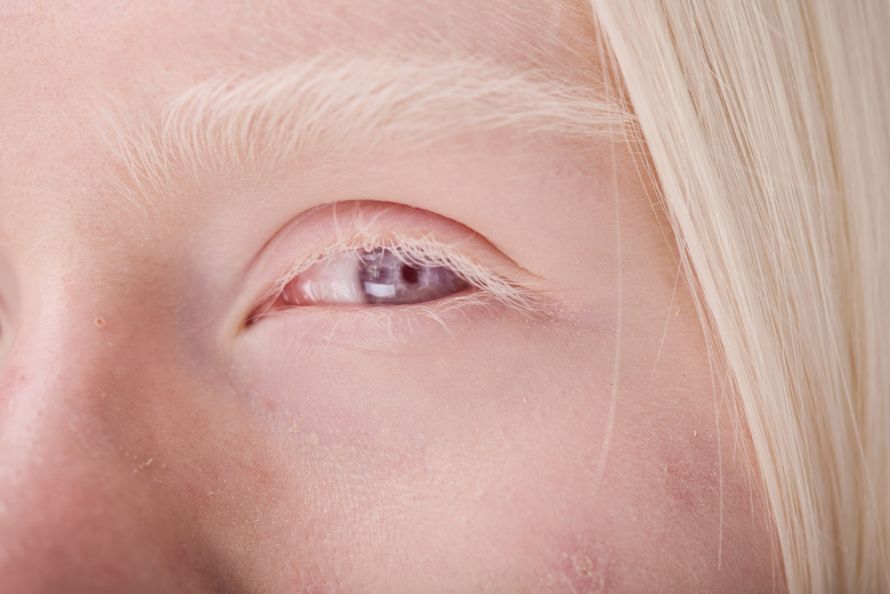 Most people with albinism have lighter eye and hair colors @ AnnaStills /AdobeStock
If the iris is absent at birth, experts refer to this as aniridia. Defects in the iris are called colobomas.
The ciliary body (corpus ciliare)
The ciliary body (corpus ciliare) is part of the middle layer of the eye. It is located between the iris and the choroid of the eye. It consists of the ciliary epithelium (membrane) and the ciliary muscle and forms a ring around the lens of the eye, thereby providing support for it.
It also plays a role in the production of aqueous humor for the eye chambers. The aqueous humor ensures stable intraocular pressure.
During aqueous humor production, the epithelium first releases the fluid into the posterior chamber of the eye. From there, it can flow into the anterior chamber, so that the cornea and lens are “bathed” in the fluid.
The anterior and posterior chambers of the eye contain approximately 125 microliters of aqueous humor. Production takes about one hour.
The ciliary body and the lens are connected by zonular fibers (suspensory ligaments). Tension on these fibers causes the lens to contract or relax. This allows the eye to focus on distant and near objects due to the lens’s flexible refractive power.
Diseases of the Ciliary Body
Anatomically, the ciliary body is closely connected to the iris. Therefore, diseases often occur in combination. Doctors refer to inflammation of both areas as “iridocyclitis.” If left untreated, this can lead to glaucoma or cataracts.
Eye pain and sensitivity to light may indicate inflammation of the ciliary body.
Other typical symptoms include:
- Vision problems
- Changes in the color of the pupil
- Adhesions between the pupil and the cornea
Inflammation of the ciliary body often has internal causes, such as:
- Herpes viruses (human papillomaviruses)
- Various bacteria
- Corrosive chemicals
- Autoimmune diseases (rheumatic spectrum)
- Comorbidities associated with chronic intestinal inflammation
- Connective tissue disorders
The ciliary body can also be affected by tumors. The most common of these is malignant melanoma of the ciliary body. This is a life-threatening condition that requires urgent ophthalmologic care, ideally at an ophthalmic oncology center.
Causes of Uveitis and Complications
The causes of uveitis are varied. Possible causes include infections caused by viruses or bacteria, and, less commonly, by fungi or parasites. Uveitis can also occur in association with rheumatism, ankylosing spondylitis, arthritis, juvenile idiopathic arthritis, Crohn’s disease, sarcoidosis, or Reiter’s disease. Toxoplasmosis is also among the known triggers. In many cases, however, the cause remains unclear—that is, the cause is unknown. Consequently, a wide variety of different diseases can trigger uveitis.
If left untreated, uveitis can lead to serious complications such as glaucoma, cataracts, retinal detachment, damage to the optic nerve, and, as a result, permanent vision impairment.
Diagnosis of Uveitis
Uveitis is diagnosed by an ophthalmologist. Key steps include examining the anterior and posterior segments of the eye, assessing the cornea, anterior chamber, vitreous body, and retina, and measuring intraocular pressure. Depending on the findings, possible systemic causes are also investigated, such as an underlying rheumatological condition. If the vitreous body, retina, or posterior segment of the eye are involved, additional examinations are particularly important.
Treatment Options
The primary goal is to quickly control the inflammation. Eye drops containing cortisone are frequently used. In more severe cases, cortisone in tablet form may also be necessary. In addition, the goal is to relieve pain and prevent the pupil from sticking shut. If the inflammation is caused by a virus, bacteria, or other pathogens, targeted treatment is required. In rare cases, the condition may also be caused by fungi or parasites. Without treatment, there is a risk of damage, persistent vision problems, changes to the vitreous humor and retina, increased intraocular pressure, glaucoma, cataracts, or even retinal detachment. Therefore, any inflammation in the middle layer of the eye should be carefully treated and monitored.
Frequently Asked Questions
What is uveitis?
Uveitis is an inflammation of the middle layer of the eye. It can affect the iris, ciliary body, and choroid.
Is iritis the same as uveitis?
No—not exactly. Iritis refers to inflammation of the iris. It is a form of uveitis, usually in the sense of anterior uveitis.
What are the possible causes of uveitis?
Causes include autoimmune diseases, infections, rheumatic diseases, and pathogens such as viruses or bacteria. Toxoplasmosis, ankylosing spondylitis, Crohn’s disease, and juvenile idiopathic arthritis are also possible causes.
How is uveitis treated?
Depending on the cause, treatment may include eye drops, corticosteroids, other anti-inflammatory medications, and targeted treatment of the underlying condition.
Can uveitis be dangerous?
Yes; if left untreated, it can lead to complications such as glaucoma, cataracts, damage to the optic nerve, and permanent vision loss.
Share this article