If the dental pulp near the root of the tooth becomes inflamed, root canal treatment is often the only way to save the tooth after a root infection. During this procedure, performed under local anesthesia, the inside of the tooth is filled, sealed, and, if necessary, covered with a crown. The most common cause of severe root inflammation is tooth decay.
Here you will find further information as well as a selection of root canal specialists and centers.
What causes root inflammation?
Tooth decay is by far the most common cause of root inflammation (pulpitis). If tooth decay is not treated in time, it eats deep into the tooth. Bacteria can then penetrate the pulp (the innermost part of the tooth). This results in inflammatory changes inside the tooth, which usually manifest as throbbing, severe pain.
At this stage, the dentist can still treat the pulpitis without root canal therapy.
If the pain suddenly disappears, this is a sign of permanent damage to the nerve pathways in the pulp. The pulp dies. It must now be removed from the interior of the tooth to prevent serious complications. Such complications include, for example, the inflammation spreading to the jawbone or complete tooth loss.
Accidents or surgical procedures on the teeth are a much less common cause of root inflammation than tooth decay. For example, a blow to the jawbone can cause the enamel to fracture, exposing the dental nerve and allowing bacteria easy access. In rare cases, the dental nerve may be damaged during treatment for tooth decay.
What is the goal of root canal treatment?
In the past, severely damaged teeth were simply extracted to prevent the inflammatory process from spreading to the rest of the body. Today, the goal is to avoid this by performing root canal treatment and preserving the tooth.
A preserved tooth is more beneficial for the masticatory system than a replacement with implants or partial dentures.
The goal of the filling is to seal the prepared root canal with a special filling material in a way that is impervious to bacteria. This is intended to permanently secure and preserve the tooth.
General Root Canal Treatment
First, the dentist must determine whether the tooth is still alive—that is, whether the pulp is merely inflamed or has already died.
Dead teeth no longer react to cold or heat. The dentist will therefore subject the tooth to a cold test (known as a vitality test):
- healthy teeth only feel the cold,
- severely inflamed nerves react with a brief, sharp pain, and
- dead teeth neither sense the cold nor react with pain.
An X-ray will then provide definitive information about the presence and extent of the root infection.
The principle of root canal treatment is to remove inflamed or dead tissue from inside the tooth. The dentist then seals the resulting cavity with filling material.
The procedure is usually performed under local anesthesia, as it is very painful. Root canal treatment can be divided into four stages:
- removal of the pulp
- determining the length of the root canal
- preparation of the individual root canals
- filling and sealing the root canals
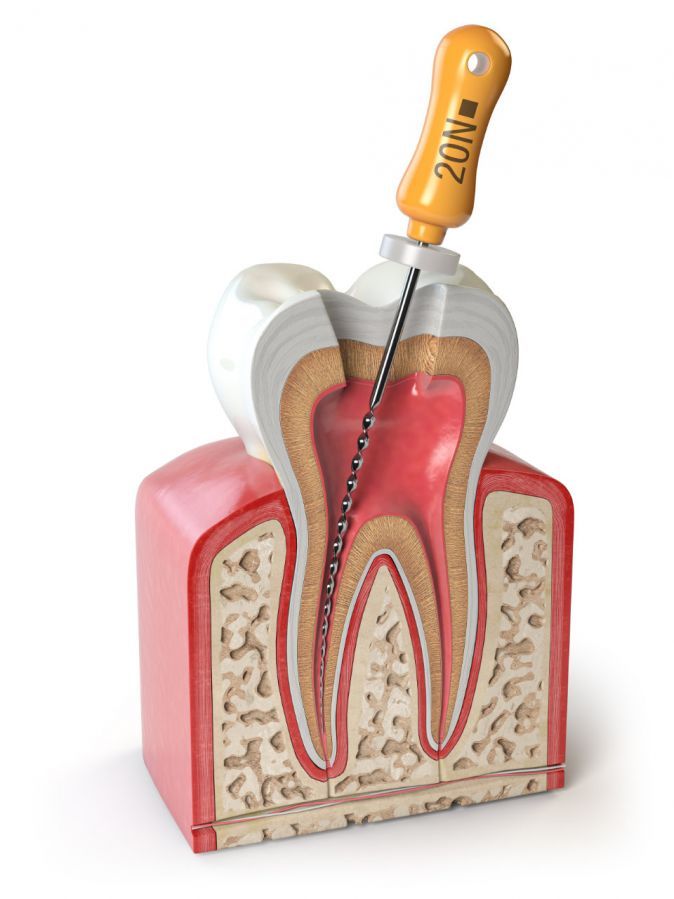
Using tiny instruments, the dentist removes the pulp and prepares the root canals © Maksym Yemelyanov | AdobeStock
Removal of the pulp
First, the dentist opens the crown of the tooth to remove the pulp. Any existing decay is completely removed with a drill before a hole is drilled down to the interior of the tooth. The exposed dental pulp is then completely removed using an extirpation needle.
To completely seal the hollow interior of the tooth, the dentist must determine the length of each root canal. This allows him to establish the working length of the instruments needed for root canal treatment.
To do this, the preparation instruments are first inserted through the opening into the interior of the tooth, and then an X-ray is taken. The X-ray shows how far the instruments are from the root tip and what length they should have within the canal.
In some cases, the root canal length can also be determined electrically. This involves inserting a small probe into the open root canal, which indicates the end of the canal via a measuring device.
Root Canal Preparation
Next, the root canal is prepared for root canal filling. Using flexible burs and files—operated either mechanically or manually—the dentist smooths and widens the canals.
In addition to instrument-based preparation, ultrasonic root canal preparation now offers a gentler method.
Laser light has a thermally induced bactericidal effect. The root canal is sterilized by the laser light. This eliminates the need for repeated rinsing with an antibacterial solution and medicated fillings.
For the patient, this means a significant reduction in treatment time and an acceleration of the healing process.
The use of laser light is particularly beneficial in cases of pus accumulation in the root canal. This usually eliminates the need to split the root canal treatment into two sessions. It is not necessary to wait for antibacterial and anti-inflammatory medications to take effect.
Before actually filling the root canal, the dentist thoroughly rinses out the inside of the tooth.
Filling the Root Canal
The filling material is always a foreign substance that is
- is bacteria-proof,
- non-resorbable, and
- radiopaque
. In practice, there are several methods for filling root canals:
- the paste-only filling
- filling with a post and paste
- filling with multiple posts and a small amount of paste
Pure paste fillings consist either
- epoxy resin, which has excellent sealing properties and good dimensional stability, or
- guttapercha, a thickened latex extracted from the tropical gutta-percha tree.
Pastes used in combination with posts are either
- on a gutta-percha base or
- on a mixture of zinc oxide and eugenol.
The combination of inserted posts and paste provides the tooth with additional stability. This is particularly important when a significant amount of natural tooth structure has had to be removed.
Posts can be either semi-solid or solid.
Semi-solid posts must always be used in combination with a paste. These posts consist of a mixture of
- guttapercha,
- zinc oxide,
- waxes, and
- plastics with good biocompatibility.
In addition, there are solid posts made of silver, titanium, or plastic. They can either be placed in the root canal in combination with a paste or used on their own.
The disadvantage of using rod fillings alone is that they do not form a tight seal against the inner walls of the tooth. This creates cavities where bacteria can colonize again. For this reason, such filling methods are generally avoided today.
After the root canal has been filled, another X-ray is taken. This allows the dentist to ensure that the canals have been filled completely and without air pockets.
To restore the tooth, depending on the size of the access hole, a filling is placed or a crown is fitted. This restores the tooth to a fully functional part of the masticatory system.
Complications During Root Canal Treatment
Complications during root canal treatment occur only in the rarest of cases. They can be caused by:
- Root canals that are difficult or impossible to access
- Resistant bacterial infection
- Persistent chronic inflammation despite removal of the pulp
- Fracture of a dental instrument
- Rupture of the outer tooth wall
If the root canals are inaccessible to the dentist, the only option left is usually complete extraction of the tooth.
Resistant bacterial infection and persistent inflammation require medical treatment. This involves either oral administration of antibiotics or the local application of medication directly into the exposed tooth root. In some cases, it is appropriate to use a combination of oral and local antibiotics.
At this point, the dental treatment is paused, and a temporary filling is placed over the tooth. The root canal filling can only be performed after the bacterial infection has been eliminated.
There is a particular risk of a dental instrument breaking during mechanical root canal preparation. To remove the small metal fragments, the dentist often has to remove more healthy tooth structure.
If the broken instrument cannot be easily removed, it will remain permanently in the root canal even after the canal has been filled. Depending on how deep the instrument is embedded, there is a risk of inflammation of the surrounding tissue. The root tip is particularly at risk.
In rare cases, the tooth root may be perforated laterally during root canal preparation. This is particularly likely when the root canal has a highly curved or tortuous course. Dentists refer to this as a “via falsa,” or “wrong path.”
The resulting hole is simply sealed off during the root canal sealing process. It should not cause any further problems once the wound has healed following the root canal treatment.
In some cases, the tooth root is already so damaged and compromised that root canal treatment will no longer be successful. In such cases, an apical resection may be necessary.
Through a minor surgical procedure, the damaged portion of the root tip is removed from the outside. This way, at least the rest of the tooth can still be saved.