The slit lamp (also known as a slit-lamp microscope) is one of the most important diagnostic instruments in ophthalmology. During a slit-lamp examination, a narrow, focused beam of light illuminates the patient’s eye. This allows the doctor to examine the eye through a magnifying lens (microscope).
Below you will find further information as well as a selection of specialists who perform slit-lamp examinations.
Function and Use of the Slit Lamp
The slit lamp allows the ophthalmologist to detect small irregularities and changes in the cornea. The slit lamp provides 6x to 30x magnification.
Since the ophthalmologist uses both eyes when looking through the microscope, a three-dimensional image is created. The slit lamp is therefore a stereomicroscope.
The slit lamp has been used for detailed eye examinations since 1911. Experts found ways early on to better illuminate and magnify the barely visible structures of the eye.
In particular, it is impossible to view the interior of the eye and the fine details of the retina without the aid of such instruments. For these purposes, the slit lamp is the instrument of choice. With the slit-lamp microscope, the eyeball is examined closely under illumination and at high magnification.
The width of the light slit can be adjusted to various settings. The illumination methods are also variable (diffuse, direct, lateral, frontal).
This allows for precise optical inspection of all anterior and middle segments of the eye, as well as the posterior segments with the use of an additional lens.
Additional instruments can be used in conjunction with the slit-lamp examination. For example, it is possible to take photos or videos or to measure intraocular pressure. The procedure is used both preventively as part of routine checkups and to diagnose existing symptoms.
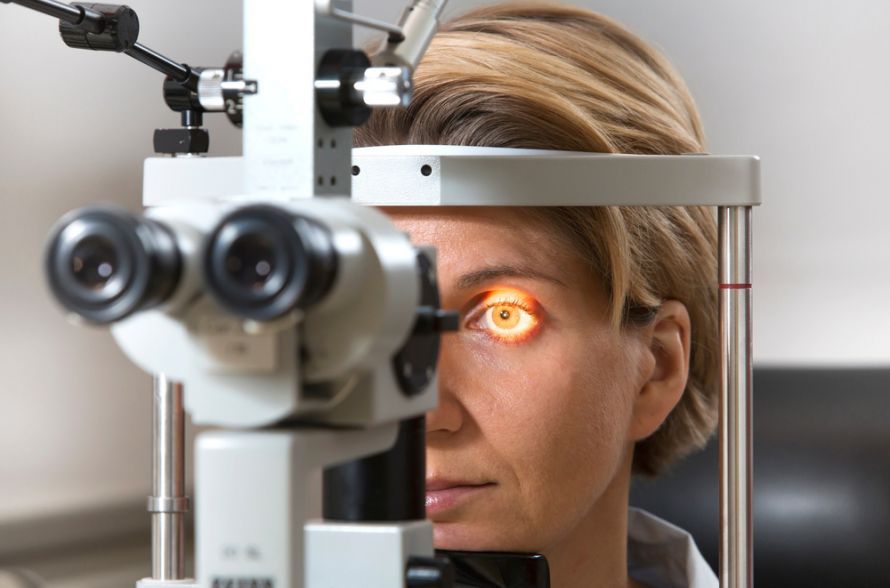
The narrow beam of light allows for a visual cross-section through the transparent sections of the eye @ mmphoto /AdobeStock
The slit lamp can be used to diagnose the following:
- Corneal injuries
- Clouding of the lens (cataracts)
- Various inflammations and hemorrhages in the anterior and middle segments of the eye
In the fundus, conditions such as retinal changes, retinal detachment, or damage to the optic nerve head can be detected.
Areas of Examination
The slit lamp is used to detect various eye diseases and allows for a magnified view of the eye being examined in all sections of the eye.
The following list details the areas of the eye that can be examined with the slit lamp:
- Eyelids
- Conjunctiva
- Cornea
- Anterior chamber
- Lateral areas of the anterior chamber
- Lens
- Vitreous body
- Retina
- Optic disc
- The area of sharpest vision, the macula
The following disorders and diseases can be detected through a slit-lamp examination:
- Lesions of the cornea
- Injuries, chemical burns, and thermal burns
- Lesions of the corneal epithelium
- Corneal inflammation
- Abnormalities in the curvature and size of the cornea
- Tissue atrophy, corneal degeneration
- Dystrophy, bilateral, progressive, hereditary
- Corneal opacity
- Examination of the sclera, i.e., the scleral tissue
- Deep layers of the sclera for signs of injury, discoloration, and tissue atrophy
- Scleraectasia
- Degenerative changes and calcifications in the area of the palpebral fissures
- Episkleritis
- Scleritis
- Cataract
- Displacement of the lens
- Inflammation of the iris and ciliary body
- New blood vessel formation in the iris due to reduced blood flow to the retina
- Tumors in any part of the eye
- Malformations of the iris, lens, eyelid, or choroid
- Aniridia
- Albinism
- Vitreous opacity
- Inflammation inside the eye
- Diabetic retinopathy
- Macular degeneration
The Slit-Lamp Examination
During an eye examination with a slit lamp, the patient sits facing the doctor. A chin rest and a padded forehead rest stabilize the patient’s head so that it does not move during the examination.
To get a clear view of the back of the eye, the patient’s pupils must be dilated. To achieve this, the patient is given eye drops that dilate the pupils.
In addition, the patient receives a local anesthetic in the form of eye drops—the pupils are dilated with these drops, and the patient is also given a local anesthetic to prevent them from squinting. The doctor uses a focused beam of light to examine the front of the eyes. This allows them to detect any abnormal or pathological changes.
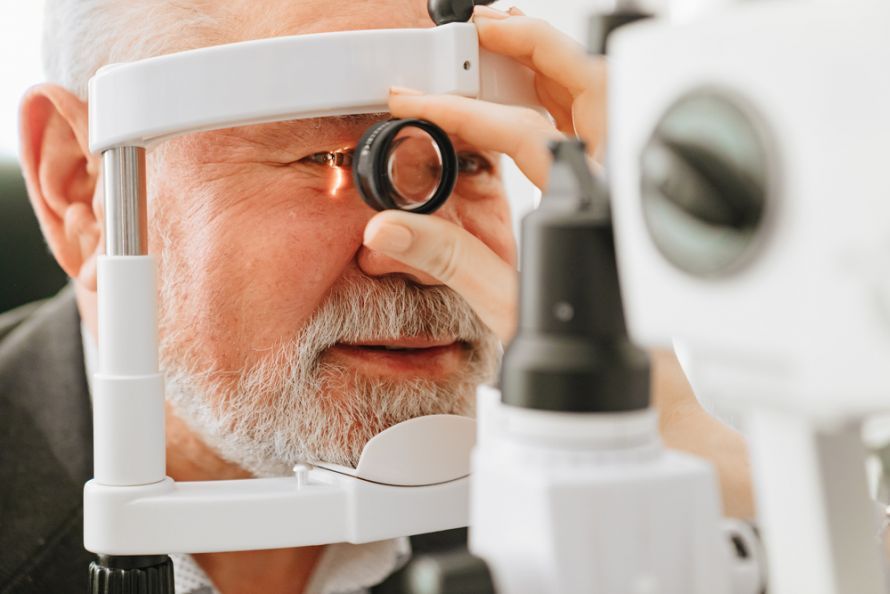
The slit lamp is the most important diagnostic tool in ophthalmology @ andrey /AdobeStock
There are no risks associated with the non-contact slit-lamp examination. The use of instruments that require direct contact with the cornea is not necessary. However, side effects may occur when eye drops are administered.
These mainly include:
- Allergic reactions
- Itching
- Burning sensation in the eyes
- Reddened conjunctiva
- Increased tearing
Any symptoms usually disappear on their own after a short time.
Medication that dilates the pupils requires caution: The pupil naturally constricts whenever light enters it. The medication blocks this function.
As a result, even normal light exposure can cause glare. For this reason, you must not drive while the medication is active.
FAQ
What is slit-lamp microscopy?
In slit-lamp microscopy, a focused beam of light illuminates the eye while the doctor examines it through a microscope with 6x to 30x magnification—this allows even fine structures to be clearly assessed.
What eye conditions can be diagnosed with this method?
The slit-lamp microscope examination is used to diagnose corneal changes, cataracts, inflammation, macular degeneration, and diabetic retinopathy, as well as to monitor the progression of existing conditions.
How is the patient prepared for the examination?
The patient is stabilized using a chin rest and a forehead rest. To dilate the pupils and numb the eye, the patient is given eye drops—a so-called mydriatic—as well as a local anesthetic.
Are there any risks associated with the examination?
The examination itself is risk-free. The eye drops may occasionally cause itching or a burning sensation; additionally, due to pupil dilation, patients should not drive after the examination.