Presbyopia, also known as age-related farsightedness, is a natural change in the eye that occurs over the course of a person’s life. As we age, the lens loses its elasticity, making it difficult to see clearly up close. Those affected often notice that text up close appears blurry. Presbyopia usually begins around age 40 and affects nearly everyone. Glasses, especially reading glasses, can significantly improve visual acuity. Contact lenses and surgical procedures are also options for treatment. Today, ophthalmology offers various options for correcting presbyopia.
What is presbyopia?
In medical terms, presbyopia is known as “presbyopia.” The term comes from Greek, where “presbys” means “old.” The term itself implies that presbyopia is a natural aging process of the eye.
For those affected, presbyopia becomes noticeable as the ability to read up close without corrective glasses declines. This typically begins around age 45. Initially, presbyopia manifests as an increasing reading distance, because the eye can no longer focus clearly on close objects.
Causes of Presbyopia
The aging process takes place in the eye’s natural lens. In a young eye, the lens is able to change its shape.
It does this by becoming more curved and then flattening out again. This changes its refractive power, allowing it to focus on objects both far away and up close. This process is also called accommodation. Accommodation is triggered by the ciliary muscle in the eye.
Muscle contraction loosens the zonular fibers that suspend the lens in the eye. This gives the lens—which is under tension due to its elasticity—room to become more curved.
This allows it to focus on nearby objects because the lens’s refractive power increases. Over the course of a person’s life, the lens loses elasticity, causing the ability to accommodate to decrease. According to experts, the strength of the ciliary muscle and the consistency of the zonular fibers remain unchanged well into old age.
Symptoms of Presbyopia
Presbyopia, which typically begins around age 40, results in a longer reading distance and makes it impossible to see nearby objects clearly without reading glasses.
Diagnosis of presbyopia
Given the typical progression of this condition, which affects everyone, and considering one’s age, anyone can make the diagnosis themselves. However, to confirm the diagnosis and rule out other eye diseases, such as glaucoma, it is advisable to visit an ophthalmologist as one gets older.
Treatment of Presbyopia with Glasses
The treatment of choice for presbyopia is wearing reading glasses. If the person affected has a refractive error for distance vision (e.g., farsightedness or nearsightedness), multifocal glasses may be a good option. These correct near vision differently than distance vision, eliminating the need to switch between multiple pairs of glasses.
A patient who is primarily nearsighted will be able to see up close without glasses when experiencing presbyopia. This is possible because the entire optical system of a nearsighted person has its focal point close up. Thus, the image is sharp there even without accommodation.
Surgical Treatment of Presbyopia
If reading glasses cause significant impairment, it is generally possible to treat presbyopia surgically. However, when considering surgical treatment options, you should bear in mind that it is not possible to fully restore accommodation. Surgery is essentially a compromise. It involves pseudo-accommodation.
In general, surgeries to correct presbyopia can be performed on the cornea or the lens; some methods use a laser. In principle, these methods involve reshaping the surface to generate multiple focal points simultaneously. Monovision is also an option. In this case, doctors adjust one eye for distance vision and the other for near vision.
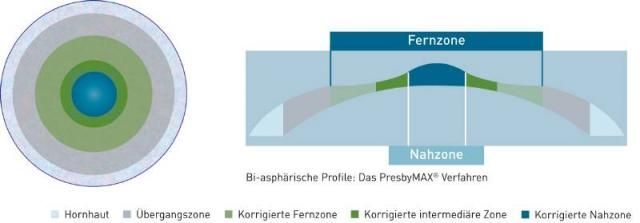
Figure 1: Example of laser reshaping of the corneal surface to correct presbyopia (Source: Schwind)
Artificial Lenses for the Treatment of Presbyopia
When the natural lenses are replaced with artificial lenses, special lenses are available for correcting presbyopia:
- Multifocal lenses
- Accommodative intraocular lenses
- Multifocal lenses for the treatment of presbyopia
Multifocal lenses are lenses that generate multiple focal points simultaneously. They currently represent the most reliable method of correcting presbyopia, allowing patients to see clearly at both near and far distances without relying on glasses.
The primary focus of these lenses is on improving quality of life; multifocal lenses do not provide any optical benefit.
On the contrary, optical side effects, such as glare or halos, are more common and more pronounced than with single-vision lenses. This is due to the optical principles by which multiple focal points are created.
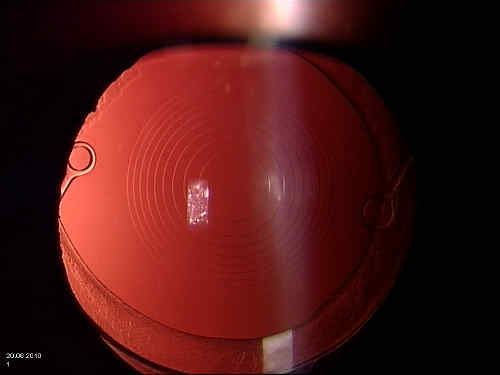
Figure 2: Example of a multifocal intraocular lens in the eye following removal of the natural lens.
Strictly speaking, these lenses are pseudo-accommodative lenses, since artificial lenses cannot mimic natural accommodation. The mechanisms involved are too complex for that.
The principle underlying these lenses is the shift principle. This causes the lens to move slightly forward within the eye during accommodation. As a result, the focal point shifts.
This principle is limited, however, because an artificial lens with normal refractive power would require too much forward movement to achieve sufficient accommodation. This is anatomically impossible, as the artificial lens would then have to move in front of the iris. Consequently, there is insufficient data in the literature for such lenses to demonstrate that they eliminate the need for glasses.
Prospects for a Cure for Presbyopia
Presbyopia is a natural aging process. A cure is not possible. Accordingly, treatment with medication is also not possible.
Conclusion
Presbyopia, also known as age-related farsightedness, is a consequence of physiological aging and directly affects the eye’s lens. This normal aging process of the eyes reduces the lens’s elasticity, causing the ability to see clearly up close to gradually decline. Typically, presbyopia becomes noticeable while reading, as visual acuity declines and the reading distance increases. Objects can often only be seen clearly if they are held closer to the eye or adjusted accordingly.
Presbyopia results from the physiological aging of the eye’s lens and usually begins in one’s early 40s. Many people affected therefore need reading glasses, as most people use them to compensate for presbyopia. Various treatment options are available to correct presbyopia, including glasses, contact lenses, and surgical procedures. The appropriate prescription is customized for each individual, often following an eye exam by an ophthalmologist. Other factors, such as the cornea or astigmatism, can also affect visual acuity. In addition, conditions such as cataracts or glaucoma become more common with age, which is why regular checkups are important.
Presbyopia is often combined with other refractive errors such as myopia or hyperopia, which makes vision correction more complex. Nevertheless, the goal remains to enable both sharp near vision and good distance vision. Modern approaches in ophthalmology, supported by German ophthalmologists, offer effective correction options that restore clear near vision.
Overall, it is clear that presbyopia is a condition that responds well to treatment, and that proper correction of age-related farsightedness is crucial for managing daily life without limitations.
FAQ
What is presbyopia?
Presbyopia is the age-related decline in the eye’s ability to see clearly up close. It is also known as age-related farsightedness.
When does presbyopia begin?
Presbyopia usually begins around age 40 and progresses with age.
Why does presbyopia develop?
The cause is the loss of elasticity in the lens, which limits the eye’s ability to focus.
How is presbyopia treated?
Treatment often involves reading glasses, progressive lenses, or contact lenses. In some cases, surgery may also be an option.
Can presbyopia be prevented?
No, it is part of the natural aging process, but it can be effectively managed with appropriate vision aids.
Share this article