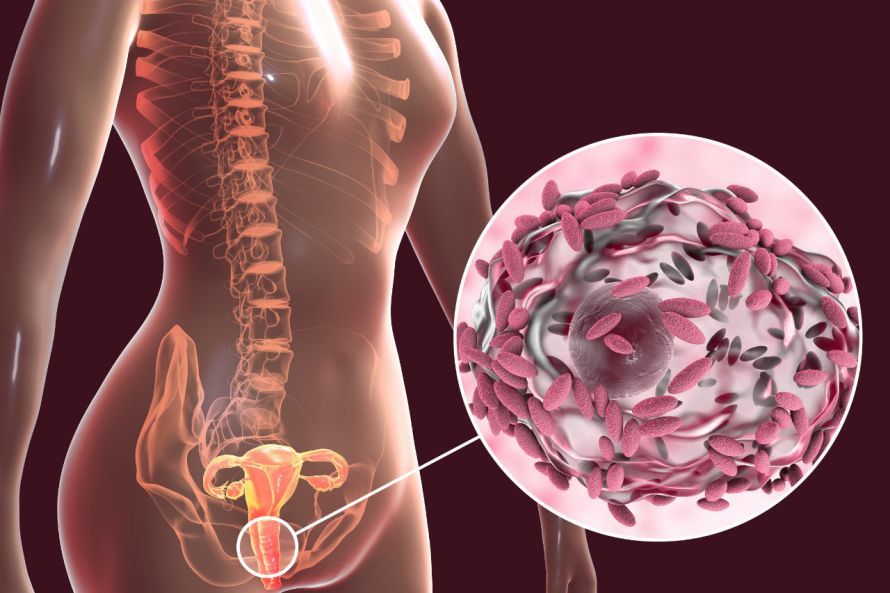
Doctors refer to bacterial vaginosis as a pathological imbalance of the vaginal flora. The condition is also known as Gardnerella infection, Haemophilus vaginalis infection, or amine colpitis. It is caused by an overgrowth of the bacterium Gardnerella vaginalis and other microorganisms in the vagina. Bacterial vaginosis typically manifests as increased vaginal discharge with an unpleasant, fishy odor. It is usually treated with antibiotics and/or lactic acid preparations.
Here you will find further information as well as a selection of specialists in bacterial vaginosis.
Causes - How Does Bacterial Vaginosis Develop?
The healthy vaginal flora of a sexually mature woman consists primarily of various types of lactic acid bacteria (lactobacilli). They are also known as Döderlein bacteria, named after the German gynecologist Albert Döderlein. These bacteria normally maintain an acidic environment in the vagina with a pH value of 3.8 to 4.4. In this way, they suppress the growth of disease-causing pathogens.
In bacterial vaginosis, however, the “good” lactic acid bacteria are displaced by disease-causing (pathogenic) microorganisms. These primarily include the bacterium Gardnerella vaginalis, but also
- chlamydia,
- mycoplasmas, and
- Bacteroides bacteria.
This leads to excessive colonization of the vagina by pathogenic bacteria. The number of lactic acid-producing lactobacilli decreases, and the pH of the vaginal flora rises to approximately 5. This throws the vaginal environment out of balance—resulting in the condition known as “bacterial vaginosis.”
A major risk factor is improper vaginal hygiene. Read on to learn how you can prevent this condition.
Symptoms—What Are the Signs of Bacterial Vaginosis?
Bacterial vaginosis does not necessarily cause symptoms. In about 40 to 50 percent of cases, bacterial vaginosis is asymptomatic, meaning the affected women have no symptoms.
Otherwise, about half of patients complain of increased vaginal discharge (fluor vaginalis). It is thin, sometimes foamy, and ranges in color from grayish-white to yellowish. In addition, it usually has an unpleasant fishy odor, though it can sometimes smell sweet.
In some cases, the unpleasant fishy odor occurs even without the accompanying discharge. Other women, on the other hand, report increased discharge, but without the fishy odor.
Those affected find the fishy vaginal odor particularly distressing and unpleasant.
It has nothing to do with poor intimate hygiene. Rather, it arises because the pathogens responsible for bacterial vaginosis break down certain proteins into so-called amines.
Symptoms such as
- itching,
- burning,
- redness, and
- skin irritation
in the external vaginal area are generally not typical of bacterial vaginosis. However, they can occur in rare cases.
In addition, symptoms such as
- mild stabbing pain and
- difficulty during sexual intercourse or urination
may also occur.
Diagnosis of Bacterial Vaginosis
The gynecologist performs a gynecological examination to make the diagnosis. During the exam, the doctor takes a swab from the woman’s vagina and then conducts a series of tests and examinations.
These include
- a pH test,
- the Amintest,
- a cytological examination under a microscope to assess the vaginal cells, and
- a bacterial culture.
Bacterial vaginosis is diagnosed if at least three of the following four findings are observed:
- There is an increase in thin to foamy, grayish-white to yellow, homogeneous vaginal discharge (fluor vaginalis).
- The pH of the vaginal flora is greater than 4.5.
- The vaginal discharge has a fishy odor (amine odor).
- In a vaginal smear, so-called clue cells can be detected in at least 20 percent of the vaginal cells.
pH Test for the Diagnosis of Bacterial Vaginosis
The pH level can be easily determined using tweezers and a pH indicator strip.
In addition, special gloves are available at pharmacies. These make it very easy to measure the pH value at home.
Amintest for diagnosing bacterial vaginosis
The so-called Amintest, also known as the “whiff test,” allows for a better assessment of the fishy odor. To perform this test, the doctor first takes a vaginal swab.
The doctor then adds one or two drops of a 10% potassium hydroxide solution to the swab sample. The potassium hydroxide solution intensifies the typical fishy odor of the vaginal discharge. This allows the doctor to better determine whether bacterial vaginosis is present.
Cytological Examination for the Diagnosis of Bacterial Vaginosis
As part of the cytological examination, the unstained specimen is examined under a microscope. The unstained specimen consists of material collected from a vaginal swab.
If so-called clue cells can be detected under the microscope in at least 20 percent of the vaginal cells (vaginal epithelial cells), this indicates bacterial vaginosis. Clue cells are cells colonized by bacteria that are visible under the microscope as small granules.
The microscopic examination also allows for an assessment of the number of bacteria. The doctor can also determine whether the bacterial colonization is a mixed infection involving various bacterial species.
A cytological examination can only establish a presumptive diagnosis of “bacterial vaginosis.” Further tests are necessary for a definitive diagnosis. These include, for example, performing a bacterial culture.
Performing a bacterial culture
A bacterial culture can be used to definitively detect and identify the pathogen responsible for bacterial vaginosis. It is typically performed when
- bacterial vaginosis recurs regularly (persistent recurrences) or
- it is necessary to check whether other microorganisms might be responsible for the symptoms.
Differential Diagnosis
Differential diagnosis is intended to ensure that the symptoms are not caused by other conditions with similar symptoms. This is also necessary in the diagnosis of bacterial vaginosis.
Conditions with symptoms similar to those of bacterial vaginosis include
- vaginitis and
- inflammation of the mucous membrane of the cervix (cervicitis).
In addition, infection with other microorganisms, such as Trichomonas or Mycoplasma, should be ruled out.
Treatment of Bacterial Vaginosis
Although bacterial vaginosis is not a serious condition, the symptoms can be very uncomfortable for affected women. In some cases, it can also lead to complications—that is, serious conditions such as inflammation
- of the cervical lining (cervicitis),
- of the uterine lining (endometritis),
- the fallopian tubes (salpingitis),
- the vaginal opening (vulvitis), or
- the Bartholin’s glands (bartholinitis),
.
Therefore, bacterial vaginosis should always be treated. Treatment usually involves medication, specifically antibiotics.
In addition, preparations containing lactic acid bacteria can also be used. They have a positive effect on the imbalance in the vaginal flora that occurs with bacterial vaginosis.
Treatment with Antibiotics
Antibiotics are the gold standard for the medical treatment of bacterial vaginosis. The antibiotic metronidazole, in particular, has proven to be very effective. It works especially well against anaerobic bacteria. Other active ingredients are also available, including clindamycin, amoxicillin, and nifuratel.
Antibiotics can be administered either
- orally in the form of tablets (metronidazole) or
- intravaginally in the form of vaginal suppositories or vaginal tablets
. Topical treatment with an antibiotic vaginal cream (metronidazole, clindamycin) is also an option.
The duration of treatment depends on the severity of the condition and the ability of the vaginal flora to regenerate.
Treatment with lactic acid preparations
Local treatments with lactic acid-containing preparations, as well as vaginal suppositories containing lactic acid bacteria (lactobacilli) or ascorbic acid (vitamin C), are also possible. These preparations are available over the counter at pharmacies.
Such treatment is intended to restore the natural vaginal environment. However, it is neither as fast nor as thorough as antibiotic treatment. Instead, it is mainly used following antibiotic treatment. It serves to support the recovery that has been achieved and to prevent a recurrence of bacterial vaginosis.
Prognosis for Bacterial Vaginosis
If bacterial vaginosis is treated with antibiotics, the prognosis is generally good. In most cases, bacterial vaginosis clears up within a week of starting antibiotic treatment.
For example, the normal vaginal flora is restored one week after oral administration of metronidazole. 80 percent of patients are then cured. Similarly good results are achieved with intravaginal administration of metronidazole.
However, the relapse rate after successful treatment is quite high, at 60 to 70 percent. Simultaneous treatment of the partners of affected women may help prevent relapses.
Bacterial Vaginosis During Pregnancy
In pregnant women, bacterial vaginosis can lead to various complications. For example, pregnant women with bacterial vaginosis have an increased risk of
- preterm labor,
- premature rupture of the amniotic sac, or
- preterm birth.
In addition, an infection of the amniotic sac (amnionitis) can occur during pregnancy. This is caused by various biochemical reactions between the fetus and the uterus resulting from bacterial vaginosis.
After delivery, bacterial vaginosis can lead to further complications. These include, among other things,
- inflammation and delayed healing of an episiotomy,
- an abdominal abscess following a cesarean section, and
- inflammation of the uterine lining (endometritis).
Bacterial vaginosis should therefore always be treated medically during pregnancy.
Prevalence of Bacterial Vaginosis
Bacterial vaginosis is the most common microbiological imbalance of the vaginal flora in sexually active women. In Europe, bacterial vaginosis is found
- in 5 percent of women who come in for a routine checkup, and
- in 30 percent of women treated at a clinic for sexually transmitted diseases,
.
Among pregnant women in Europe, approximately 7 to 22 percent are affected by bacterial vaginosis. Overall, about 20 percent of all women experience a bacterial vaginal infection at least once in their lives, most commonly bacterial vaginosis.
Preventing Bacterial Vaginosis
Preventing bacterial vaginosis is only possible indirectly. As a general rule: Be sure to attend regular preventive checkups with your gynecologist! This allows existing bacterial vaginosis to be detected and treated. The gynecologist can also intervene if complications are looming.
However, psychosocial stress is also considered a risk factor. Therefore, women experiencing a lot of everyday stress should counteract it with exercise and targeted relaxation techniques—especially if they have had bacterial vaginosis multiple times.
An Important Role in Prevention: Vaginal Hygiene
Many women feel the need to thoroughly clean their intimate area. They use soap or shower gel for this, followed by an intimate deodorant. While this creates a fresh and pleasant feeling immediately afterward, this sensation is subjective and does not last long.
Excessive vaginal hygiene, such as vaginal douching, is particularly harmful! Regular cleansing with water alone is completely sufficient and helps maintain the pH level of the vaginal flora at a constant level.
Chemical substances cause severe irritation in the vaginal flora, disrupting its balance. Many personal care products also have a high pH level, which throws off the naturally acidic environment of the vaginal mucosa (low pH level).
To prevent bacterial vaginosis, therefore, practice intimate hygiene using only lukewarm water. Special cleansing lotions formulated to match the pH level (< 5) of the vaginal environment are also recommended. They are available, for example, at pharmacies or drugstores.
Special treatment regimens or lactic acid preparations can help restore and acidify the vaginal flora. This aids
- to regenerate the vaginal flora,
- restore the population of natural lactic acid bacteria (lactobacilli), and
- to stabilize the pH level over a longer period of time.
Cleaning the anus—and especially the direction in which you wipe after a bowel movement—can also contribute significantly to a healthy vaginal flora. Wiping in the correct direction—from front to back (toward the anus and beyond)—prevents bacteria from the intestines from being accidentally introduced into the vagina.
Keep an eye on the pH level of your vaginal flora
If you tend to have an overly acidic vaginal environment, you can monitor it yourself using over-the-counter pH tests. These test kits are available in pharmacies as special pH indicator papers or pH test gloves.
Sex and Bacterial Vaginosis
Bacterial vaginosis is not a sexually transmitted disease, but it can be exacerbated by sexual intercourse. The bacteria that cause it can also be present in the male genital area. However, they do not cause any symptoms there. As a result, a man may unknowingly pass them on to his partner. This means the woman may come into contact with the bacteria repeatedly.
Comprehensive treatment therefore also includes treating the affected woman’s sexual partner.
Gardnerella vaginalis is also a gut bacterium. As a result, it is often transmitted from the anal area to the vagina during sexual intercourse. Additionally, switching from anal sex to vaginal intercourse increases the risk of introducing the bacteria into the vagina.
A condom provides protection in this situation. A fresh condom should be used, especially when switching directly from anal sex to vaginal intercourse.
Bacterial Vaginosis in Men
In men, too, the genital area is often colonized by bacteria such as Gardnerella.
However, these pathogenic bacteria generally do not cause any symptoms. It is possible, however, for a usually mild and short-lived inflammation of the glans (balanoposthitis) to develop.
Share this article