Ebstein’s anomaly (also known as Ebstein’s disease) is a congenital heart defect that is very rare. In Ebstein’s anomaly, the ventricle that supplies the pulmonary circulation is reduced in size, and the atrium is enlarged. Due to the valve malformation, the valve does not close completely (tricuspid regurgitation), causing blood to flow back into the right atrium. This blood is missing from the pulmonary circulation and, in turn, places a strain on the atrium. As a result, the right side of the heart enlarges and cardiac function is impaired.
Below you will find treatment options and specialists.
What is Ebstein's anomaly?
Ebstein’s anomaly is a rare congenital heart defect in which part of the right ventricle becomes the right atrium. The atrium is larger than in a normal heart, while the ventricle is smaller.
This results in excessive strain on the ventricle, leading to right-sided heart failure. Accounting for less than 1 percent of all congenital heart defects, Ebstein’s anomaly is relatively rare. It affects men and women equally.
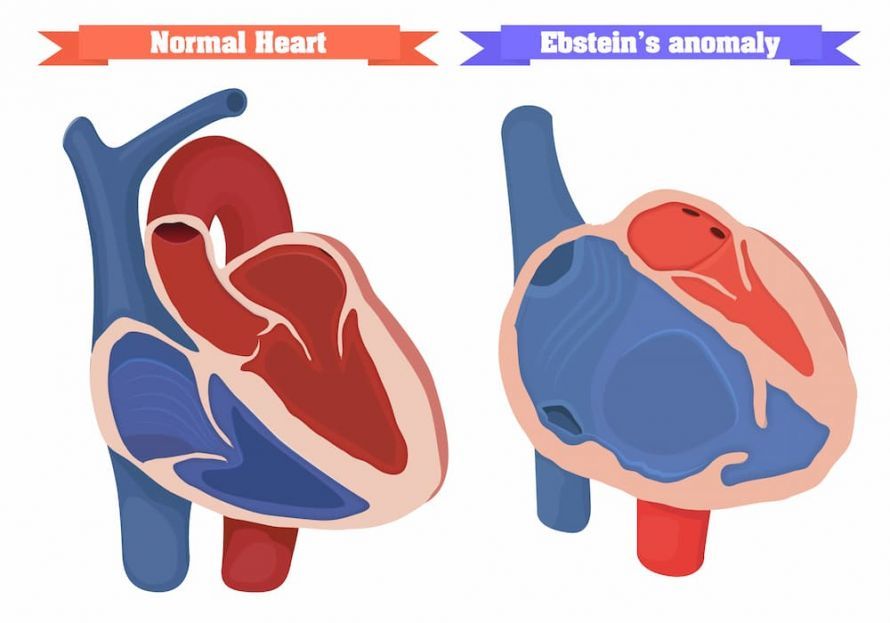 Only 0.3–0.5% of 1,000 newborns have Ebstein’s anomaly @ alkov /AdobeStock
Symptoms of Ebstein’s anomaly
Symptoms can vary widely and depend on the type of displacement and the degree of valve malformation. For example, people with a mild form of the condition may be largely asymptomatic. They can live to an advanced age with only mild physical limitations.
The main symptoms of Ebstein’s anomaly are:
- Reduced physical performance
- Fatigue
- Dizziness
- Shortness of breath
- Heart rhythm disturbances (most commonly atrial fibrillation)
Severe forms of Ebstein’s anomaly are usually already apparent in newborns. In most cases, there is also a hole in the septum (between the right and left atria). Experts also refer to this hole as an atrial septal defect. It allows blood to circulate between the atria.
An atrial septal defect can be recognized by a bluish discoloration of the lips or hands (cyanosis). There is a risk of suffering a transient ischemic attack (TIA, a precursor to a stroke) or a stroke.
Due to the strain on the heart, its function declines as the disease progresses. This manifests as increasing arrhythmias or sudden cardiac death.
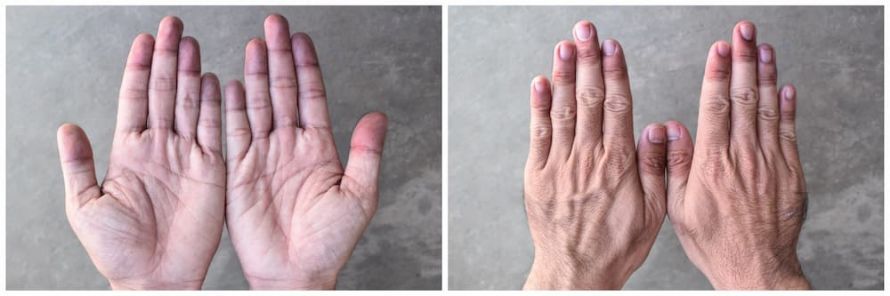 In cases of cyanosis, the blood contains too little oxygen, causing it to appear bluish through the skin @ ZayNyi /AdobeStock
Causes and Associated Symptoms of Ebstein’s Anomaly
Normally, the heart valve prevents blood from flowing back into the atrium. Because this valve is displaced and malformed in Ebstein’s anomaly, it cannot close completely. Blood flows back into the atrium. Doctors refer to this as valve insufficiency (valve leakage).
The greater the displacement and malformation, the more severe the valve insufficiency. As the disease progresses, the right ventricle also enlarges because it attempts to compensate for the backflow of blood and pump sufficient blood to the lungs.
The enlargement of the ventricle is also accompanied by increasing ventricular weakness. This leads to enlargement of the entire heart and, consequently, to heart failure.
The causes of valve displacement and malformation remain unclear. For a long time, experts believed that taking lithium and benzodiazepines during pregnancy increased the risk to the unborn child. However, more recent studies have not been able to confirm this.
An international team of researchers has, however, identified a gene mutation in some affected individuals. This gene is responsible for certain structural proteins in the heart muscle. As a result, experts now believe there is a genetic component to the development of Ebstein’s anomaly.
Treatment of Ebstein’s anomaly
Treatment of Ebstein’s anomaly depends on the severity of the malformation.
The goal of current therapies is to reduce symptoms and prevent complications (enlargement of the heart, heart failure, and arrhythmias).
-
Medication
Doctors use medications such as antiarrhythmic drugs to stabilize heart function and prevent arrhythmias.
Medication is recommended for shortness of breath, physical weakness, fatigue, fluid retention in the legs, heart palpitations, and mild heart enlargement.
-
Surgical Intervention
Surgery may be considered if heart function continues to decline.
Surgery is recommended in cases of:
- Decreasing physical endurance
- Progressive enlargement of the heart
- Increasing cyanosis
- Severe tricuspid valve regurgitation with worsening symptoms
- Neurological disorders such as TIA or stroke
- Arrhythmias that cannot be treated with medication
During the procedure, cardiac surgeons repair or replace the malformed and displaced valve. In addition, they close the hole in the heart’s septum (atrial septal defect).
The surgical approach depends largely on the condition of the tricuspid valve leaflets and the size of the right ventricle: If sufficient natural valve tissue is available, valve repair (valve reconstruction) is preferred over valve replacement.
If the valve can no longer be repaired, surgeons implant an artificial valve. This can be mechanical or biological.
With a mechanical valve replacement, patients must take blood thinners (Marcumar) for the rest of their lives to prevent blood clots.
In 25 percent of cases of Ebstein’s anomaly, there are additional conduction pathways in the heart that lead to uncoordinated electrical impulses (arrhythmias and atrial fibrillation). Surgeons eliminate these pathways during valve reconstruction using radiofrequency energy or cold (Maze procedure).
If surgery is not possible, doctors can also ablate and destroy the conduction pathways using catheter ablation. In some cases, the heart beats too slowly or irregularly after the procedure, in which case a pacemaker is required.
In addition, doctors typically administer endocarditis prophylaxis to prevent inflammation of the inner lining of the heart (endocarditis).
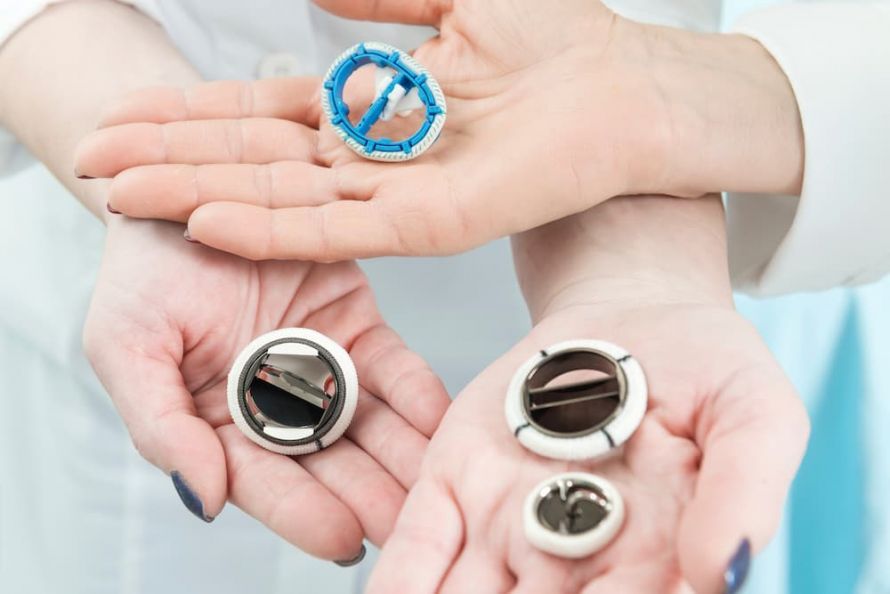 Biological heart valves last about 10 to 15 years; mechanical heart valves last a lifetime @ pirke /AdobeStock
Conclusion
With Ebstein’s anomaly, it is important to detect any worsening of the condition early so that surgical intervention can be performed in a timely manner. Therefore, regular checkups with a specialist are essential.
Share this article