Age spots, also known as senile lentigines or actinic lentigines, are usually harmless pigmentations. However, some people wish to undergo treatment for aesthetic reasons. Before undergoing treatment, you should first consult a dermatologist. The dermatologist will determine the cause of the dark spot on your skin. Age spots can sometimes resemble malignant skin lesions, which is why a proper diagnosis is important.
Below you will find further information and a selection of specialists for the removal of age spots.
What are age spots?
“Spotty pigmentation” of the skin is a cosmetic concern that many people find bothersome. In Latin America and Asia, it is even one of the most common reasons for consulting a dermatologist.
These dark spots are called hyperpigmentation and tend to increase with age. That is why they are also known as age spots. The medical term is senile and/or actinic lentigines (senile = related to old age; actinic = caused by light damage). The spots primarily appear on areas of the body that are frequently exposed to sunlight.
In many cases, age spots are harmless. However, otherwise healthy individuals may seek treatment due to concerns about their appearance.
Pigmented spots of other origins, particularly malignant skin lesions, can be accompanied by increased pigmentation. Therefore, a consultation with a dermatologist is essential before any cosmetic medical treatment. The doctor will determine whether the spot is an age spot or a symptom of another condition.
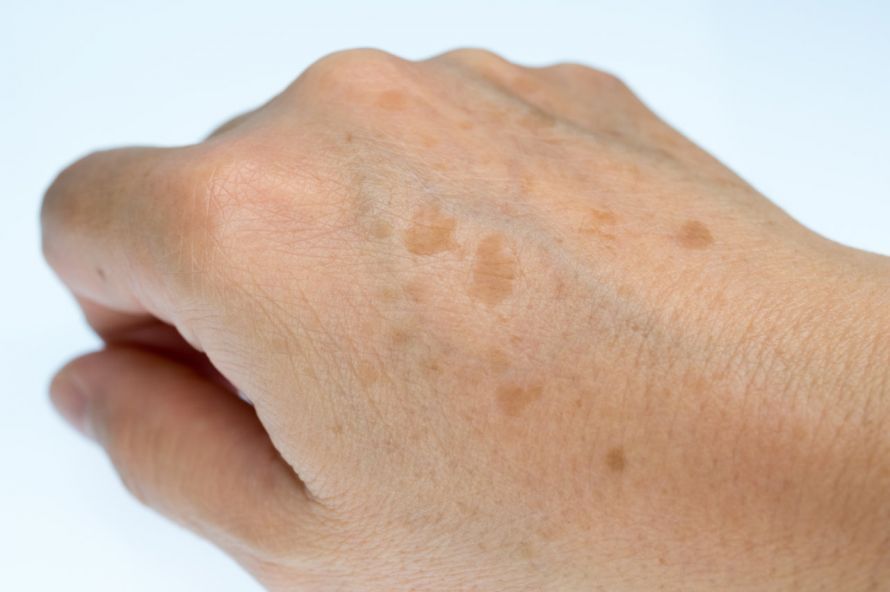
Distinguishing Age Spots from Other Skin Lesions
Age spots, which are very common, must be distinguished from the following conditions, among others:
Melasma (chloasma)
Melasma appears as irregularly shaped, gray-brown patches on the face, particularly on
- the cheeks,
- the nose,
- the forehead,
- the chin, and
- the upper lip.
It primarily affects women with skin phototypes IV–VI. Melasma is an acquired, symmetrical hypermelanosis.
The most important causes include genetic predisposition and exposure to UV light, as well as
- pregnancy,
- medications (e.g., oral contraceptives/the pill),
- hormone replacement therapy,
- thyroid dysfunction,
- cosmetics, and
- phototoxic substances.
Histological examination of melasma reveals at the cellular level that the melanocytes are not increased in number but are enlarged. They also exhibit prominent dendrites.
Post-inflammatory hyperpigmentation
Post-inflammatory hyperpigmentation can develop anywhere on the body. It occurs after the healing of various inflammatory skin lesions, most commonly, for example, after
- acne vulgaris,
- eczema,
- trauma,
- psoriasis,
- lichen planus, or
- drug-induced rashes.
The darker the affected person’s skin type, the more likely they are to develop post-inflammatory hyperpigmentation.
At the microscopic level, post-inflammatory hyperpigmentation is characterized by an abnormal distribution of the excess melanin pigment produced. It can be deposited both exclusively in superficial cell layers and in deeper cell layers. The number of melanocytes remains unchanged.
Nevi
Naevus cell nevi are benign moles in which, histopathologically and depending on the type of mole, the melanocytes
- are found exclusively in the upper layer (epidermal),
- exclusively in the dermis, or
- distributed throughout all layers (epidermal and dermal)
.
Malignant melanomas, lentigo maligna
Malignant melanoma and lentigo maligna are forms of malignant black skin cancer. In these conditions, melanocytes become malignant, grow uncontrollably, and can form metastases (secondary tumors) in other parts of the body.
Before treating age spots, the presence of malignant melanoma and lentigo maligna must be definitively ruled out.
Other Types of Hyperpigmentation
In addition, the following conditions may be considered in the differential diagnosis of hyperpigmentation (less commonly):
- Riehl’s melanosis (face),
- Poikiloderma of Civatte,
- phototoxic hyperpigmentation, Berloque dermatitis,
- Naevus fuscocoeruleus (Ito),
- Oculodermal melanosis (Ota),
- Mongolian spots.
Various Methods for Treating Age Spots
Treatment of age spots with bleaching agents
Depigmenting agents (so-called bleaching agents) are categorized into three groups:
- phenol derivatives,
- Non-phenolic substances,
- Combination preparations.
The most effective treatment involves a triple combination consisting of hydroquinone, a retinoid, and a corticosteroid:
- Hydroquinone is a phenolic substance, a tyrosinase inhibitor that blocks melanin production. The bleaching effect becomes apparent after several weeks of daily topical application.
- Tretinoin (retinoid) accelerates superficial cell turnover, thereby facilitating the penetration of hydroquinone into the skin. In this way, it counteracts “steroid atrophy.”
- The corticosteroid minimizes the skin irritation caused by hydroquinone and tretinoin.
Commercially available preparations are available in Europe, as well as “custom formulations” prepared by dermatologists.
The use of hydroquinone must be limited to two to three months and combined with sun protection! Prolonged use can cause gray discoloration of the skin and/or nails (ochronosis). Discoloration of the nails has so far been observed particularly in patients with dark skin.
Contact allergies to hydroquinone have been described as another potential side effect.
Other substances used for the topical treatment of age spots:
- hydroquinone derivatives mequinol and arbutin,
- various retinoids,
- Kojic acid (5-hydroxy-2-hydroxymethyl-4-H-pyran-4-one),
- L-ascorbic acid (vitamin C),
- licorice,
- soy extract,
- N-acetylglucosamine,
- niacinamide.
Most of these products result in a temporary lightening of unwanted pigmentation. However, the pigmentation returns once use of the product is discontinued.
In many cases, these bleaching agents are also used as pre- and post-treatment for other therapeutic methods. This enhances their bleaching effect.
Treatment of Age Spots with Chemical Peels
Peeling methods can be used to remove pigments located in the stratum corneum of the skin. There are superficial, medium-depth, and deep peels. These involve the use of 70-percent glycolic acid or trichloroacetic acid in concentrations ranging from 10 to 35 percent.
The different types of peels differ primarily in terms of their penetration depth. This results in varying effects on the individual layers of the skin.
So-called “light” peels work by loosening and subsequently removing superficial, keratinized skin cells from the epidermis (exfoliation).
Medium-depth peels can also treat deeper pigmentation disorders and repair sun damage.
Treatment of Age Spots with Laser and Light Systems
In addition, laser and light systems whose wavelengths are absorbed by melanin can be used to treat age spots. Based on the principle of selective photothermolysis, their pulse durations are in the nanosecond range.
Post-Treatment Care Following Age Spot Treatment
Paradoxically, all peeling and laser methods also carry the risk of post-inflammatory hyperpigmentation. For this reason, these methods should only be performed by experienced therapists. The therapeutic goal and potential side effects must be weighed on a case-by-case basis.
To achieve a satisfactory long-term result, the skin area treated with peeling or laser/light must be protected from the sun. This is particularly important immediately after treatment, when the skin is still reddened.
Protection is achieved by avoiding UV exposure and using sunscreen with a high sun protection factor (e.g., SPF 50). Otherwise, unwanted changes in pigmentation could occur again.
Depending on the intensity of the treatment, the redness can last from a few days to several weeks. During this time, the skin may be covered with tinted cosmetics.
Share this article