
Robotics – the modern knee
September 23, 2026
Knee replacement surgery is one of the most common orthopaedic procedures in Germany. Every year, around 180,000 patients undergo knee replacement surgery because pain, instability or restricted mobility can no longer be managed despite conservative treatment. Alongside tried-and-tested surgical procedures, robot-assisted systems are becoming increasingly important: they enable the surgery to be planned on an individual patient basis and allow the prosthesis to be precisely adapted to the patient’s specific anatomy. The editorial team of the Leading Medicine Guide spoke to Professor Rüdiger von Eisenhart-Rothe, MD, about modern treatment methods and their potential.

Whether an artificial knee joint is the appropriate treatment option can be reliably assessed through a combination of medical diagnostics, functional evaluation and the patient’s individual circumstances. It is not solely the degree of osteoarthritis that is decisive, but the interplay of symptoms, limitations and objective findings.
“When considering the right time for joint replacement, the focus is always on the individual’s level of suffering. If everyday activities such as shopping or walking the dog can no longer be carried out pain-free, or can only be managed with painkillers, and if there is also advanced osteoarthritis confirmed by X-ray, an artificial joint is considered a sensible option. Age plays a secondary role in this decision. The idea that one must ‘hold out’ until the age of 55 or older is now considered outdated – because it is precisely the years in which one wishes to remain active that should not be lost to pain. Furthermore, one should not delay treatment out of fear: the function of the knee prior to surgery has a significant impact on the outcome afterwards. If misalignments, such as progressively worsening bow legs, damage the ligaments, or if there is a progressively worsening, pronounced lack of extension, a standard prosthesis will eventually no longer suffice, and more complex models will be required. Comorbidities, physical resilience and individual expectations also play a role, as a prosthesis should not only relieve pain but also suit the patient’s lifestyle,” explains von Eisenhart-Rothe.
3D planning and robotic assistance have brought about enormous changes in knee replacement surgery in recent years. This technical support enables the surgeon to tailor the operation to the individual patient.
“In the past, all knees were operated on according to the same formula: the leg was straightened and the joint line aligned perpendicular to it, regardless of whether someone had bow legs, knock-knees, or male or female anatomy. Today we know that only around 15 per cent of people actually have such a ‘textbook knee’. Most people naturally have a slight bowleg; in men, this is often more than three degrees. If such a knee is artificially straightened, many patients do not feel entirely comfortable with it afterwards – which, amongst other things, explains why 15 to 20 per cent of patients, whilst experiencing no complications, do not perceive the knee as their own joint, a so-called ‘forgotten joint’ . This is precisely where modern, personalised joint replacement comes in. 3D imaging allows the individual anatomy to be mapped precisely, and robotics enables all incisions to be made with the highest precision. In this way, the artificial joint can be optimally adapted to the natural leg axis and the individual’s anatomy. The robot alone does not automatically improve the knee – rather, it creates the technical conditions necessary to implement this personalised approach in the first place. There are, however, situations in which robotics cannot be used. Almost all systems are tied to specific prosthesis models, which often do not offer a nickel-free option. “Even in cases of very severe misalignments requiring a coupled prosthesis, traditional surgery is performed because these implants are not integrated into the robot-assisted systems and, due to the coupling mechanism, are aligned mechanically in the traditional way,” says von Eisenhart-Rothe, adding with regard to nickel allergy:
“When it comes to nickel allergies and knee prostheses, two perspectives clash: in Germany, the issue is taken into account more frequently, whilst many other countries – including the USA, from where most robotic systems originate – hardly regard nickel allergies in connection with implants as a problem. The reason: nickel primarily causes T-cell-mediated contact allergies, i.e. skin reactions, such as those caused by costume jewellery or jeans buttons. It is true that a knee prosthesis, situated deep within the body, can trigger a genuine allergic reaction, but this is extremely rare – estimates suggest less than one per cent. Nevertheless, the psychological aspect plays a major role. If someone has a severe nickel allergy and later develops pain, the prosthesis is quickly suspected – even if the symptoms have other causes. To avoid such situations, German and Swiss manufacturers, for example, offer (titanium-)coated or nickel-free implants, in which the nickel does not come into contact with the tissue. However, robotic systems are closed systems that are only compatible with certain prostheses – mostly American models, which do not offer nickel-free variants. Consequently, patients with a nickel allergy cannot always undergo robot-assisted surgery. Sometimes the risk can be weighed up together: many patients accept a standard implant despite their allergy once they understand how low the actual risk is. However, those who expressly request a nickel-free implant will undergo surgery using the conventional surgical technique without a robot.”
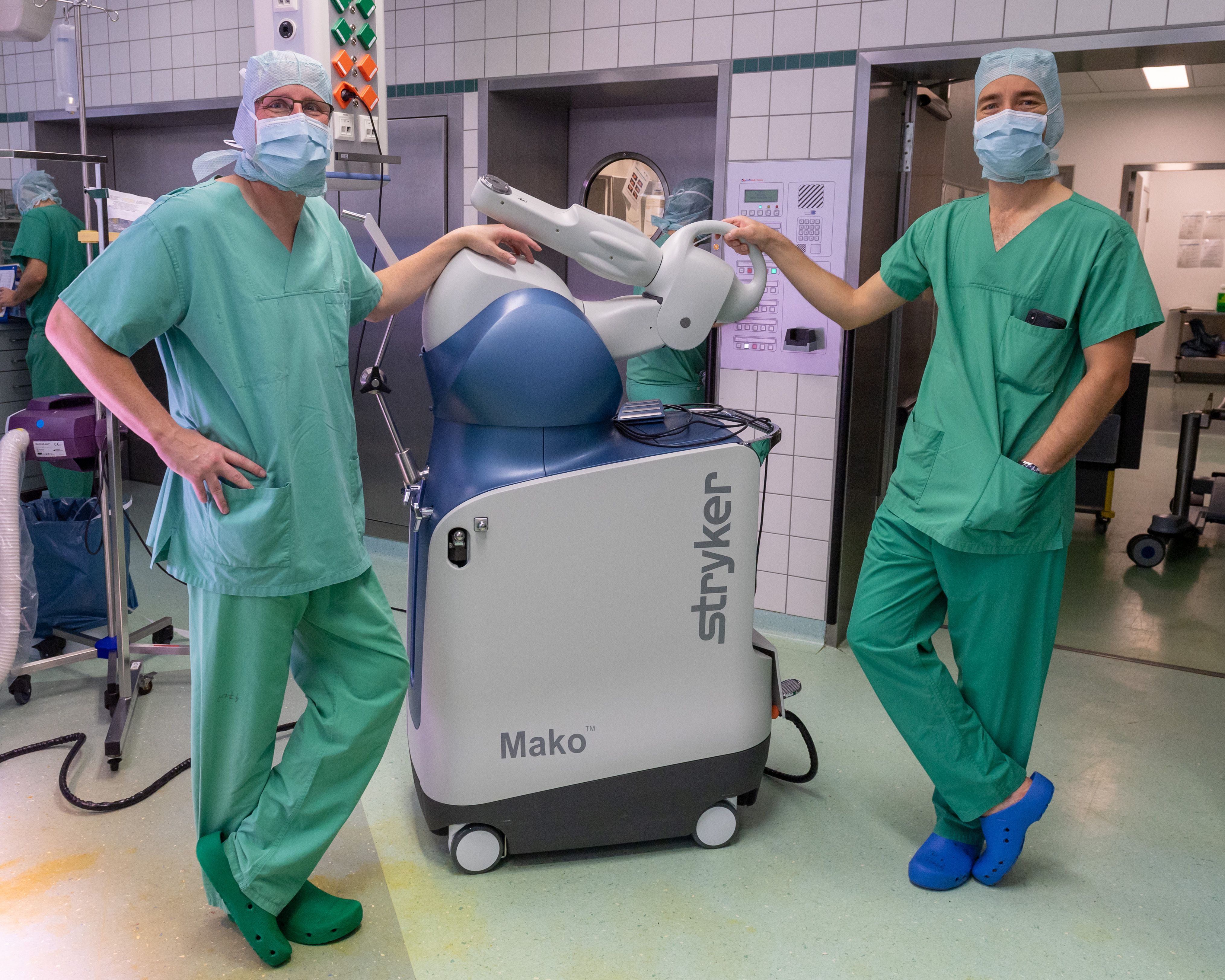
Modern 3D imaging forms the basis of personalised knee replacement surgery. Using a three-dimensional image of the patient’s joint, the surgeon can determine the optimal position of the prosthesis within the bone for knee reconstruction even before the operation. This allows the implantation to be planned optimally and adapted to the patient’s individual anatomy.
Revision surgery is among the most challenging procedures in knee replacement, as the normal anatomical conditions have been lost and a significantly altered, often pre-damaged tissue and bone bed must be reconstructed. Primary implants that are either firmly fixed or have become loose must be removed in a way that minimises damage to the surrounding tissue, and significant bone defects usually need to be compensated for. Here, too, robotics can make a valuable contribution in the future.
Professor Rüdiger von Eisenhart-Rothe, MD, comments: “Regardless of the technique used, revision surgery is among the most demanding procedures in knee arthroplasty. First and foremost, it must be clearly established why an existing prosthesis is causing symptoms. The first step is always to rule out an infection, as this must be treated as a priority. If no infection is detectable, mechanical causes in particular must be investigated – for example, loosening of the prosthesis, malalignment or problems in the area of the kneecap. Only once the cause of the pain has been clearly identified and can actually be resolved by replacing the prosthesis should a revision be carried out. Replacing the prosthesis without a confirmed diagnosis is associated with significantly poorer prospects of success. In principle, robotic surgery can also be used following previous operations, provided that the anatomical conditions remain intact. If only joint-preserving procedures such as arthroscopy or realignment osteotomies have been carried out previously, there are generally no restrictions. The situation becomes more complex when an existing (partial) knee prosthesis needs to be replaced. In such cases, the use of robotic technology depends largely on the available bone stock and on both the existing and the required prosthesis. If there are major bone defects or if a more rigidly coupled prosthesis is required, the operation is carried out using the conventional surgical procedure again, because personalised adjustments can no longer be feasibly implemented and the systems are not designed for this purpose.”
The precise robotic implantation of the knee prosthesis creates excellent biomechanical conditions for a long service life.
Prof. Rüdiger von Eisenhart-Rothe, MD: “There is indeed strong evidence to suggest that robot-assisted knee replacements last longer. A major advantage of robotics lies in the exceptionally precise execution of the planning. Studies show that robot-assisted systems achieve the planned axes and target angles more reliably than free-hand techniques. This reduces misalignment – a key factor in ensuring the long-term stable function of the prosthesis. The greatest advantage, however, lies in the personalised positioning of the prosthesis. Because implantation is based on precise, patient-specific planning, fewer incisions into the soft tissues are often required. This leads to less tissue damage, less post-operative pain and, in many cases, faster rehabilitation. Whether robotics generally leads to higher long-term patient satisfaction or a longer lifespan for all knee prostheses cannot yet be conclusively answered scientifically. Many studies merely compare the use of a robot with conventional surgery, whilst ignoring the alignment technique. However, the real added value only arises when the technology is consistently used for personalised reconstruction of the knee joint. The evidence is particularly compelling in the case of partial knee replacements, known as ‘sliding’ prostheses. Register data show significantly lower revision rates and fewer complications here – in some cases even better results than those achieved by highly experienced surgeons with a high caseload. It is precisely in these procedures that the exact position of the implant determines long-term success, and this is exactly where robotics demonstrates its greatest strengths.”
Robotics does not automatically make a knee prosthesis better, but it creates the technical conditions for a more precise, gentler and, in certain areas, demonstrably more durable outcome.
In 2019, the Department of Orthopaedics began using robotic systems for the implantation of knee replacements. To further improve these, in-house research groups were established with the aim of combining robotics, artificial intelligence and orthopaedics.
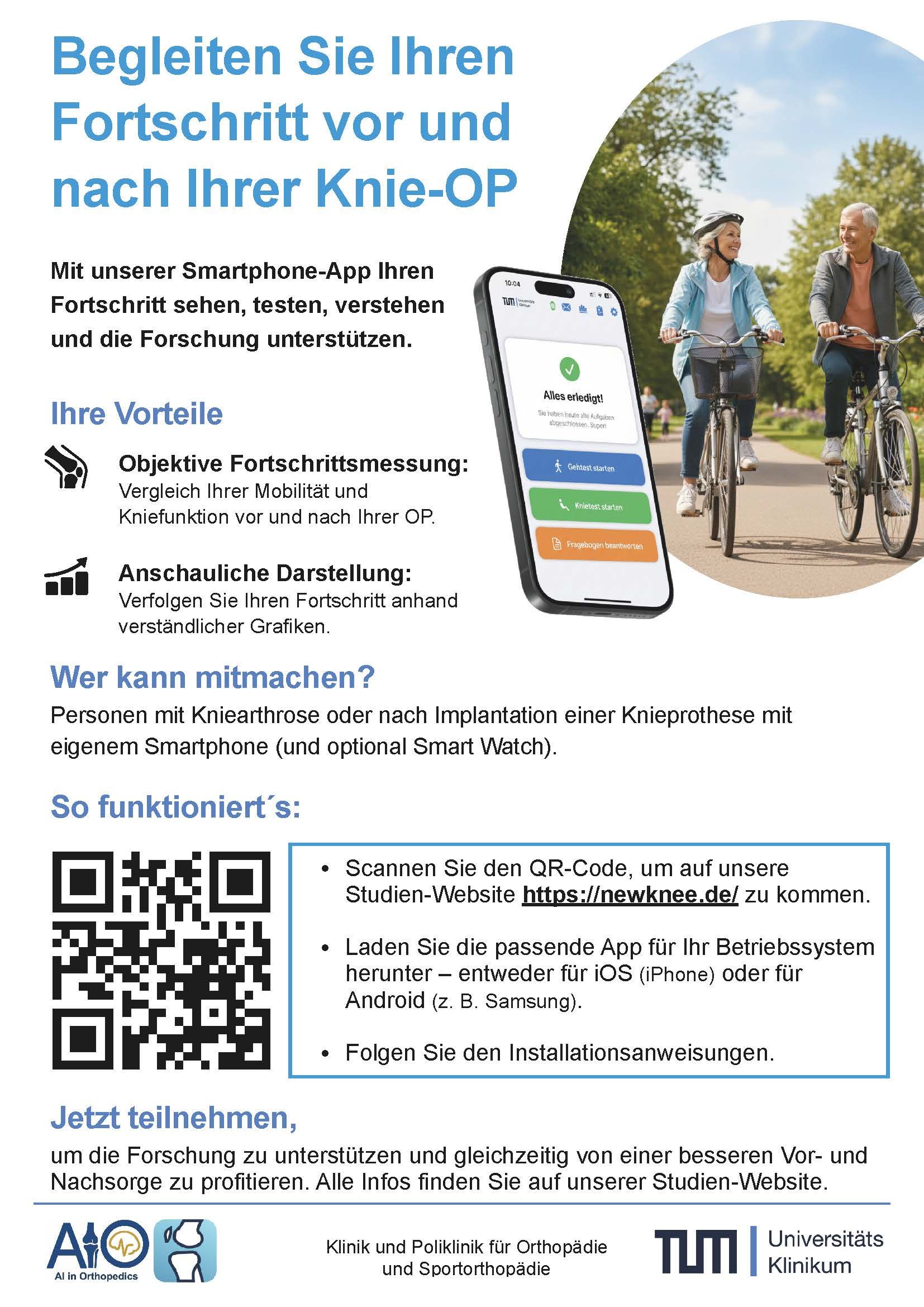
Professor Rüdiger von Eisenhart-Rothe, MD: “We have been using robot-assisted knee replacement for around seven years and have now implanted over 1,600 Mako knee prostheses. We now have two robotic systems at our disposal. In addition, together with the Munich School of Robotics, we have a research platform that closely links clinical care, research and training. Our aim extends far beyond the purely clinical application of new technology. Personalised knee surgery only makes sense if we understand which surgical strategy actually delivers the best results for which anatomy. To this end, the robot provides us with a wealth of objective data: How much bone was resected? What was the ligament tension? What leg axis was set? We link this information to the long-term treatment success of our patients and to functional data. In this way, a digital twin of the knee joint is created step by step. In the long term, the aim is to develop an intelligent decision-making system that supports surgeons in selecting the optimal surgical strategy for each individual knee anatomy. In parallel, we have developed the NewKnee app. It utilises the smartphone’s motion sensors to objectively document how knee joint function develops following surgery or as osteoarthritis progresses. This enables patients to track changes in mobility, walking distance and activity levels in their daily lives. The movement data from smartphones and wearables such as fitness trackers offers enormous potential. The recorded acceleration data can be used to deduce, with a high degree of certainty, how well a knee joint is functioning. What is particularly exciting is that the first functional changes may be detectable years before a clinical diagnosis of osteoarthritis is made. If this can be achieved reliably, we could intervene therapeutically much earlier in future and counteract progressive joint damage. Wearables also open up entirely new possibilities in post-operative care. They enable continuous digital monitoring of progress, support individually tailored exercise programmes and facilitate close-knit care – without patients having to attend the clinic in person on a regular basis.”
A clinic’s specialisation is crucial to the success of knee replacement surgery. In addition to a high volume of operations, routine and well-established procedures have a direct impact on the quality and safety of a procedure.
Prof. Rüdiger von Eisenhart-Rothe, MD: “Experience and routine are essential quality factors in joint replacement surgery. That is why I believe greater centralisation of complex procedures makes sense. It is not the total number of operations performed by a hospital that is decisive. It is equally important that surgeons perform implantations regularly and that an experienced interdisciplinary team is available. This is the only way to ensure well-established procedures and a high level of treatment safety. The advantage of specialised centres is particularly evident in complex revision surgeries or cases of periprosthetic infections. However, anyone specifically seeking robot-assisted treatment faces a challenge, as there is as yet no official register of specialised centres, and the mere presence of a robot is not a sufficient indicator of quality. An important quality indicator for patients is EndoCert certification. Centres providing maximum care must demonstrate consistently high case numbers, structured treatment protocols and proven expertise in primary and revision arthroplasty. This ensures a standard of quality that can make a decisive difference, particularly in complex procedures. Ultimately, however, the personal aspect also counts. Patients should feel well advised, be able to understand the proposed treatment strategy and develop trust in the surgeon. If this foundation is sound, it makes sense to agree on a joint treatment decision. Seeking too many second opinions often leads to uncertainty. One final thought: for the surgeon, joint replacement is part of everyday clinical practice – for the patient, it often means a return to mobility, independence and quality of life. This realisation obliges us surgeons to perform every procedure with the utmost precision, the greatest care and full attention”.
- Director of the Clinic and Polyclinic for Orthopaedics and Sports Orthopaedics at TUM Klinikum Rechts der Isar; one of Germany’s leading experts in knee and hip joint replacement and orthopaedic oncology.
- Specialises in primary and revision joint replacement, custom-made prostheses, robot-assisted joint replacement and complex tumour surgery.
- Head of an EPZmax-certified arthroplasty centre and a recognised sacral centre; performs over 1,400 arthroplasties annually.
- President of the German Society for Endoprosthetics (AE), past president of the German Knee Society, founding president of the German Hip Society and AE Master Endoprosthetist.
- Over 300 scientific publications; editor of *Der Orthopäde*; regularly recognised as a leading clinician.
Share this article