The femtosecond laser has revolutionized cataract surgery and is now considered a state-of-the-art method in ophthalmology. During cataract surgery, the clouded lens in the eye is removed and replaced with an artificial lens. The use of a laser enables a particularly precise and gentle treatment of cataracts.
Compared to traditional surgery with a scalpel, the procedure performed with the femtosecond laser is precise and computer-controlled. Incisions in the cornea and the opening of the lens capsule are made with great precision. The laser breaks up the lens so that it can then be aspirated. This innovative technique improves visual acuity and increases the safety of the surgery.
What is cataract surgery?
Cataract surgery is the most common invasive medical procedure in Germany, with approximately 700,000 procedures performed each year. It is one of the most successful treatments in all of medicine:
Many patients not only see better after cataract surgery than they did before, but better than they ever have. This is especially true when doctors correct pre-existing nearsightedness or farsightedness with an intraocular lens (IOL) during lens removal. The introduction of the femtosecond laser has the potential to make cataract surgery even more precise and safer.
How does a femtosecond laser work?
The femtosecond laser operates using ultrashort pulses of light. One femtosecond is equal to 10⁻¹⁵ seconds. The high energy density causes thousands of tiny air bubbles, consisting of water and carbon dioxide, to form in the tissue.
These precisely separate the target tissue layer without damaging the surrounding tissue. The precision of the incision is measured not in millimeters, but in micrometers.
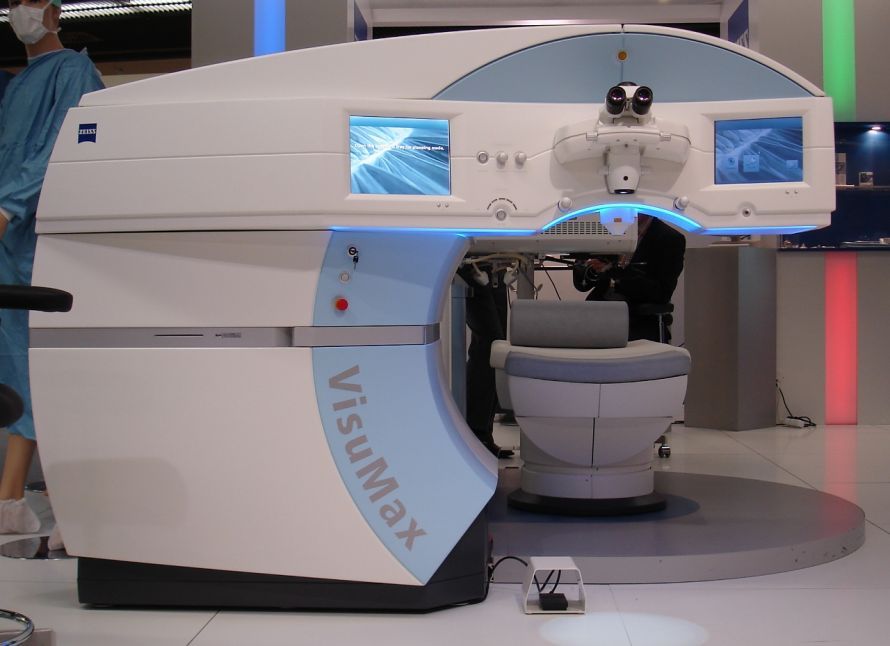
Femtosecond Laser
Preparation for Surgery
Several preliminary examinations are necessary before cataract surgery.
First, the doctor must measure the eye precisely in order to accurately calculate the specifications of the replacement lens.
Unlike the eye’s natural lens, the artificial lens is not elastic. Therefore, it cannot focus on different distances. The eye’s natural refractive power is thus lost.
For this reason, various types of artificial lenses are available:
- Monofocal lens:
The monofocal lens is focused on distant objects. The patient can see clearly at a distance but needs corrective eyewear for near vision.
- Multifocal lenses:
Multifocal lenses have two or more focal points. The patient does not need visual aids. Multifocal lenses are more delicate and more complex to manufacture. That is why they are also more expensive. Generally, patients get along better with a monofocal lens. So if you have no problem wearing glasses or contact lenses, you should opt for this type of artificial lens. For the examination, the patient is given eye drops that dilate the pupils. After the examination, you should not drive a car.
Procedure for Cataract Surgery with a Femtosecond Laser
Cataract surgery using the new femtosecond laser technology is performed in two steps:
- Step using the femtosecond laser
- Manual step performed by the surgeon
Using a fine instrument, the surgeon makes a minimally invasive incision in the natural lens capsule—which is to be preserved—to open it. This capsule provides support for the implanted intraocular lens (IOL).
Until now, the lens has been broken up and aspirated (phacoemulsification) using a small ultrasound probe. The surgeon must carefully control the ultrasound energy to avoid damaging the sensitive inner surface of the cornea (endothelium).
With femtosecond laser technology, the surgeon no longer needs to manually open the lens capsule with a sharp instrument. The femtosecond laser pulses perform this task with pinpoint precision.
The femtosecond laser also handles the fragmentation of the lens. Since the lens is fragmented using the femtosecond laser, ultrasound plays only a supplementary role. The ultrasound energy, which has the potential to damage the cornea and other eye structures, is no longer necessary.
A study by the University Eye Clinic in Bochum showed that the femtosecond laser requires only a fraction of the time typically needed for phacoemulsification. The eye is exposed to ultrasonic energy to a much lesser extent.
Advantages of the femtosecond laser procedure
The femtosecond laser procedure is more precise and gentler, and yields better results in terms of wound healing and visual improvement.
The precise, circular incisions in the lens capsule allow for accurate positioning of the intraocular lens, resulting in stable visual performance.
The femtosecond laser generates less heat, which normally damages the surrounding tissue.
Another advantage of this technology: For patients with astigmatism, only a single session is needed to correct the cornea’s geometry.
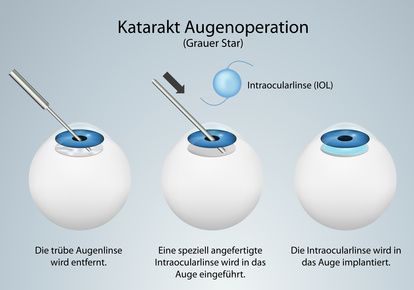
The steps of cataract surgery @ bilderzwerg /AdobeStock
Possible complications and risks
Based on current knowledge, the femtosecond laser does not pose any particular risks. However, the lens capsule may become cloudy after surgery.
This so-called secondary cataract (capsular fibrosis) can be treated quickly, in a single session, and painlessly using a special YAG laser. It does not recur afterward
Follow-up care after cataract surgery with a femtosecond laser
In the first few days to weeks after cataract surgery with a femtosecond laser, you will need to use eye drops to prevent inflammation.
With a standard IOL (monofocal intraocular lens), you will need a separate visual aid. Therefore, your ophthalmologist will check after a few weeks to determine the prescription for your future glasses.
Conclusion
In conclusion, cataract surgery using the femtosecond laser is one of the most advanced methods in cataract surgery. The use of the femtosecond laser achieves unprecedented precision and accuracy, particularly in making the incision and creating the circular opening in the lens capsule. Compared to manual procedures, the femtosecond laser operates with greater precision and gentleness, thereby minimizing damage to the surrounding tissue.
A thorough preoperative examination is conducted prior to surgery, during which the eye is measured to select the optimal intraocular lens. During cataract surgery with the femtosecond laser, the clouded lens is prepared using the laser, then removed via phacoemulsification and replaced with an intraocular lens (IOL). These artificial lenses—particularly premium lenses or multifocal lenses—enable improved visual quality and often reduce the need for glasses.
The femtosecond laser in cataract surgery also enables particularly precise treatment of patients with astigmatism, as incisions can be made in the cornea with great precision. Femtosecond laser-assisted cataract surgery is considered safe and effective, as described in the *Deutsches Ärzteblatt*. During the procedure, laser energy creates tiny air bubbles from water and carbon dioxide, which break up the lens and facilitate its removal.
The surgery is typically performed on an outpatient basis using eye drops, which makes the procedure comfortable for the patient. Nevertheless, the surgeon’s experience remains a decisive factor in the success of the treatment. Overall, femtosecond laser-assisted cataract surgery is an innovative surgical technique that can significantly improve distance visual acuity—often within just a few months after surgery.
FAQ
What is femtosecond laser cataract surgery?
Femtosecond laser cataract surgery is a modern form of cataract surgery. During the procedure, the clouded lens in the eye is precisely fragmented and removed using laser energy. An artificial lens is then implanted to improve visual acuity.
What are the advantages of the femtosecond laser?
The femtosecond laser enables a particularly precise and gentle procedure. Incisions in the cornea and the opening of the lens capsule are made with exact precision and in a circular shape. This reduces the risk of complications and improves visual quality after the procedure.
How is the procedure performed?
The procedure is performed on an outpatient basis and begins with a thorough preliminary examination. The femtosecond laser handles key steps such as making the incisions and preparing the lens. The lens is then fragmented using ultrasound energy and aspirated before an artificial lens is implanted.
Who is this method suitable for?
This method is particularly suitable for patients with cataracts as well as those with astigmatism. Patients who desire high precision and freedom from glasses also benefit from this technique.
Is the treatment safe?
Femtosecond laser-assisted cataract surgery is considered safe and effective. Studies and clinical experience show that the procedure can be performed with greater precision and is less invasive than manual techniques.
About the medical author
Prof. Dr. med. Burkhard Dick
Medical writer