ICL is a modern solution for correcting refractive errors and is one of the most innovative procedures in ophthalmology. It is an implantable intraocular contact lens that is placed in the eye alongside the natural lens. Unlike conventional contact lenses, this lens remains permanently in the eye and serves as an alternative to glasses or contact lenses for many patients. The ICL is particularly suitable for treating nearsightedness, farsightedness, or astigmatism.
The implantation precisely corrects the refractive error without altering the cornea. The natural lens is preserved, as these are phakic intraocular lenses. Many patients benefit from improved vision and the ability to see clearly.
Thus, the ICL offers an effective solution for a life without glasses.
What are implantable contact lenses (ICL)?
Implantable contact lenses are also known as intraocular contact lenses, or ICLs (implantable contact lenses) for short. They make it possible to live without glasses or contact lenses and are a type of refractive surgery.
During a brief outpatient procedure, doctors insert the implantable contact lens. This allows for the easy and successful correction of most refractive errors, such as nearsightedness, farsightedness, and astigmatism.
With the implantable contact lens (ICL), doctors insert a contact lens between the iris and the natural lens of the eye during eye surgery. This outpatient procedure has been in use for 15 years. It is used for specific refractive errors where other eye surgeries, such as LASIK, do not provide a solution.
Special Implantable Contact Lens: Visian ICL
The Visian ICL is an additional lens, similar to a contact lens. Unlike a contact lens, however, doctors insert the Visian ICL into the eye; it does not remain on the surface of the cornea.
This special lens is soft and small. Doctors place it in front of the natural lens. The Visian ICL implantable contact lens can correct nearsightedness and farsightedness. The so-called Visian ICL Toric also corrects astigmatism. Every 6 minutes, doctors worldwide implant an intraocular contact lens.
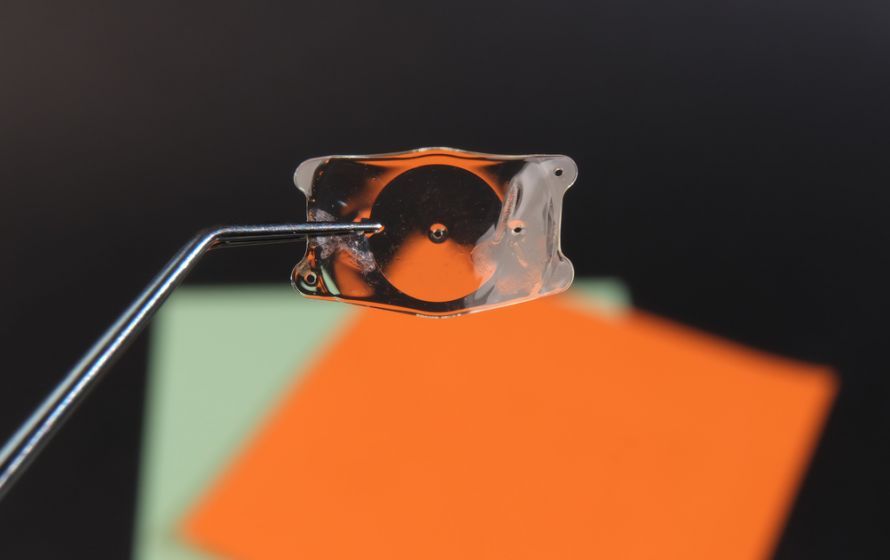 Implantable Contact Lenses (ICL) @ Mohammed /AdobeStock
Material of an intraocular contact lens
The Visian ICL intraocular contact lens is made of a material called Collamer. Collamer has a variety of special properties, such as good biocompatibility.
The body accepts the material and does not perceive it as a foreign body. Therefore, there is no rejection reaction. Furthermore, Collamer is known for its optical clarity, durability, and flexibility.
Preliminary Examinations Before Intraocular Contact Lens (ICL) Implantation
Specially trained technical staff and the surgeon will thoroughly examine your eyes before inserting an implantable contact lens.
These painless examinations typically take about two to three hours.
For example:
- visual acuity is measured
- intraocular pressure is measured, and
- corneal topography and anterior chamber depth are determined
In addition, doctors measure the eye to calculate the prescription for the contact lens. Depending on the degree of astigmatism, special toric artificial lenses can correct it. Discuss the pros and cons of the various options with your surgeon.
Further examinations using a slit lamp and magnifying glass provide crucial information on whether the insertion of an implantable contact lens is possible. The specific procedure to be used is also determined during these examinations.
It is possible to determine as early as the preliminary examination how much your vision will improve with an intraocular contact lens. Only after these examinations can the doctor give you a recommendation regarding the surgery.
This will be the case if:
- There are no other eye diseases present
- Vision improvement is possible with an implantable contact lens
Procedure for Inserting an Implantable Contact Lens
The Visian ICL is small and flexible. Doctors can therefore roll it up and insert it through a small opening in a matter of seconds.
Once the Visian ICL is in the eye, it unfolds and positions itself between the iris and the natural lens. It remains there and corrects your vision without the need for further surgery.
Using the same procedure, doctors can remove or replace the Visian ICL implantable contact lens if necessary. This is a reversible procedure.
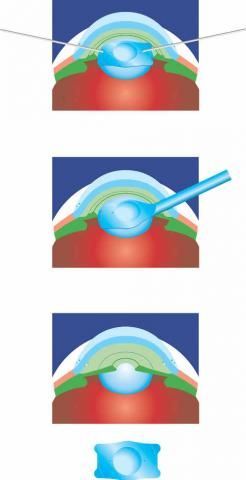
Images from bottom to top: Steps 1 through 3
Before implantation, you will receive topical anesthetic eye drops and a mild sedative so that you do not feel anything during the procedure.
The individual steps of intraocular contact lens implantation:
- First, the doctor makes a small 2- to 3-mm incision at the edge of the cornea (corneal incision).
- Then, he fills your eye with a gel-like substance
- After that, they implant the Visian ICL
- Now he carefully places the contact lens behind the iris
- Finally, the doctor removes the gel-like substance from the eye
The small incision is a self-healing wound, so sutures are not necessary. The implantation is an outpatient procedure and takes only a few minutes.
Medications with an implantable contact lens
Before the surgery, you should continue with your usual routine. Do not change your diet or treatment regimen, and take your medications as usual.
If you are taking Marcumar or other anticoagulants, please consult your primary care physician. After the surgery, you will need to use anti-inflammatory eye drops. Your surgeon will discuss with you how often and for how long you will need them.
Complications and Risks of an Intraocular Contact Lens
The following complications are possible:
- Eye infections, which may lead to severe or very severe impairment, including loss of vision in the affected eye
- Increased sensitivity to light and glare, possibly permanent
- Reduced night vision, possibly permanent
- Overcorrection or undercorrection, requiring further surgery or corrective glasses
If you are over 40 years old, you may need reading glasses after the surgery
Follow-up care after ICL implantation
The first follow-up examination generally takes place at the clinic the day after surgery. The doctor will discuss the use of eye drops with you. You should apply these to the operated eye for about two weeks. The doctor will also explain when you should wear protective eyewear.
Itching or a scratchy sensation is common during the first few days. Your vision will also be somewhat blurry at first, especially immediately after surgery. This is normal because the pupil is still dilated. Neither watching TV nor reading will harm your eyes.
Patients often achieve fairly good visual acuity within one to two days. You should reach stable visual acuity within a month. You may not drive again until your doctor gives you the green light.
Schedule follow-up exams one week and one month after the procedure. The final exam usually takes place 2 to 3 months after the procedure. After that, these exams will be part of your routine eye checkups.
Conclusion on Implantable Contact Lenses
The intraocular contact lens is a modern and effective solution for correcting refractive errors and achieving long-term independence from glasses and contact lenses. Implantable contact lenses, such as the ICL lens, are classified as phakic lenses and allow for correction without removing the eye’s natural lens. Unlike lens replacement surgery, the natural lens remains in the eye, which is a major advantage, especially for younger patients.
The implantable Collamer lens is considered biocompatible and is not recognized by the body as a foreign object, as it adapts perfectly to the structure of the eye. During the procedure, the lens is inserted into the eye through a small opening at the edge of the cornea and positioned in the posterior chamber of the eye. Such implantable contact lenses are particularly suitable for treating farsightedness or astigmatism, as well as for patients with thin corneas or dry eyes. The phakic intraocular lens provides clear vision and enables many patients to live without glasses or contact lenses, as well as to see clearly without glasses in everyday life. Compared to conventional contact lenses, the lens remains permanently in the eye and does not need to be inserted or removed daily.
Intraocular lenses are precisely implanted behind the iris, ensuring that the lens is securely positioned within the eye. Modern refractive eye surgery techniques ensure that implantable intraocular lenses provide a reliable improvement in your vision and can be performed on either one eye or both eyes. Overall, phakic intraocular lenses enable a lasting correction of refractive errors and offer many people the chance for clear vision and a life without visual aids.
FAQ
What is an ICL?
The ICL is an implantable contact lens that is inserted into the eye as an intraocular lens in addition to the natural lens of the eye. It is designed to permanently correct refractive errors and enables clear vision without glasses or contact lenses.
Who is an intraocular contact lens suitable for?
An intraocular contact lens is suitable for patients with nearsightedness, farsightedness, or astigmatism. It is a particularly good alternative to laser eye surgery for patients with thin corneas or dry eyes.
How is the ICL implanted?
During the procedure, the ICL lens is inserted into the eye through a small incision. The procedure is performed under local anesthesia and takes only a few minutes. The lens is positioned in the posterior chamber of the eye.
What are the advantages of implantable contact lenses?
Implantable contact lenses are well-tolerated and biocompatible. The natural lens is preserved, and the refractive error is precisely corrected. Many patients achieve clear vision and can do without glasses or contact lenses.
Are there any risks associated with ICL implantation?
As with any procedure, there are potential risks associated with intraocular lens implantation. These include inflammation or complications, though they are rare. A thorough preoperative examination by an ophthalmologist is crucial for success.
About the medical author
Dr. med. Gero Krommes
Medical writer