Magnetic field therapy is a treatment involving constant or pulsating magnetic fields. Its benefits depend heavily on the specific condition being treated.
In the case of knee osteoarthritis, there is evidence to suggest it may provide pain relief. For improved mobility, cartilage regeneration and several other areas of application, the effectiveness is unclear or unproven. In the case of lower back pain, the unclear assessment of benefits applies only to the treatment with constant fields that was investigated and cannot simply be extended to pulsed devices.
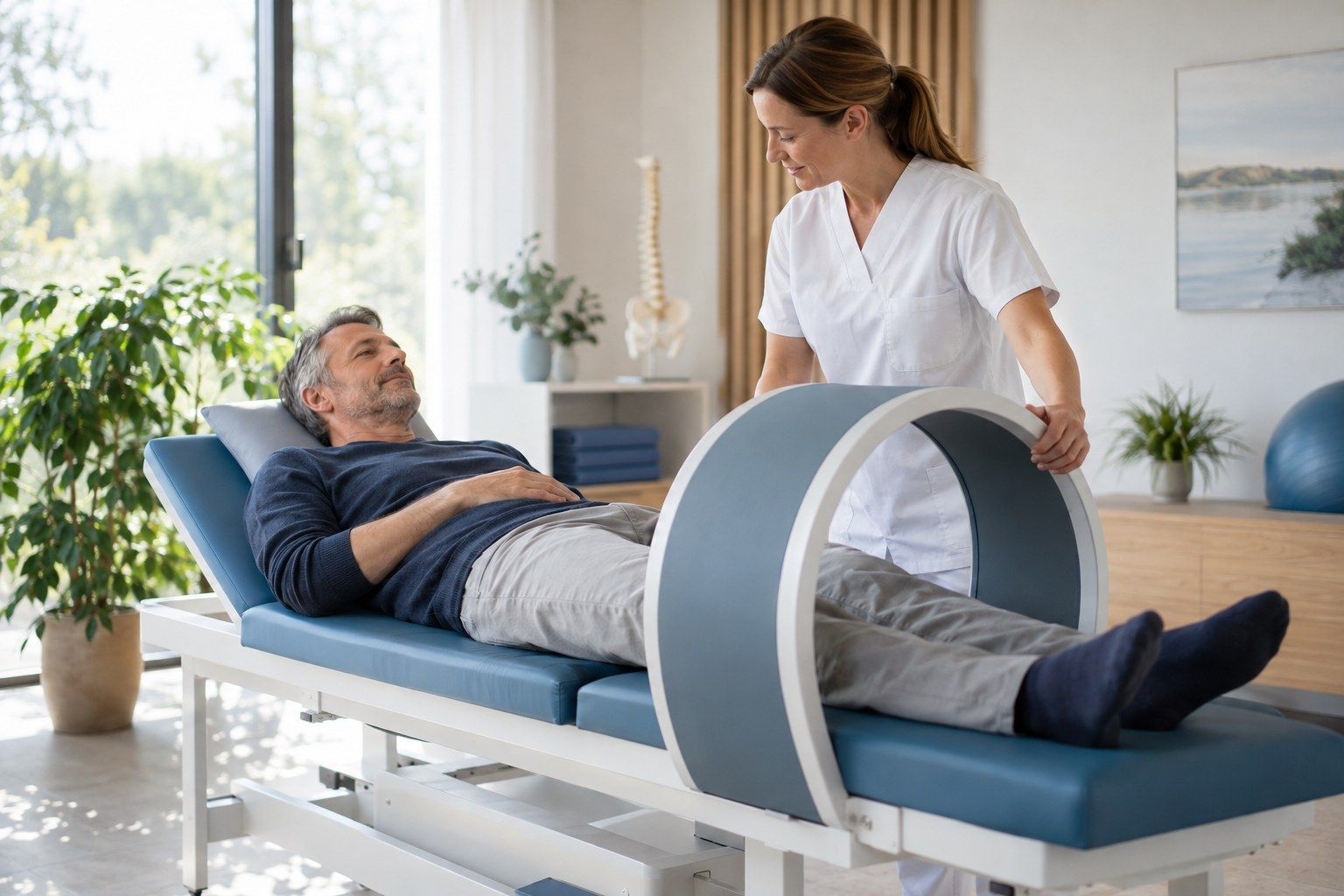
Image generated by AI
How does magnetic field therapy work?
Magnetic field therapy involves the use of magnetic fields without the need for surgery. A suitable device can generate a constant magnetic field. In many other devices, electric currents flow through a coil, generating a field that changes at regular intervals. This pulsed application is also known as PEMF.
The frequency and field strength vary depending on the device. However, the strength of the magnetic stimuli alone does not indicate whether the treatment will have a noticeable benefit for a specific condition.
Even a magnet in an insole generates a field. However, the design alone does not prove any health benefits.
Magnetic field therapy is one of the physical treatment methods. At a cellular level, magnetic fields are thought to stimulate cells or tissues, influence metabolism or contribute to improved blood circulation. Such explanatory models do not yet demonstrate any clinically noticeable benefit. The decisive factor is whether the treatment measurably reduces symptoms associated with a specific condition.
High-intensity electromagnetic transduction therapy, or EMTT for short, differs from standard pulsed applications. It operates at a different technical intensity and is a distinct procedure in its own right.
Who is the treatment suitable for?
Even following an orthopaedic examination, the potential effects of pulsed magnetic fields cannot be generalised to all conditions of the musculoskeletal system.
- Knee osteoarthritis: Electromagnetic treatments may help to reduce pain.
- Shoulder surgery: Following surgery for a rotator cuff tear, PEMF may be considered during early rehabilitation to reduce pain.
- Frozen shoulder: In one study, several parameters improved more significantly with PEMF, although both groups also performed exercises.
- Lower back pain: The benefits of the static application studied are unclear; this does not automatically apply to pulsed devices.
- Healing of bone fractures: The benefits in cases of delayed bone healing have not been sufficiently established.
- Venous leg ulcers: It remains unclear whether healing can be accelerated using electromagnetic fields.
There is no evidence of effectiveness for pain beneath the acromion. There is also no proven therapeutic benefit for magnetic field mats with weak pulsed fields.
How well is the effectiveness of magnetic field therapy substantiated?
The scientific evidence for its benefits varies depending on the area of application. A Cochrane review suggests that electromagnetic treatments can relieve pain. It is less certain whether this also leads to a noticeable improvement in physical function.
A recent controlled trial on knee osteoarthritis found neither an increase in cartilage thickness nor a reduction in knee symptoms reported by participants, compared with a placebo treatment.
Random allocation is intended to minimise differences between the groups under investigation. However, when interpreting the results, the duration of the study, the control group and the characteristics examined must be taken into account.
In one clinical trial, magnetic field therapy was combined with physiotherapy and other physical interventions. In this case, any improvement cannot be definitively attributed to the magnetic field alone. In another programme studied, participants carried out daily mobility, stretching and strengthening exercises.
In the case of chronic pain, the underlying cause is decisive. The inconclusive assessment of static magnetic field therapy for lower back pain does not prove either the benefit or the ineffectiveness of all pulsed treatments.
How does the treatment work?
Before the first treatment, any potential magnet-sensitive implants must be identified. Anyone with a pacemaker, an insulin pump or any other electronic implant should inform their doctor.
- First, the treating specialist will clarify the treatment objective and the type of device to be used.
- In a clinical trial, the affected knee was treated and the therapy was combined with physiotherapy.
- After the session, you should watch out for increased pain, skin changes or other symptoms.
Depending on the device, the treatment duration ranges from a few minutes to just under an hour. A study protocol for knee osteoarthritis comprised eight sessions over four weeks. In another study, six sessions of 15 minutes each took place over three weeks. This does not yield a universally applicable number of sessions.
What are the risks and contraindications?
Skin rashes and increased pain have been described as possible side effects of electromagnetic treatments for osteoarthritis. The frequency of these symptoms could not be reliably determined in the studies analysed.
In a controlled study on knee osteoarthritis, no adverse events were observed. This does not, however, rule out rare risks. In studies on bone healing, mild skin irritation occurred as a treatment-related complication.
The potential consequences of long-term use of low-intensity magnetic field mats have not been sufficiently investigated. Magnetic-sensitive implants may also be a contraindication to their use. For static devices, the IGeL-Monitor explicitly lists such implants as a contraindication.
What is important to bear in mind afterwards, and what alternatives are available?
Magnetic field therapy should not replace effective standard treatment. For knee osteoarthritis, targeted exercise and anti-inflammatory painkillers are options, as is weight loss for those who are overweight. This applies particularly if the magnetic treatment brings no discernible benefit.
| Procedure | For whom | Duration or prerequisites | Advantages and limitations |
|---|---|---|---|
| Pulsed magnetic field therapy | People with specific conditions, such as pain caused by knee osteoarthritis | The duration depends on the device and the treatment plan. | Pain relief is possible; however, there is no evidence that it promotes cartilage regeneration. |
| Targeted exercises | People with knee osteoarthritis | The exercises are carried out regularly; in the accompanying programme examined, they are done daily. | The exercise programme remains an integral part of the treatment and is not replaced by the magnetic field. |
| Anti-inflammatory painkillers | People with osteoarthritis pain requiring treatment | The duration depends on the treatment plan agreed with a doctor. | The medicines may affect pain and inflammation; individual contraindications and risks must be taken into account. |
| Weight loss | People with knee osteoarthritis who are overweight | This is only recommended for those who are overweight. | Weight loss can complement the rest of the treatment and is only indicated in cases of excess weight. |
For chronic venous leg ulcers, compression using bandages or stockings is an established treatment. It is unclear whether electromagnetic fields further accelerate healing. The suitability of any alternative treatment depends on the underlying condition.
How much does magnetic field therapy cost?
An archived IGeL assessment quotes a price of 7 to 20 euros for a session of static magnetic field therapy for lower back pain. This is not a documented standard price for pulsed magnetic field therapy. The total cost of this depends, amongst other things, on the device, the duration of the session and the number of appointments.
The static application for lower back pain examined in this assessment is not covered by statutory health insurance and must be paid for out of pocket. Before undergoing a self-funded medical treatment, those with statutory health insurance must be provided with the estimated costs in writing and give their written consent.
Whether private health insurance covers the costs depends on the specific policy. Before starting treatment, ask for a written breakdown of the session price, the planned number of appointments and any possible additional costs.
Which doctors carry out magnetic field therapy?
Physiotherapists also use electromagnetic techniques to treat osteoarthritis. However, the professional title alone does not prove that the technique is effective for the specific condition in question.
The specialist medical training in naturopathic treatments covers the fundamentals of physical therapies as well as counselling and the determination of indications for electrotherapy, including magnetic field therapy. In the field of alternative medicine, this may indicate additional expertise.
A sign of quality is an open-ended discussion about the specific treatment goal, effectiveness, potential risks, costs and available options covered by health insurance. During the initial consultation, you can ask the following questions:
- What is a realistic treatment goal for my condition, for example in the case of migraine or with regard to my general well-being?
- Which test results support the use of this treatment?
- What significance do specifications such as ‘gauss’ have for the proposed device, and is my implant compatible with it?
- What are the total costs for all the planned sessions?
You can find specialists in magnetic field therapy at the end of this text.
Frequently asked questions about magnetic field therapy
What is the difference between static and pulsed magnetic field therapy?
Static magnetic field therapy uses a constant field. In the pulsed variant, the magnetic field changes at regular intervals; this form is also known as PEMF.
Is the effectiveness of magnetic field therapy for knee osteoarthritis scientifically proven?
Pain relief is possible, but cannot be reliably predicted. No increase in cartilage thickness was observed when compared with a placebo treatment.
Can I use this treatment if I have a pacemaker?
You must consult a doctor in advance to confirm that the treatment is compatible with your specific device. Inform your doctor about your pacemaker and any other electronic implants.
What side effects might the treatment have?
Skin rashes, increased pain and mild skin irritation have been reported. The studies do not allow for a reliable determination of how frequently these side effects occur.