The Tension-free Vaginal Tape (TVT) is one of many surgical methods used to treat stress incontinence. The Tension-free Vaginal Tape is a “vaginal sling” that doctors insert vaginally. Following preliminary examinations and when the indication is appropriate, TVT sling surgery is a minimally invasive and low-risk method for treating stress incontinence.
When is a tension-free vaginal tape (TVT) recommended?
Stress incontinence is characterized by involuntary urine leakage during physical exertion.
This occurs when:
- Coughing
- Sneezing
- Lifting
- Jumping
- Climbing stairs
- Standing up
The cause is weakness of the urethral sphincter.
Stress incontinence is usually classified according to the Stamey scale:
- Grade I: Involuntary urine leakage during strenuous physical activity (e.g., coughing, sneezing, straining)
- Grade II: Involuntary urine leakage during mild physical exertion (e.g., running, climbing stairs, changing position)
- Grade III: Involuntary urine leakage at rest and while lying down
The following tests are used to diagnose stress incontinence, depending on their invasiveness:
- Medical history
- Voiding diary
- Urine analysis (Stix, Uricult)
- Pad test
- Vaginal assessment and pH measurement
- Karyopyknotic index
- Urethrocystoscopy
- Cough provocation test with a full bladder
- Urodynamics (cystometry with urethral pressure profile)
Grade I stress incontinence is usually treated conservatively with medication. Surgical treatment (e.g., TVT implantation) is generally reserved for more severe forms of incontinence.
What is a tension-free vaginal tape (TVT)?
A tension-free vaginal tape (TVT) is a suprapubic alloplastic sling (“vaginal tape”) that doctors insert vaginally.
Alternative methods include:
- The transobturator sling (TOT)
- The abdominal surgical procedure (lower abdominal incision)
- Burch colposuspension and
- The autologous pubovaginal sling (lower abdominal incision: fascial suspension)
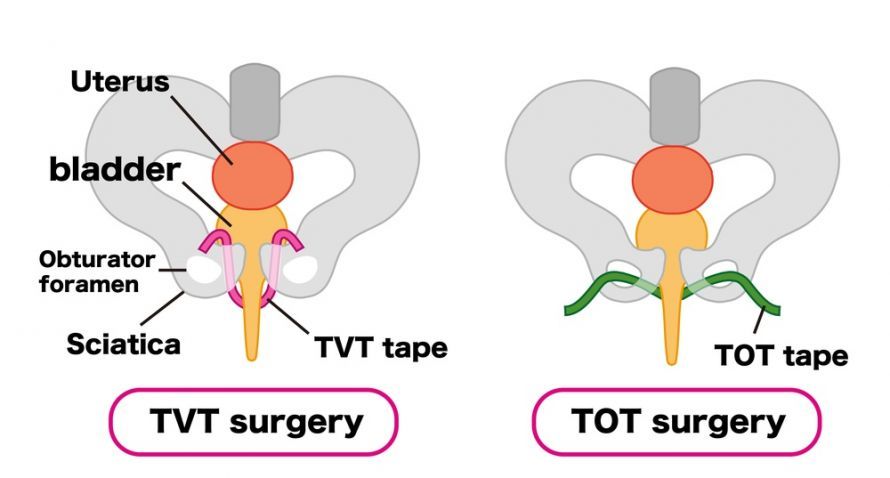
In TVT and TOT surgeries, doctors implant a tension-free tape through the vagina (tension-free vaginal tape) to treat urinary incontinence @ sayukichi /AdobeStock
This surgical method was first developed by Ulmsten and Petros in the early 1990s.
Doctors insert the polypropylene tape vaginally through a small incision in the anterior vaginal wall up to the abdominal wall. There, they position it without tension.
These tapes support the sphincter muscles by acting like a hammock beneath the urethra. They form an anchor that leads to fibrosis (the ingrowth of the body’s own connective tissue) along the tape structures.
This restricts the hypermobility of the urethra and improves continence. Continence rates reach about 80 percent after a 10-year follow-up period.
 According to estimates, one in five women experiences a weak bladder @ doucefleur /AdobeStock
Possible Complications and Risks of TVT Strings
TVT slings are foreign materials. This can lead to foreign body reactions with excessive scarring and associated pain.
Primarily, doctors may injure or perforate adjacent organs, such as the bladder, during insertion. Severe bleeding (sometimes requiring a blood transfusion) and hematoma formation are also possible in rare cases.
Furthermore, the polypropylene band may cause erosion or penetration of the urethra, bladder, and/or vaginal mucosa. This means that the band cuts through the urethra, the bladder wall, or the vaginal wall.
In such cases, doctors must surgically remove the tape. They then reconstruct the damaged areas. They may then need to perform another incontinence surgery using the patient’s own tissue.
The following complications are also possible:
- Recurrence of urge symptoms
- Urge incontinence
- Overcorrection leading to urinary retention
- Use of a single-use catheter
About the medical author
Dr. med. Andreas Neisius
Medical writer