The nervous system of the legs is an important part of the peripheral nervous system and supplies the lower extremities. The nerves of the lower extremities originate from the lumbosacral plexus, which is composed of the lumbar plexus and the sacral plexus.
Spinal nerves extend from the spinal cord into the leg and branch into numerous branches. These branches run alongside blood vessels such as arteries and veins, and together with the nerves, they form functional units.
The sciatic nerve is the largest nerve and divides into the tibial and fibular nerves.
The nerves provide motor and sensory innervation to the muscles of the thigh, lower leg, and foot. The autonomic nervous system also plays an important role in regulation.
An Overview of the Nervous System
The body is crisscrossed by countless nerve fibers. They are responsible for
- transmitting sensory information from the legs to the brain, as well as
- transmitting commands from the brain to the muscles
. As soon as one or more nerves are impaired, functional disorders occur.
Usually, those affected first notice nerve problems in their extremities. They often suffer from nerve pain in the legs, which can become chronic. Injuries or compression of the nerves can lead to
- a pes planus,
- clubfoot, or
- classic “lumbago”
may develop. Below you will find information on the functions, as well as disorders, of the various nerves in the leg.
Nervus ischiadicus: The sciatic nerve
The sciatic nerve is one of the strongest nerves in the human body. It is also one of the nerves that causes the most problems.
Origin and Course
The sciatic nerve originates in the spinal segments of the lumbar spine. From there, it passes through the so-called sciatic foramen before traveling toward the back of the knee. The ischial foramen (foramen ischiadicum majus) is an opening in the ischium located roughly in the center of the buttocks.
The sciatic nerve is covered by
- the gluteal muscles and
- the hamstrings (ischiocrural muscles), which it also innervates.
A herniated or bulging intervertebral disc can compress or irritate the sciatic nerve. This condition is called sciatica. Sciatica is usually accompanied by sensory disturbances and numbness in the legs.
If the sciatic nerve is damaged or even severed, serious paralysis can result. In the event of an injury to the sciatic nerve, the affected person may no longer be able to bend the corresponding leg.
Such an injury or severing can result
- a thigh or pelvic fracture or
- a dislocation of the sacroiliac joint
.
Femoral Nerve: The Thigh Nerve
Origin and Course
The femoral nerve (nervus femoralis) originates in the region of the first and fourth lumbar vertebrae. From there, it travels to the thigh. It innervates not only the anterior and medial aspects of the thigh but also the midfoot.
Disorders
The femoral nerve supplies a large portion of the thigh muscles. Therefore, an injury to the nerve causes serious damage. This results not only in movement disorders but also in paralysis.
Active flexion of the hip joint is no longer possible. As a result, affected individuals can no longer sit up on their own when lying on their back. Furthermore, they can no longer straighten their knee.
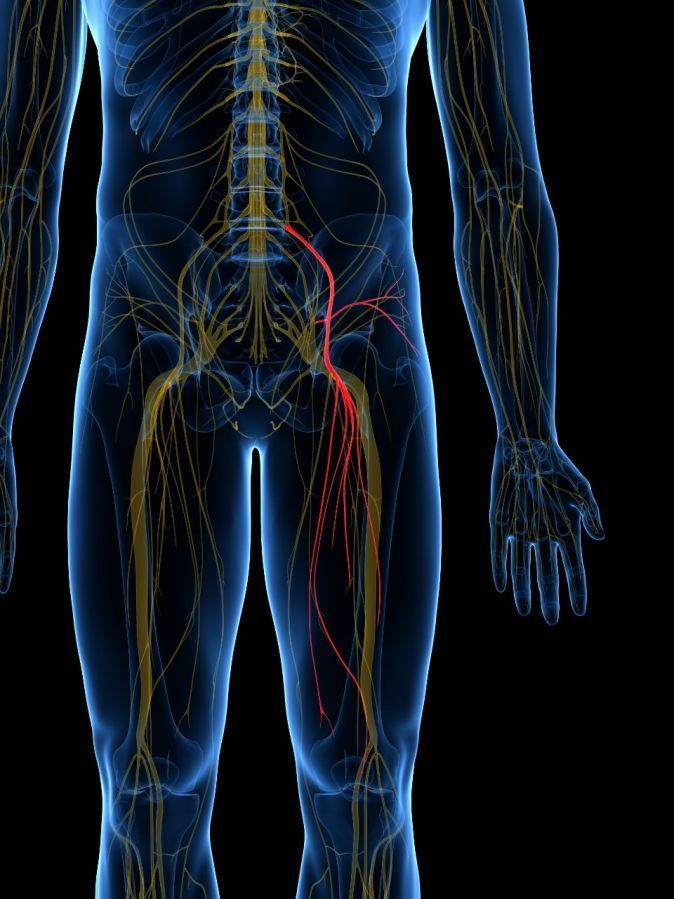
Nervus obturatorius: The obturator nerve
Origin and Course
The obturator nerve (Nervus obturatorius) originates between the second and fourth lumbar vertebrae. From there, it runs across the pelvis to the inner thigh.
Conditions
Newborns are primarily affected by obturator nerve palsy, as the nerve is compressed during birth. Due to the palsy, the leg falls outward when the infant is lying on their back. Children try to compensate for the palsy by moving their leg outward while crawling.
Tibial Nerve: The Tibial Nerve
Origin and insertion
The tibial nerve (nervus tibialis) is a branch of the sciatic nerve that extends to the back of the knee. In this area, it is responsible for the sensory innervation of the calf.
Disorders
If the tibial nerve is damaged, the calf muscles fail. Affected individuals can no longer stand on the balls of their feet or place their feet flat on the ground. They can only walk on their heels. This condition is medically referred to as heel-to-toe gait or claw foot.
Nervus peroneus communis: The peroneal nerve
Origin & Function
The peroneal nerve (nervus peroneus communis) is one of the two main branches of the sciatic nerve. It runs along the outer side of the knee before branching out again in the calf region.
The branches of the peroneal nerve innervate the tibial muscles and the muscles responsible for extending the toes.
Disorders
Damage to the peroneal nerve is medically referred to as peroneal palsy. Since the muscles that lift the foot and toes are paralyzed, this results in a classic drop foot. The gait resembles a “stepping or stork-like gait” because those affected walk on their tiptoes.
The peroneal nerve also innervates the short and long peroneal muscles. Therefore, damage to the nerve can cause clubfoot. In this case, the foot is permanently turned inward. In this condition, there is also a dysfunction of the posterior tibial muscle (musculus tibialis posterior). This muscle is responsible for the inward rotation of the foot. The dysfunction can be either acquired or congenital.
If the peroneal nerve is injured, the condition is referred to as acquired clubfoot. Congenital clubfoot results from
- an unfavorable embryonic position in the uterus
- a low volume of amniotic fluid
- birth injuries.
In most cases, a pointed-foot posture is also present.
Polyneuropathy: Nerve pain associated with other conditions
If nerve pain in the legs occurs even while sitting, this is referred to as polyneuropathy. Unlike a nerve injury, polyneuropathy is associated with other medical conditions. About 30 percent of patients with polyneuropathy have diabetes.
Other causes of polyneuropathy:
- Hypothyroidism
- Alcohol abuse
- Liver and kidney dysfunction
- Mineral deficiency (vitamin B)
- Circulatory disorders
Typically, those affected experience a tingling sensation in their legs, which is sometimes accompanied by numbness. Occasionally, patients exhibit an unsteady gait because they can no longer feel their limbs.
Polyneuropathy is treated symptomatically. If, for example, there is a vitamin B deficiency, appropriate dietary supplements must be administered. Occupational therapy and physical therapy may also be beneficial in the treatment of polyneuropathy.
Conclusion
Overall, it is evident that the nervous system of the legs is closely linked to veins and nerves as well as the vascular supply and constitutes an important part of the peripheral nervous system. The most important nerves—such as the femoral nerve, the obturator nerve, and the posterior cutaneous nerve of the thigh—originate from the branches of the plexus and innervate various areas of the lower extremity. Peripheral nerves run alongside vessels such as the femoral vein, popliteal vein, and great saphenous vein, as well as the dorsal arch of the foot.
The branches of the sciatic nerve, as well as structures such as the gluteus maximus and gluteus minimus, innervate the back of the thigh, while other nerves innervate the outer side of the thigh. The vegetative nervous system and the autonomic nervous system also regulate blood flow and metabolism.
The central nervous system, comprising the brain and spinal cord, is directly connected to this part of the nervous system and coordinates all movements. The function of the skin and muscles is controlled via sensory and motor pathways. Overall, it is clear that this complex section of the lower extremity represents a finely tuned interplay of nerves, blood vessels, and muscles.
FAQ
What is the nervous system of the legs?
The nervous system of the legs comprises the nerves of the lower extremities that originate from the lumbosacral plexus. It controls muscles and transmits sensory information.
Which nerves supply the leg?
The most important nerves include the femoral nerve, the obturator nerve, and the sciatic nerve. Its branches, such as the tibial nerve, supply the lower leg and foot.
What is the function of the tibial nerve?
The tibial nerve innervates muscles in the lower leg and foot, including structures such as the gastrocnemius muscle. It is important for movement and stability.
How do nerves and blood vessels work together?
Veins and nerves often run alongside arteries. This vascular-nervous supply ensures the proper function of muscles and tissues.
What role does the autonomic nervous system play?
The autonomic nervous system regulates unconscious processes such as blood flow and metabolism in the lower extremities.