
Pachymetry is an important examination in ophthalmology used to measure the thickness of the cornea. This measurement of corneal thickness provides crucial information for the diagnosis of various eye diseases. Corneal thickness plays a central role, particularly in the assessment of glaucoma or prior to LASIK surgery.
Corneal thickness can also influence the results of intraocular pressure measurements. An ophthalmologist therefore often uses pachymetry as a complementary test to intraocular pressure measurement. The examination is painless and is performed using modern techniques such as ultrasound or optical coherence tomography (OCT). In an eye center, it is often part of routine preventive examinations. This allows for early treatment to be initiated if any abnormalities are detected.
Definition: What is pachymetry?
Pachymetry is an ophthalmic diagnostic procedure used to measure the thickness of the cornea. As part of the outer layer of the eye, the cornea forms the front, light-transmitting protective layer of the eye. It is, so to speak, the “windshield of the eye.”
If various diseases are suspected, such as
- glaucoma,
- keratoconus (thinning and deformation of the cornea), or
- various corneal diseases
, this examination technique is essential. Furthermore, the thickness of the cornea has a significant impact on the results of other eye measurement procedures. This includes the measurement of intraocular pressure.
Accurate knowledge of corneal thickness is also important prior to various surgical procedures. Pachymetry is therefore an extremely important diagnostic tool.

When is pachymetry performed?
Pachymetry can be used for various purposes. Typically, measuring corneal thickness is necessary only once during the course of treatment. It may be indicated again if
- significant changes are observed in the eyes,
- treatment is adjusted, or
- the eyes need to be re-examined for eye diseases.
Diagnosis of pathological changes in the cornea
One of the functions of the cornea is to refract incoming light through its curvature. If the thickness or curvature of the cornea changes, the refraction of light is altered. This, in turn, affects visual acuity.
Pachymetry allows for precise measurement of corneal thickness. This can indicate the presence of certain conditions. With early treatment, some conditions can be stopped in time.
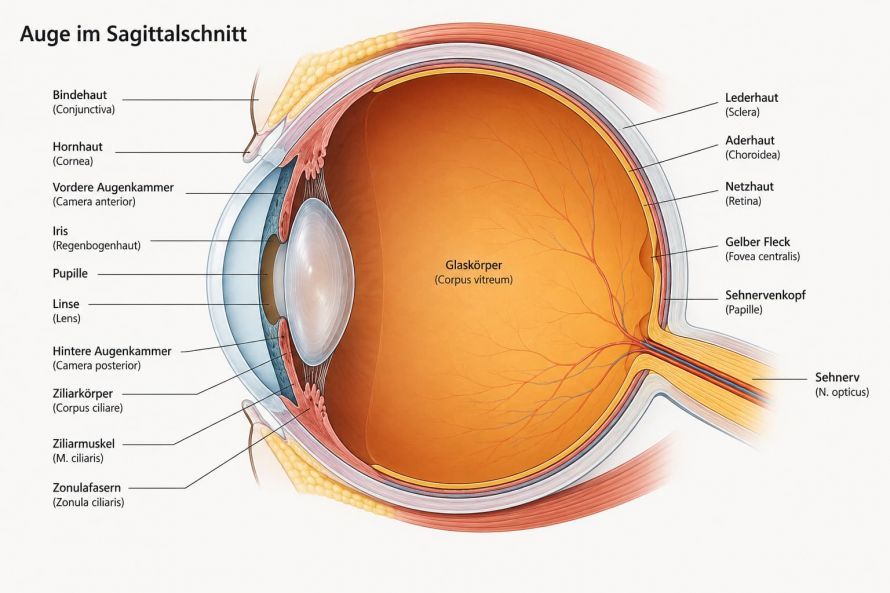
The pressure inside the eye—known as intraocular pressure—gives the eye its uniformly curved shape. This shape is absolutely essential for the eye to function properly. Abnormal intraocular pressure can lead to eye diseases and vision loss. One particularly feared condition is glaucoma, a chronic damage to the optic nerve caused by elevated intraocular pressure.
Intraocular pressure can be determined by applying a defined counterpressure to the eye from the outside. However, the effects of this external pressure on the eye are influenced by the thickness of the cornea. The results of intraocular pressure measurements vary depending on the cornea’s thickness.
On average, the cornea has a thickness of 550 µm = 0.550 mm at its center. However, the cornea can also be significantly thicker and, consequently, less flexible. In such cases, the intraocular pressure measurement would erroneously indicate a higher intraocular pressure.
For this reason, the thickness of the cornea must first be precisely measured using pachymetry. Once this value is known, the intraocular pressure measurement can be adjusted upward or downward as necessary.
Preoperative Examination for Various Eye Surgeries
Various surgical procedures on the eyes to improve vision require a minimum corneal thickness. The refractive power of the cornea can be adjusted using laser treatment, thereby correcting refractive errors.
During laser treatment, corneal tissue is ablated. Therefore, it is essential to measure the thickness of the cornea beforehand using pachymetry. Only then can a decision be made as to whether laser treatment should be recommended or discouraged. The mechanical stability of the cornea must still be maintained after surgery.
A certain corneal thickness is also absolutely necessary for the treatment of keratoconus using cross-linking. In this procedure, the cornea is cross-linked to stabilize the thinned cornea. However, such a procedure is only possible with a minimum corneal thickness of 400 µm. Otherwise, a corneal transplant—such as deep anterior lamellar keratoplasty (DALK)—may be necessary.
Other corneal surgical procedures also require a certain corneal thickness. Alternatively, they require precise knowledge of the corneal thickness and condition for planning purposes.
Procedure and Costs of Pachymetry
Pachymetry is painless and provides results accurate to within a few micrometers.
The measurement can be performed non-contact optically using a so-called optical coherence pachymeter. Otherwise, an ultrasound examination is used, in which a small ultrasound probe is placed on the cornea.
Sometimes a complete thickness profile across the entire cornea may be necessary. This results in a kind of “thickness map.” This can be performed optically and non-contact, for example, using Scheimpflug imaging with the so-called Pentacam.
There are no known risks or side effects associated with this procedure.
.jpg)
Ultrasound Pachymeter
In Germany, pachymetry is available to all patients as an optional diagnostic procedure. However, public health insurance plans rarely cover the full cost of this examination. The costs are generally considered affordable, though.
Private health insurance plans are more likely to cover the costs. In any case, the patient should check with their insurance provider in advance regarding coverage or cost-sharing.
Nevertheless, it is often worthwhile to have a pachymetry performed. If glaucoma is suspected, a precise measurement of intraocular pressure can help refine the diagnosis. This allows for early intervention. For this reason, pachymetry is now an integral part of many diagnostic procedures and treatment plans.
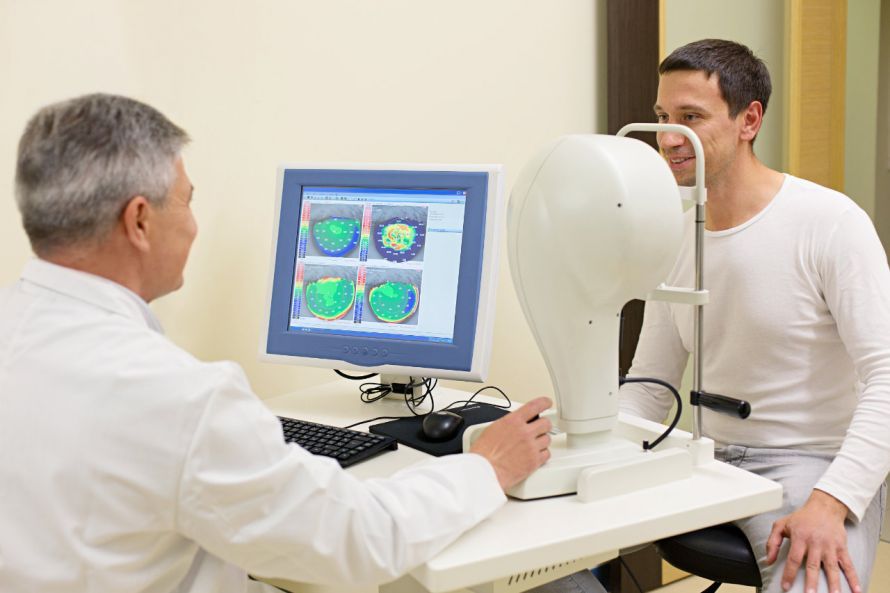
Pachymetry being performed by an ophthalmologist © bigguns | AdobeStock
Conclusion
Pachymetry is a modern procedure for precisely determining the thickness of the cornea and plays a central role in ophthalmology. It is performed by an ophthalmologist or at an eye center and provides important data for glaucoma diagnosis as well as for planning surgery or refractive procedures on the eye. Corneal thickness can be measured using either ultrasound or optical pachymetry, which involves the use of a special measuring device called a pachymeter. Using sound waves or light waves, this method yields precise measurements accurate to one-thousandth of a millimeter.
Performing pachymetry allows for a more accurate determination of intraocular pressure, as the thickness of the cornea is taken into account as a correction factor. Without this adjustment, readings could be inaccurate, particularly in cases of elevated intraocular pressure or glaucoma. The examination also provides crucial information for conditions such as keratoconus or other corneal diseases, as changes across the entire corneal surface can be detected.
As a painless and quick examination, pachymetry is now part of standard diagnostic practice and is frequently used as part of a preventive eye exam. Modern imaging techniques such as ultrasound or diagnostic lasers further increase accuracy and enable a precise medical diagnosis. Knowledge of corneal thickness is also essential prior to planned surgical procedures or during surgery to minimize risks and determine the optimal residual corneal thickness.
Overall, it is clear that pachymetry plays an important role not only in cases of existing eye diseases but also in preventive care. It helps detect abnormalities early, before structures are damaged, and thus supports safe and individually tailored treatment.
FAQ
What is pachymetry?
Pachymetry is a test used to measure the thickness of the cornea in the eye. It is used in ophthalmology to obtain important information for diagnosis and treatment.
Why is measuring corneal thickness important?
Corneal thickness affects the measurement of intraocular pressure and is crucial in the assessment of glaucoma. It also plays an important role in planning LASIK or other procedures.
How is pachymetry performed?
Pachymetry is usually performed using ultrasound or optical pachymetry. A special measuring device, or pachymeter, precisely measures the thickness of the cornea down to one-thousandth of a millimeter.
Is the examination painful?
No, pachymetry is painless and takes only a few minutes. It can be performed as part of a preventive eye exam at an ophthalmologist’s office or an eye center.
When should a pachymetry be performed?
A pachymetry is recommended if glaucoma is suspected, before surgery such as LASIK, or for regular monitoring of certain eye conditions.

About the medical author
Sabine Schneider
Editor-in-Chief
Sabine Schneider – medical author: Explore expert articles and medical expertise in the Leading Medicine Guide.
More about the medical author →