To produce the saliva that breaks down food, humans have three large and 600 to 1,000 small salivary glands. Cancer can develop in any of these salivary glands. Salivary gland cancer is therefore an umbrella term for all possible types of cancer affecting the salivary glands. They are often benign.
Below you will find further information as well as a selection of specialists in salivary gland cancer.
Types of Salivary Gland Cancer
To produce the saliva that breaks down food, humans have three major salivary glands:
- The parotid gland (Glandula parotis)
- The submandibular gland (Glandula mandibularis)
- The sublingual gland (Glandula sublingualis)
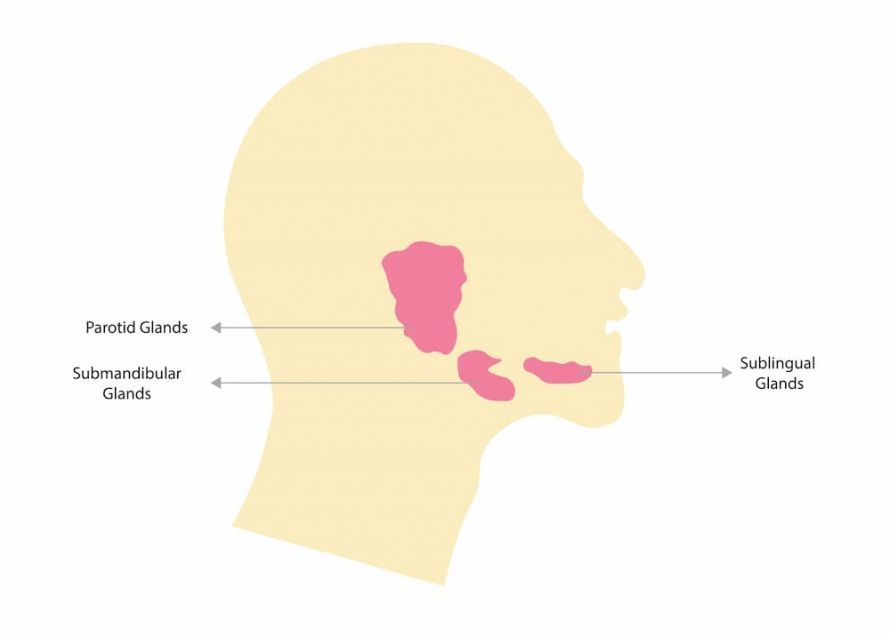 The location of the three major salivary glands @ Jeniffer /AdobeStock
In addition, we have about 600 to 1,000 other small salivary glands located in the oral mucosa. Cancer can develop in any of these salivary glands.
The international classification distinguishes between 9 benign and 18 malignant tumors of the salivary glands. In most cases, the condition is a pleomorphic adenoma or cystadenolymphoma (Warthin tumor) of the parotid gland. Both are benign tumors that occur much more frequently than malignant ones.
Malignant tumors include mucoepidermoid carcinoma, adenoid cystic carcinoma, and acinar cell carcinoma. In most cases, they are found in the submandibular or sublingual salivary glands. Metastases (spread) from another tumor to the salivary glands also occur. In very rare cases, the minor salivary glands are affected by malignant cancer.
Symptoms of Salivary Gland Cancer
Benign salivary gland tumors are characterized by slow growth. Therefore, patients initially have no symptoms. A benign tumor manifests as a visible and palpable swelling that is usually not painful.
If the tumor constricts the gland’s duct, it can lead to painful inflammation of the salivary gland.
Tumors in the submandibular gland are malignant in 50 percent of cases and lead to paralysis of the facial nerve (nervus facialis). This results in impaired facial muscle function, disturbed facial expressions, a “crooked” smile, and slurred speech.
Malignant tumors are often painful. In advanced stages of the disease, additional symptoms may occur:
- Swelling
- Reduced saliva production and dry mouth
- Sensory disturbances
- Pain
- Unilateral facial paralysis
 Swelling is a typical symptom of salivary gland cancer @ Missleestocker /AdobeStock
Causes and Risk Factors for Salivary Gland Cancer
The exact causes are still unknown. Most tumors occur spontaneously and without a family history of the disease. There is an increased risk of salivary gland cancer if the patient received radiation therapy to the head and neck region during childhood or adolescence.
Tobacco use and certain viral infections (particularly Epstein-Barr and HIV) may also contribute to salivary gland cancer, though this has not yet been proven.
Treatment of Salivary Gland Cancer
- Treatment of Benign Tumors
Treatment for salivary gland cancer is primarily based on the complete removal of the tumor. This also applies to benign tumors, as they can cause long-term problems and lead to inflammation or difficulties with eating.
Since humans have multiple salivary glands, patients are not significantly affected by the removal of a single large salivary gland.
Doctors can usually remove most tumors without difficulty in a single surgical procedure. Since even benign salivary gland tumors can recur, doctors remove each tumor with a wide margin. This means that doctors remove not only the tumor itself but also a portion of the surrounding healthy tissue.
However, the safest approach is to remove the entire affected salivary gland. Doctors do this, for example, as part of a complete removal of the parotid gland (total parotidectomy) or during the removal of the submandibular gland (submandibulectomy).
- Treatment of Malignant Tumors
The treatment of malignant tumors is usually more complex, as they can spread to other organs in the body. Most often, the soft tissue (lymph nodes) is affected.
When treating malignant tumors, doctors first remove a generous amount of the affected tissue. In addition, they also remove the lymph nodes in the neck (“neck dissection”).
If the malignant tumor affects adjacent tissue structures such as parts of the facial nerve, bones, or muscles, doctors remove these as well.
To minimize the physical strain of the surgery on the body, patients first undergo radiation therapy or chemotherapy. The goal is to shrink the tumor beforehand. In some cases, a combination of surgery and radiation therapy or chemotherapy is used.
- Further Treatment Measures
For benign tumors and malignant tumors in children and adolescents, no further treatment is required after surgery.
Chemotherapy or radiation therapy is recommended if:
- Doctors were unable to completely remove a tumor
- Metastases are present in other organs
- The cancer is particularly aggressive
Radiation therapy is most effective, especially for localized tumors.
In children, doctors weigh the benefits against the risks, as children are more sensitive to radiation therapy. Children often develop secondary cancers or facial growth abnormalities. For this reason, doctors rarely use radiation therapy in children. When they do, it is usually in combination with chemotherapy.
Share this article