News
European Lecture 2019: High Honor for Prof. Dr. Andreas Raabe!

Prof. Dr. med. Andreas Raabe ·
Prof. Dr. Andreas Raabe, a neurosurgery specialist in Bern and director and chief physician of the University Clinic for Neurosurgery at Inselspital, has long been regarded as a specialist operating at the highest level. But now he has received a particularly rare honor that is by no means awarded every year: At this year’s congress of the European Association of Neurosurgical Societies (EANS) in Dublin, the renowned neurosurgeon was invited to deliver the “European Lecture” during the awards session—a highly acclaimed speech!
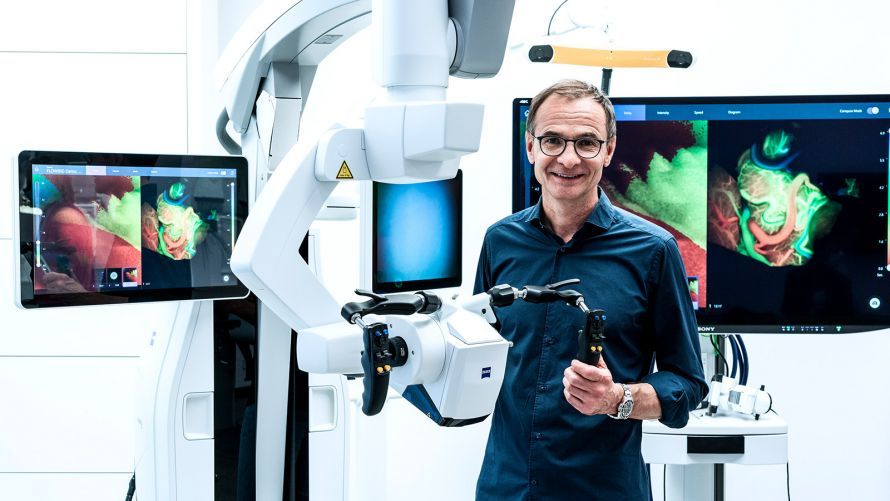
Bern, October 10, 2019 – The “European Lecture Award” is considered a highly coveted honor among leading scientists worldwide. It is reserved for individuals who, through many years of research and development in the field of neurosurgery, have provided decisive impetus to the discipline. Strictly speaking, Prof. Dr. Andreas Raabe has actually earned this award twice—namely, through two inventions that have transformed neurosurgery worldwide. In doing so, he has also significantly improved patient safety.
Market-Ready Inventions for Greater Patient Safety
Prof. Raabe, a specialist who is also ranked by the Leading Medicine Guide as one of the world’s leading neurosurgeons, has made a name for himself in several roles: He is active as a physician and researcher, but also as a pioneer and inventor. As an inventor, he has been able to significantly reduce the complication rate in his field—where even the slightest error can have dramatic consequences—using two innovative tools: ICG-assisted angiography and dynamic mapping. Prof. Dr. Jürgen Beck, Medical Director of the Department of Neurosurgery at the University Medical Center Freiburg, is certain: These tools have “significantly improved surgical work by providing an ‘extra hand’ and an ‘extra eye.’” They are “so intuitive to use” that they can be easily integrated into everyday surgical practice.
Knowledge, wisdom, technique, technology—Prof. Raabe continuously improves the entire field of neurosurgery, including patient safety, based on these pillars. However, as Prof. Raabe emphasizes, in order to continuously advance this field of medicine, methods are needed to maintain the current level of knowledge, refresh what has been learned, and acquire new knowledge. That is why a new software-based approach to medical learning is part of a current research project at Inselspital (University Hospital of Bern).
Complex Surgeries: Optimized Neurosurgery
One of the most well-known achievements of the Bern-based neurosurgeon is the invention and market-ready development of dynamic, continuous mapping using a probe during brain surgery. This special probe indicates a safe distance from the motor pathway tissue during the surgical removal of tumor tissue. If the surgeon comes dangerously close to the intact motor pathway, a warning beep sounds. Thanks to this invention, injuries to healthy brain tissue during tumor resection were cut in half, from about ten percent to five percent.
With another invention, Prof. Raabe was able to reduce the rate even further: the complication rate during aneurysm resection dropped from ten to just three percent thanks to radiation-free vascular imaging (indocyanine angiography). This allows results to be optimized even during surgery, thereby preventing strokes and incomplete aneurysm clippings. This method, too, has greatly improved patient safety worldwide.
High Honor: A Highly Acclaimed Lecture
Just as diverse as his fields of work is the topic on which Prof. Dr. Andreas Raabe spoke at the European Lecture: “Knowledge, wisdom, technique, technology, and the quest for near-zero morbidity” was the title.
For Prof. Dr. Andreas Raabe, this prestigious award is certainly a welcome incentive to continue his work with enthusiasm and curiosity. In this way, he continues to improve patient safety in neurosurgery—worldwide. And, of course, this also brings a great deal of international attention to the University Hospital of Bern and, by extension, the University Clinic for Neurosurgery at Inselspital.
Share this article
About the medical author
Prof. Dr. med. Andreas Raabe
Medical Author · Chair and Director of the Department of Neurosurgery
Prof. Dr. med. Andreas Raabe – author: Explore expert medical articles in the Leading Medicine Guide.
News
Read next
- News
Kidney Stones – Modern Treatments, from Shock Waves to Lasers
Oct 7, 2026
Why Sudden, Severe Flank Pain Can Be a Warning Sign
Read more - News
Retinal Detachment: Flashes of Light Can Jeopardize Vision
Oct 5, 2026
Retinal Detachment: Quick Action Can Save Your Eyesight
Read more - News
The waiting period for a semen analysis prior to planned fertility treatment
Oct 5, 2026
Semen analysis: The effects of short waiting periods
Read more