News
A small knot can be more stubborn than you might think

Melanie Al Tikriti, BSc · September 17, 2026
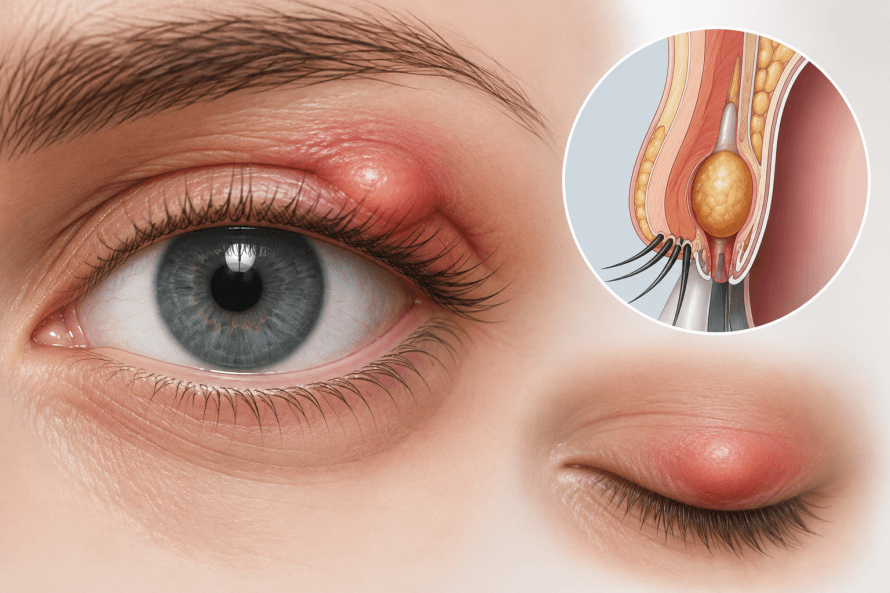
A small, painless swelling on the eyelid often seems harmless at first glance. Many people initially suspect a stye or mild eye irritation. However, if the lump does not go away over the course of several weeks, it is often a chalazion. A chalazion is a blocked sebaceous gland on the eyelid and, depending on its size, can not only be cosmetically bothersome but also impair vision. It is generally harmless and usually heals on its own. However, some can be so persistent that they last for weeks or months.
Blocked glands are the most common cause
The eyelid contains numerous small sebaceous glands that produce an oily secretion. This secretion is a component of the tear film and prevents tear fluid from evaporating too quickly.
If the duct of one of these glands becomes blocked, the secretion can no longer drain and accumulates in the tissue. There, it triggers a chronic inflammatory reaction, and gradually a small, easily palpable lump forms in the eyelid. Unlike a stye, this is not a bacterial infection but rather a sterile inflammation.
Various factors can contribute to its development
A chalazion can affect anyone. However, certain factors increase the risk.
These include, among others:
- chronic inflammation of the eyelid margins
- rosacea
- oily skin
- diabetes mellitus
- frequent rubbing of the eyes
- increased sebum production
The swelling usually develops slowly
Unlike a stye, the symptoms do not appear suddenly. A chalazion usually grows over several days or weeks. Pain is rare. Only when bacteria also colonize the area can the chalazion become inflamed.
Typical signs include:
- a palpable lump in the eyelid
- localized swelling
- slightly reddened eyelid
- a feeling of pressure
- a feeling of tightness
- cosmetically bothersome bulge
- blurred vision with larger hailstones
Hailstone or stye?
Many people confuse these two conditions. However, it’s important to distinguish between them, as the treatments differ.
Stye: Caused by a bacterial infection of an eyelid gland, it usually results in severe pain, pronounced redness, and swelling.
Pterygium: In contrast, it develops slowly and is usually barely painful. The swelling often feels firm and frequently persists for an extended period.
How the diagnosis is made
The typical swelling alone provides the ophthalmologist with important clues. During the examination, the size, location, and texture of the lump are assessed. If a chalazion persists for an unusually long time or recurs in the same spot, further examinations may be necessary to rule out other changes in the eyelid.
What treatment options are available
Many styes resolve on their own within a few weeks. Warm compresses can help liquefy the trapped secretion and promote natural drainage. In addition, a gentle massage of the eyelid margin is often recommended. If the stye persists despite these measures or impairs vision, a minor surgical procedure may be necessary. During this procedure, the stye is removed under local anesthesia.
What Those Affected Should Keep in Mind
Under no circumstances should you try to squeeze the chalazion yourself! Doing so could introduce germs into the tissue, which could cause a bacterial infection.
The following are also helpful:
- regular eyelid margin hygiene
- warm compresses
- washing your hands before touching your eyes
- Insert contact lenses only after practicing good hygiene
- Do not rub your eyes unnecessarily
- Replace cosmetic products regularly
Conclusion: Patience often gets the job done.
Although a stye is usually harmless, it does not always disappear within a few days. With consistent eyelid care, warm compresses, and a little patience, the swelling often subsides on its own. If the lump persists or grows larger, you should see an ophthalmologist to begin the appropriate treatment.
Share this article
About the medical author
Melanie Al Tikriti, BSc
Editor
Melanie Al-Tikriti, BSc – author: Explore expert medical articles in the Leading Medicine Guide.
More about the medical author →

News
Read next
- News
Uterine Prolapse – When Downward Pressure Makes Daily Life Difficult
Sep 15, 2026
Why Many Women Underestimate Early Symptoms for a Long Time
Read more - News
Heel Spurs: Why Every Step Can Be a Strain
Sep 11, 2026
Heel Spurs: Why Every Step Can Be a Strain
Read more - News
Endometriosis: Why Period Pain Isn't Always Normal
Sep 9, 2026
Endometriosis: Severe symptoms may indicate a chronic condition
Read more