Acupuncture is a technique used in traditional Chinese medicine (TCM) in which fine needles are inserted into the skin at selected points on the body.
It has been most extensively studied for chronic lower back pain and knee osteoarthritis. It can alleviate symptoms in these conditions; for many other conditions, its effectiveness is unclear or unproven. A session usually lasts 20 to 40 minutes and is rarely painful.
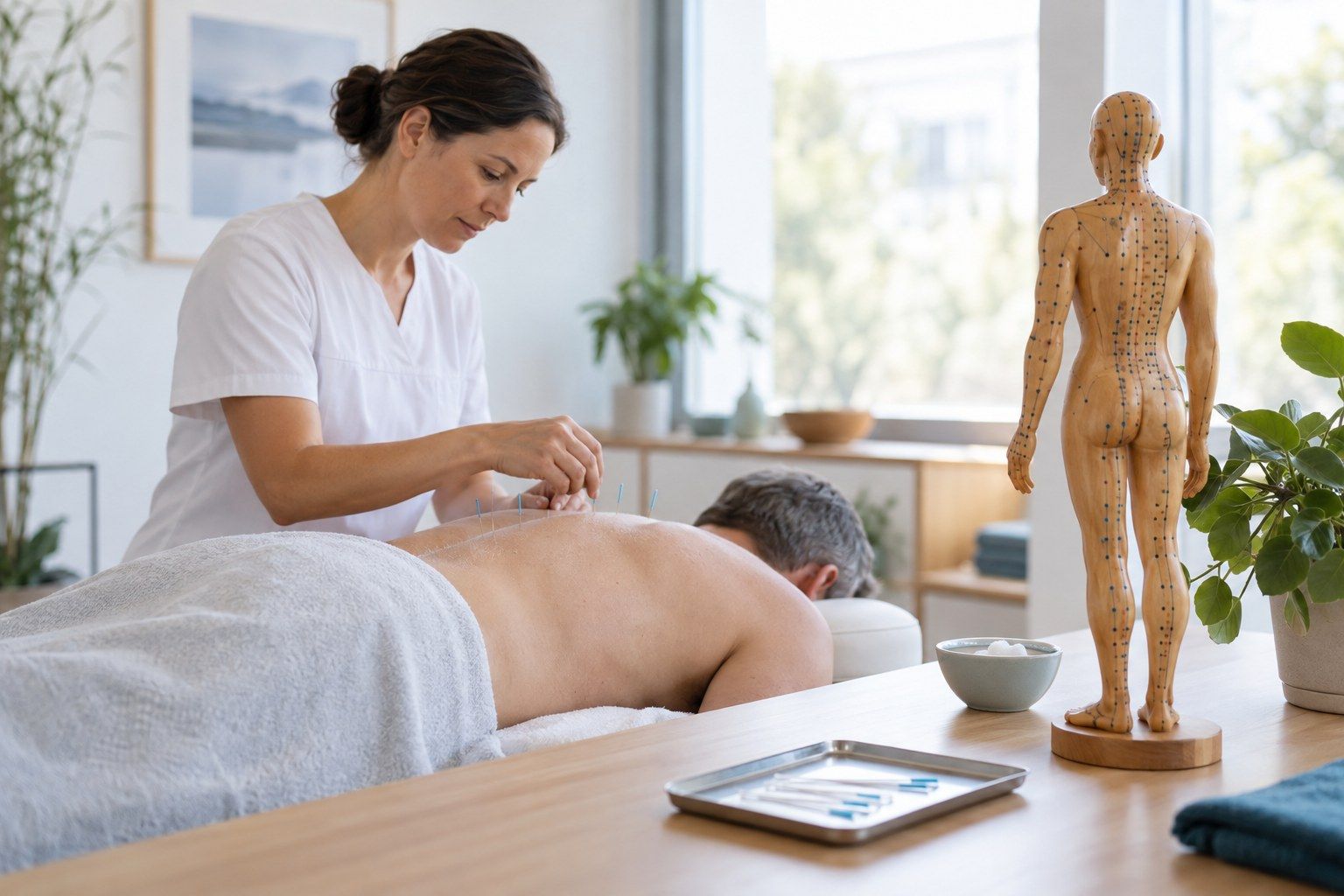
Image generated by AI
What is acupuncture?
Acupuncture is a therapeutic method of TCM and is offered as part of alternative medicine: it involves inserting needles into specific acupuncture points. At the same time, it forms part of some medical approaches to pain management.
The term is derived from the Latin word ‘acus’ (needle). The theory of meridians assigns acupuncture points to pathways through which the life energy ‘qi’ is believed to flow. According to this concept, stimulating individual points is said to regulate the flow of qi and release blockages. Occasionally, the traditional model also associates a point with an organ or a specific bodily function.
The supposed energy pathways have not been scientifically proven. Statements about energy flow, yin and yang therefore describe the traditional explanatory model and not a proven anatomical process.
Effects on the body’s own pain processing mechanisms in the brain and spinal cord are discussed as a possible scientific explanation.
Acupressure, in which selected points are stimulated by applying pressure, should be distinguished from acupuncture. Moxibustion, i.e. the application of heat to specific points on the body, is a technique associated with acupuncture.
What are the potential areas of application?
Before undergoing acupuncture, the diagnosis underlying the symptoms should be clarified. In medical pain management, it can complement other measures but does not replace treatment of the underlying cause.
- In the case of chronic back pain, only short-term relief is possible at best. Acupuncture may be considered here as a complement to active exercises, not as a stand-alone therapy.
- In cases of knee osteoarthritis, also known as gonarthrosis, relief from symptoms is possible. However, in studies, the treatment was no more effective than sham acupuncture – that is, a treatment that merely mimics acupuncture.
- For chronic non-specific neck pain – that is, neck pain with no clearly identifiable cause – it may be used in combination with active measures.
- For acute non-specific neck pain, the guideline does not recommend acupuncture.
Acupuncture may be considered for the prevention of episodic migraine. However, studies provide conflicting results as to whether it is more effective than sham acupuncture in this regard. It is unclear whether acupuncture prevents tension-type headaches.
In the case of allergic rhinitis, which includes hay fever, studies suggest a possible improvement in nasal symptoms. Further research is needed to confirm this finding.
- Its benefits in antenatal care are unclear.
- Its effectiveness in treating nausea and vomiting during pregnancy has not been proven.
- No benefit has been demonstrated in helping people to give up smoking.
- Its effectiveness for weight loss has not been scientifically proven.
What should be clarified before an acupuncture treatment?
Before the first session, a doctor should determine the cause of the symptoms, as acupuncture is no substitute for necessary diagnostic tests. The following questions should be answered:
- What condition is causing the symptoms?
- Are you taking any anticoagulant medication?
- What benefits can realistically be expected for this specific set of symptoms?
- What other active or medical treatments are available as alternatives?
- Is this a service covered by health insurance or one that patients pay for themselves?
Anyone taking anticoagulant medication must mention this before the injection, as these medicines can increase the risk of minor bleeding and bruising at the injection sites. Patients should also ask about the potential benefits compared with other treatments.
How does the treatment work?
In traditional body acupuncture, sterile, single-use needles are inserted into selected acupuncture points. A session usually lasts around 20 to 40 minutes.
- The doctor determines which points on the body are to be treated.
- To stimulate these points, the needles may be moved or warmed before insertion.
- After the prescribed duration of treatment, the needles are removed.
Many patients feel a slight tingling sensation when the needles are inserted; severe pain is rare. The sensation depends on the insertion site and the individual’s pain threshold.
In addition to body acupuncture, ear acupuncture, cranial acupuncture and laser acupuncture are also available. However, it is conventional body acupuncture that determines whether costs are covered by statutory health insurance schemes.
What risks and side effects are possible?
In an analysis of prospective studies that continuously recorded adverse events from the start of treatment, around 9% of patients experienced at least one adverse event during a course of treatment.
- Minor bleeding at the insertion site
- Minor bruising
- Pain during or after the needle insertion
- Temporary worsening of symptoms
- Dizziness or circulatory problems
In an older German survey, slight bleeding was recorded in around 3 per cent, bruising in around 2 per cent and dizziness in 1 per cent of documented treatments.
Serious adverse events are rare: a review of studies estimated their frequency at approximately 1 event per 10,000 patients treated. Sterile, single-use needles reduce the risk of infections being transmitted during the injection.
Chest pain or shortness of breath immediately after the appointment are not normal reactions and must be investigated by a doctor straight away.
What alternatives are there?
In cases of chronic back pain with no clear cause, active measures such as targeted strengthening and stabilisation exercises are an important alternative to acupuncture alone. Acupuncture can complement these measures, but should not replace them.
| Procedure | Who is it suitable for? | Possible benefits and limitations |
|---|---|---|
| Acupuncture | For chronic back pain or knee osteoarthritis | Can provide short-term relief from back pain and may alleviate symptoms of knee osteoarthritis; does not replace active treatment for back pain |
| Strengthening and stabilisation exercises | For chronic back pain with no clear cause | Are an important active alternative to acupuncture alone |
| Strengthening and flexibility exercises | For knee osteoarthritis | Can reduce pain and improve joint function |
| Conservative orthopaedic measures | Depending on the cause of musculoskeletal complaints | Conservative treatment in orthopaedics combines several non-surgical procedures, depending on the diagnosis. |
How much does acupuncture cost?
Statutory health insurance covers traditional body acupuncture for pain in the lumbar spine or for pain caused by knee osteoarthritis, provided the symptoms have persisted for at least 6 months.
In these cases, a standard course of treatment comprises up to 10 acupuncture sessions within a maximum of 6 weeks. In justified exceptional cases, statutory health insurance funds may cover up to 15 sessions within 12 weeks.
For other conditions, some health insurance funds provide voluntary subsidies; patients should enquire about the conditions with their insurance fund before starting treatment. In order for the practice to be able to bill the treatment as a service covered by health insurance, it requires authorisation from the relevant Association of Statutory Health Insurance Physicians.
Those paying out of their own pocket will receive an invoice based on the medical fee schedule. The standard rate is 2.3 times the standard fee: according to the IGeL-Monitor, a session then costs either 26.81 or 46.92 euros, depending on its duration. If a consultation or additional services are included, the amount increases. For example, the IGeL-Monitor quotes between 25 and 60 euros for a session including a consultation during pregnancy. Ask about the total cost of all planned sessions before you start.
Which doctors practise acupuncture?
Medical acupuncture is offered, amongst others, by suitably qualified specialists in internal medicine or orthopaedics. In cases of pain-related conditions, it may form part of a more comprehensive approach to medical pain management.
Anyone wishing to obtain the additional medical specialisation in acupuncture must, according to the model course syllabus, hold specialist recognition in a field involving direct patient care and complete a 200-hour further training course. Approval from the Association of Statutory Health Insurance Physicians is also required for the treatment to be covered by health insurance.
During the initial consultation, you may ask the following questions:
- What condition is to be treated, and what benefits can realistically be expected?
- What alternatives are available for my symptoms?
- Are sterile, single-use needles used?
- Is there authorisation for reimbursement by the health insurance fund?
You can find acupuncture specialists at the end of this text.
Frequently asked questions about acupuncture
Has the flow of energy along meridians been scientifically proven?
No. Meridians and the supposed flow of qi within them form part of the traditional explanatory model of TCM. There is no scientific evidence that these energy pathways exist anatomically.
How effective is acupuncture?
That depends on the condition being treated. For chronic back pain, acupuncture may, at best, provide short-term relief. For knee osteoarthritis, relief is possible, but it is no more effective than sham acupuncture.
Is acupuncture painful?
The insertion of the needles is often described as a slight tingling sensation and is rarely painful. Nevertheless, the insertion site may be temporarily sore, and symptoms may worsen briefly.
How many sessions are needed?
The number of sessions depends on the nature of the symptoms and the course of treatment. If the treatment is covered by statutory health insurance, a course of treatment usually comprises up to 10 sessions over a maximum of 6 weeks. In justified exceptional cases, up to 15 sessions within 12 weeks are possible.
What should patients be aware of after an acupuncture session?
After a session, minor bruising, slight pain at the insertion points or a temporary worsening of symptoms may occur. Chest pain or shortness of breath immediately after the appointment, however, are not normal reactions and must be investigated by a doctor straight away.
How much does acupuncture cost?
As a service paid for out of pocket, a session costs around 27 or 47 euros, depending on its duration, at the standard 2.3-fold fee rate; it may cost more if it includes a consultation and additional services. In cases of chronic lower back pain or knee osteoarthritis, the statutory health insurance scheme may cover the costs under specified conditions.