Men or women who are dissatisfied with the shape of their buttocks can undergo a buttock augmentation. During this procedure, implants are inserted into the buttocks to give them a fuller appearance that is in proportion to the rest of the body. Here you’ll find more information as well as a selection of specialists and centers for buttock augmentation.
What are some possible reasons for buttock augmentation?
Many women and men are dissatisfied with the shape of their buttocks. A change in the shape of the buttocks can be genetic or result from
- weight loss,
- injury, or
- illness
. Buttock augmentation can correct small or flat buttocks, thereby increasing their volume.
Surgical buttock augmentation can positively enhance your appearance and create harmonious body proportions. The reasons for buttock augmentation are therefore very personal.
What is buttock augmentation?
The goal of buttock augmentation is to use implants to correct the sagging or flaccid appearance of the buttocks. The result should be a buttock shape that harmonizes with the rest of the body.
Polytech-Silimed provides implants filled with cohesive silicone gel. They are available in three profiles with a round or oval base and are suitable for augmentation and for reconstructing soft tissue defects.
The highly durable, highly elastic shell with a barrier layer is filled with a highly cross-linked silicone gel. Due to its firmer consistency, this silicone gel meets the stress requirements of a gluteal implant. However, saline solution is also an option as a filler.
The implants have a smooth or textured (microstructured) surface.
Advantages and Disadvantages
- of the round and oval implants, as well as
- textured and smooth surfaces
are discussed with the patient.
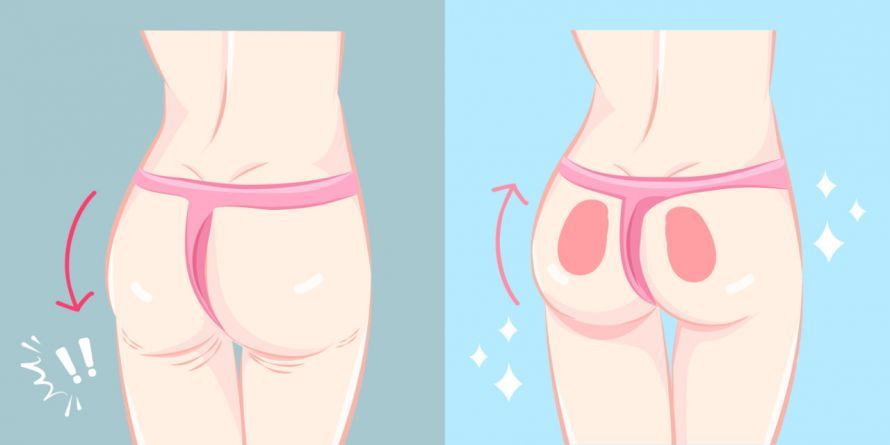
Generally, a round, smooth implant is preferred for male patients who lack projection. If the lateral contour needs to be improved, oval implants are primarily used.
Both the fillers and the shells have been examined in extensive international scientific studies
- and
- tested, and
- deemed suitable
. There was no evidence that silicone implants cause serious diseases in the body.
The risk of implant displacement is very low with today’s implants and when the procedure is performed by a qualified professional. Ongoing product testing and improvements, as well as the development of modern, minimally invasive surgical techniques, guarantee the highest possible level of safety.
Consultation and Examination Before Buttock Augmentation
What results can be achieved with buttock augmentation?
Buttock augmentation will give you the full, natural shape you desire. It will also feel just as natural as your own buttocks.
The buttock implant lasts for many years. Due to normal tissue aging processes and the effects of gravity, the shape of your buttocks will change again over time. However, it is possible to rejuvenate your buttocks at any time through a buttock lift or implant replacement.
Before Buttock Surgery
Before undergoing buttock augmentation, it’s essential to have thorough consultations with your surgeon. The goal is to build a relationship of trust and to determine which implant best meets your specific expectations. Only then can the procedure help you achieve more aesthetically pleasing proportions and improved body confidence.
If you plan to lose weight after the surgery, you should inform your surgeon of this well in advance. Weight loss will significantly alter the shape of your buttocks and may therefore compromise the surgical outcome. You should also disclose any allergies and any family history of blood clotting disorders.
The surgeon should discuss the pros and cons of different shapes and sizes, as well as textured versus smooth surfaces, with you. An experienced plastic surgeon will work with you to select a suitable implant so that the procedure can be performed efficiently. Short surgery times minimize the risks associated with anesthesia and bacterial contamination.
This reduces the postoperative recovery time to a minimum, allowing the patient to quickly resume family and work activities.
As a rule, you will also have a detailed consultation with the anesthesiologist to discuss anesthesia.
The laboratory test results required for the surgery should be obtained before the surgery date and should not be older than 14 days.
For approximately 14 days prior to surgery, you should avoid
- alcohol,
- sleeping pills, and
- pain relievers that delay blood clotting (e.g., aspirin)
.
Smoking causes blood vessels to constrict, which negatively affects wound healing. Therefore, quitting or cutting back on smoking before and after buttock augmentation is highly recommended.
How is the buttock augmentation surgery performed?
Before the surgery, the exact positioning of the implant is determined together with the patient in front of a mirror. The important anatomical structures are marked in various positions:
- Standing,
- while sitting, and
- followed by photographic documentation.
The patient is positioned face down, and the surgical site is sterilely scrubbed and draped. The surgery is typically performed under general anesthesia. This ensures a stress-free and problem-free procedure for the patient and allows the surgeon the calm necessary for the required precision work.
The surgeon injects a saline solution containing epinephrine and a local anesthetic into the region of the coccyx. The local anesthesia
- facilitates the detachment of the tissue,
- enables local hemostasis, and
- provides additional pain relief during the postoperative recovery.
The incision is approximately 6 cm long and can be discreetly placed in the upper part of the gluteal crease (intergluteal fold). From this access point, the tissue pocket (implant site) for the selected implant is prepared within the pre-marked boundaries. Through
- blunt dissection using a specially developed smooth instrument (Solz dissector) and
- local anesthesia
, the surrounding tissue is spared. As a result, minimal blood loss is expected.
After precise preparation of the implant pocket, the implant is then inserted. Implantation is usually performed between the gluteal muscles (intermuscular), but can also be performed under the skin (subcutaneous).
The wound is closed with a fine suture that is barely visible in the gluteal crease.
After a sterile dressing is applied, the patient is fitted with compression underwear. The patient should wear this for about 4 to 6 weeks postoperatively. The actual surgery takes about 90 minutes.
What happens after buttock augmentation?
In the first few days after surgery, you will feel a distinct sensation of tightness in the buttock area. This is due to swelling and stretching of the tissue. You may also experience slight bruising. However, both the bruising and the swelling will subside completely within a few days to a few weeks. Pain at the incision site is comparable to severe muscle soreness.
After initially lying on your stomach or side, you’ll be able to sit after about 2 days. You can resume light activities after a few days. You can shower again after 4 days. Full ability to work is usually restored after one week.
You should avoid overexertion and sports during the first two to three weeks.
Consistent use of the compression garment is crucial for a good postoperative result. After four to six weeks, you will no longer need to wear it.
The sutures are usually removed after 21 days. You should avoid saunas, direct sunlight, or tanning beds for about 6 weeks to ensure optimal scar healing.
Adequate postoperative follow-up care should be ensured and followed in every case. If any complications or questions arise after surgery, please contact your surgeon immediately.
The incision leaves a small scar that will fade over time and soon become barely noticeable.
The final result can usually only be assessed after the scar has fully matured, which takes 6 to 9 months. The shape of the buttocks is usually stable after 3 to 4 months.
What are the possible risks and complications of buttock augmentation?
Complications are very rare with buttock augmentation. However, there are still risks: In addition to swelling and bruising, in isolated cases there may be
- bleeding,
- postoperative bleeding,
- wound healing disorders, and
- infections.
Such complications require expert treatment by your plastic surgeon. In very rare cases, it may be necessary to temporarily remove the implant.
Silicone implants are also subject to a certain degree of material fatigue, which can lead to defects in the implant shell.
Furthermore, serious accidents can cause damage to the implant. In such cases, the filling material may come into contact with tissue. Saline solution is completely absorbed by the body. Silicone, on the other hand, can trigger foreign body reactions, which may lead to the formation of so-called silicone nodules years later.
However, the condition of the implant can now be easily determined using modern, non-invasive examination methods. If you have chosen implants from reputable manufacturers, they come with product warranties. They can also be reordered and replaced in almost all countries.
Comment on Buttock Augmentation
Buttock augmentation is an elegant procedure for correcting an aesthetically unappealing buttock shape. This generally improves psychological well-being as well.
Buttock augmentation is now a standard procedure in aesthetic plastic surgery. The surgeon’s expertise and experience are essential for a good surgical outcome. Make sure your surgeon is board-certified in plastic surgery. He or she should also be able to demonstrate sufficient surgical expertise in aesthetic surgery.
Despite careful procedures, buttock augmentation is a surgical procedure that requires a specialist
- consultation,
- surgery, and
- postoperative care
. The relationship of trust between the doctor and the patient plays a crucial role here. Professional associations can help you find suitable plastic surgeons for buttock augmentation.