During a chin correction procedure, the doctor reduces or enlarges the chin, thereby giving the face a harmonious overall appearance. There are various reasons for chin correction, such as a double chin, a protruding chin, or a receding chin.
Below you will find more information as well as specialists in chin correction.
Chin Correction for a Double Chin
A double chin is usually caused by being overweight. This results in fat deposits accumulating on the chin. In most cases, the person also has a relatively thick neck and a round face.
However, even slim people can have a double chin, which is usually due to a genetic predisposition. As we age, the skin loses its elasticity, causing folds of skin to sag in the chin area.
Medicine offers various procedures for removing a double chin. The appropriate method depends on whether the double chin is caused by excess skin or fat deposits.
A specialist in plastic and aesthetic surgery can remove excess fatty tissue from the chin area using liposuction. In most cases, this is performed on an outpatient basis. The surgeon performs the procedure behind the earlobes, so that scarring is minimal.
A newer method is the so-called fat-dissolving injection. In this procedure, the doctor injects a special active ingredient into the fatty tissue, which then dissolves the fat. The fat is subsequently eliminated via the lymphatic system.
If the double chin is caused by sagging skin, the surgeon may also perform a skin tightening procedure. The surgeon makes a small incision under the chin and removes the excess skin. This procedure is also typically performed under local anesthesia on an outpatient basis.
Removing a double chin restores a slim and fresh appearance to your neck and face. Your chin area will also appear narrower.
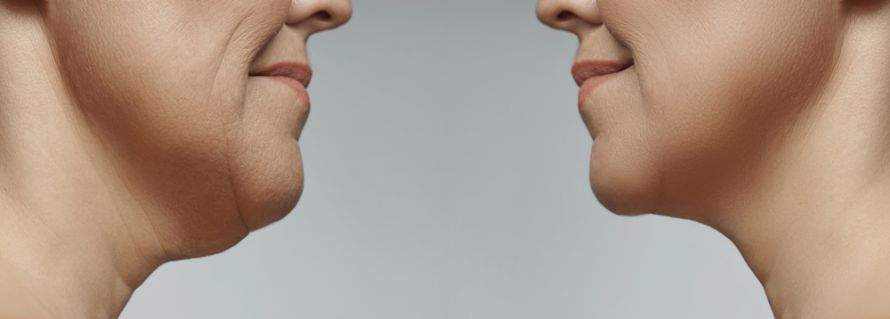 Many patients suffer from sagging skin on the neck and chin @ blackday /AdobeStock
Receding Chin and Possible Corrections
A receding chin refers to a poorly defined chin, which makes the nose and mouth appear to protrude.
There are various causes for this: On the one hand, it may be due to the lower jaw being shifted backward, making the chin appear small and receding.
Additionally, the lower jaw may be smaller than the upper jaw. In this case, the chin appears less prominent.
To correct this, the surgeon must perform a chin augmentation. An implant can be used for this purpose.
This consists of either:
- plastic
- silicone, or
- the patient’s own tissue
To insert the implant, the surgeon makes an incision inside the mouth or under the chin. The implant is then placed on the inside of the lower lip.
Another method of augmentation is jaw repositioning, though this is rarely used. In this procedure, the surgeon cuts through the lower jawbone horizontally and moves it forward. Once it is in the correct position, it is secured with plates and screws.
Another option for correction is a jaw fracture. To do this, the surgeon must break the jaw. The surgeon then moves the jaw forward and secures it in place.
A receding chin is usually distressing for those affected. However, it can be easily corrected, resulting in more defined facial features.
Chin Reduction for a Protruding Chin
A protruding chin is very prominent and can extend beyond the forehead and nose. Cosmetic surgery employs various methods to correct this.
One possible approach to reducing a protruding chin is to shave down the jawbone. This procedure is performed under general anesthesia.
To do this, the surgeon removes bone tissue from the chin area using a bone drill. He can then shape it into the desired form.
Another approach is jaw repositioning. In this procedure, the surgeon removes part of the lower jawbone and moves the jaw backward.
A protruding chin gives women a very masculine and striking appearance, while in men it appears harsh and stern. Chin reduction surgery results in softer, more approachable facial features.
Alternatives to Chin Surgery
Those who do not wish to undergo surgery can also visually enhance the chin with fillers. Hyaluronic acid is particularly commonly used for this purpose.
Deformities or asymmetries can also be corrected with hyaluronic acid injections. In most cases, patients require several sessions to achieve a satisfactory result.
A chin augmentation with hyaluronic acid lasts between one and two years; after that, the treatment must be repeated.
 Hyaluronic acid treatment on the chin @ Peakstock /AdobeStock
Patient Care After Chin Augmentation
If the procedure is performed on an outpatient basis, you can go home once the anesthesia has worn off.
The following symptoms often occur after chin augmentation:
- Pain
- Bruising
- Bruising or
- Swelling
These are harmless and subside after a few days.
If you’ve had a major surgery, the recovery period may take several weeks. During this time, you should apply cold compresses to the painful or swollen areas or take pain relievers.
Difficulty eating and speaking is also normal in the first few days after the procedure. Therefore, you should focus on eating soft foods such as soups or purees.
To prevent infections, you should maintain good oral hygiene. You can resume exercising about four to five weeks after the surgery.
Costs of Chin Correction
The cost of a chin correction varies from person to person and depends on the extent of the correction and the shape of the chin.
A chin augmentation with hyaluronic acid is relatively inexpensive and costs about 120 euros. However, this procedure must be repeated, as hyaluronic acid is not permanent.
The cost of surgery ranges from 1,900 to 4,900 euros. If multiple surgeries or special implants are necessary, the costs may be even higher.
If there is a functional jaw disorder that causes problems with chewing or speaking, health insurance will cover the costs. However, you must pay for purely cosmetic surgeries yourself.

Sources
Kinn- und Wangenkorrektur - Deutsche Gesellschaft für Ästhetisch-Plastische Chirurgie. Unter: https://www.dgaepc.de/wp-content/uploads/2015/04/Kinn-Wangenkorrektur.pdf
Kinnkorrektur (Genioplastik). Unter: https://www.mooci.org/gesichtschirurgie/genioplastik-kinnkorrektur/