Men, in particular, tend to lose their full head of hair at an early age and are prone to balding. A hair transplant can help them. Various hair transplant techniques are available to conceal bald spots on the head. A hair transplant is usually performed on an outpatient basis under local or general anesthesia and takes about 2 to 4 hours. The cost of a hair transplant starts at 4,000 euros.
Here you’ll find all the important information as well as qualified doctors for hair transplants.
Causes of Hair Loss
Approximately 12 to 15 million Germans are prone to progressive balding due to hereditary hair loss. Balding often begins as early as between the ages of 17 and 30. Many of those affected therefore suffer considerably from this predisposition.
90 percent of all hair loss is due to what is known as “androgenetic alopecia,” or male-pattern baldness. It occurs in both men and women, although women are significantly less affected. The pattern of hair loss also differs between the sexes.
In men, hair loss begins at the temples and in the crown at the back of the head. Later, it spreads across the entire top of the head.
In women, there is typically a more diffuse, general thinning of the hair across the entire scalp. However, hair loss is only truly noticeable once more than 50 percent of the hair has been lost. Certain male hormones, which everyone possesses, are responsible for this hair loss. In women, these hormones are balanced by female hormones before menopause.
The remaining 10 percent of all hair loss cases are due to internal diseases or nutritional deficiencies.
Other causes of hair loss include
- injuries from accidents or burns, or
- scarring following cosmetic procedures, such as a “facelift” or similar procedures.
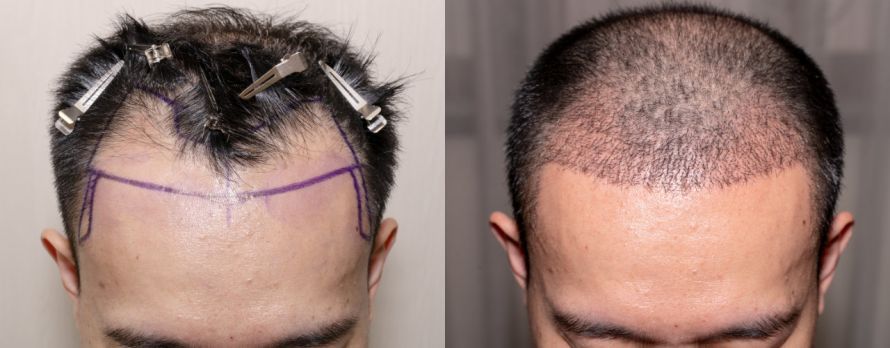
For men in particular, a hair transplant improves quality of life, as bald spots are once again covered with hair © Sugrit | AdobeStock
The Hair Transplant Procedure
A hair transplant can conceal bald spots and progressive hair loss.
The Reduction
In some cases, the scalp is very flexible. In such cases, the surgeon can excise a portion of the bald area and suture the remaining hair-bearing area together.
A fine scar usually remains at the suture site. It can be covered later by a hair transplant.
Autologous Hair Transplantation
A prerequisite for a hair transplant using the patient’s own hair is a sufficiently dense, healthy hairline. In most cases, this remains intact even in men with progressive balding until the end of their lives.
Under local anesthesia and, if necessary, twilight sleep, a narrow strip of skin with dense hair is removed from the hairline. The donor site is carefully sutured and is no longer visible due to the overlying hair. The appearance of the hairline is not affected by the hair transplant.
Hair Transplantation Methods
There are three techniques the surgeon can use to create openings in the scalp. Thanks to local anesthesia, these procedures are also painless for the patient.
Incision
Using special scalpels or needles, very fine incisions are made in the scalp.
Advantage: The grafts “sit” relatively tightly in their recipient sites. This ensures a good supply of nutrients. Blood flow is also comparatively minimally affected by the “slitting” technique.
Disadvantage: Pressure from the scalp can push the implanted hair grafts back out.
Punching or Drilling
Using a drill or a hollow punch, small sections of tissue are removed from the skin.
Advantage: By removing numerous small areas of skin, the bald area is reduced and replaced with hair-bearing skin.
Disadvantage: The wound area is considerably larger, resulting in increased scarring and a longer healing process.
Laser
The doctor uses a focused beam of light instead of a scalpel or drill. This allows him to create tiny recipient sites by vaporizing tissue.
Advantage: Scarring is minimal, so healing is favorable. Bleeding is significantly reduced by the laser, which makes it easier to insert the grafts and thus speeds up the process. This further increases the already high survival rate of the grafts.
Disadvantage: The laser is an effective tool only in experienced hands. After all recipient channels have been created using one of the aforementioned techniques, the micrografts are inserted into the channels using the finest tweezers.
After the Hair Transplant
The day after the hair transplant, a follow-up examination is conducted, including a medical hair wash. A few days later, there are practically no visible signs of the procedure. Depending on the hair type, new hair growth begins after about three to four months.
The hair then grows back at a normal rate of about one centimeter per month.
Risks and Complications of a Hair Transplant
Hair transplantation is the most commonly performed surgical procedure among men. At the same time, it is very low-risk.
However, as with any surgery, complications can occur. The scalp often becomes inflamed, which can prevent individual grafts from taking root properly. Additionally, aesthetic complications can result from surgeons with limited experience.

About the medical author
Asst Lect. Dr Klaus Exner
Medical Author · Senior Consultant · Frankfurt am Main
PD Dr. med. Dr. h.c. Klaus Exner – author: Explore expert medical articles in the Leading Medicine Guide.