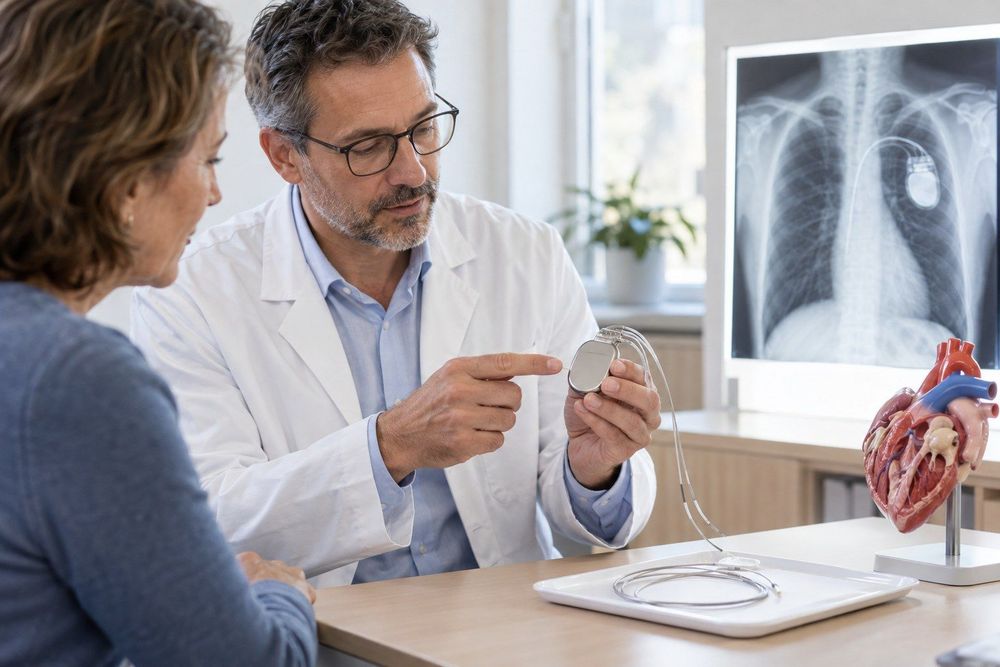
An implantable cardioverter-defibrillator (ICD) monitors the heart’s rhythm and treats dangerous rapid cardiac arrhythmias using electrical pulses or a stronger shock. It may be considered following a previous episode of life-threatening arrhythmia or as a preventative measure in cases of high individual risk.
The device is usually implanted below the collarbone. Following the procedure, regular check-ups and treatment of the underlying heart condition remain necessary.
What is an implantable cardioverter-defibrillator and who is it suitable for?
An implantable cardioverter-defibrillator continuously monitors heart activity. If it detects a dangerous, rapid arrhythmia originating in the ventricles, it can terminate it using electrical pulses or a stronger electrical shock. Such ventricular arrhythmias can trigger cardiac arrest.
During ventricular fibrillation, the heart stops pumping blood. Without rapid resuscitation, this can lead to sudden cardiac death. Ventricular tachycardia is a very rapid heartbeat that originates in a ventricle and can also become life-threatening.
Following a successful recovery from ventricular tachycardia or resuscitation, implantation may be advisable if the cause of the arrhythmia cannot be eliminated. The ICD is then intended to protect against another cardiac arrest.
Even without a previous episode, such a system can be used as a preventative measure. This requires the presence of a heart condition that significantly increases the risk of dangerous ventricular arrhythmias. Following a heart attack, heart function is reassessed before a decision is made on implantation due to impaired pumping function.
In cases of severe heart failure, the ICD may form part of cardiac resynchronisation therapy (CRT). This also coordinates the heart’s pumping action. However, the defibrillator function alone treats neither the cause nor the symptoms of heart failure.
The decision also takes into account the regular intake of necessary medication and a life expectancy of more than one year with a good quality of life. Treatment for the underlying condition should be optimally managed.
A pacemaker has a different primary function: it delivers small electrical pulses when the heartbeat is too slow. A defibrillator can also treat dangerously rapid heart rhythms.
How effective is an ICD in protecting against sudden cardiac death?
An ICD can reduce the risk of dying from a dangerous ventricular arrhythmia. In a meta-analysis of studies involving people at increased risk, 8 out of 100 people without an ICD and 3 out of 100 people with an ICD died of sudden cardiac death within 2 to 3 years.
The implanted defibrillator only intervenes when a suitable arrhythmia occurs. It does not prevent ventricular tachycardia from developing. In cases of heart failure, necessary medication therefore remains important.
The extent of the personal benefit depends, amongst other things, on the underlying condition and the risk of a recurrence. When making the decision, the potential protection, life expectancy and the burdens associated with the procedure, follow-up checks or shocks are weighed up against one another.
What preparation is required before implantation?
Before the procedure, the nature of the arrhythmia and its cause are determined. An ECG can detect ventricular tachycardia. If symptoms occur only rarely, a long-term ECG may be considered.
Depending on the clinical situation, an echocardiogram, magnetic resonance imaging (MRI), genetic testing or further investigations may be necessary. Based on the results, the doctor will assess whether an implantable device is required and which type appears suitable.
Anyone taking anticoagulant medication should discuss how to manage this before the procedure. In one study, continuing to take warfarin resulted in fewer major haematomas at the device pocket site than a temporary switch to heparin. Do not change your medication on your own.
To protect against infection, the guidelines of the German Society of Cardiology recommend the administration of an antibiotic prior to defibrillator implantation.
How does ICD implantation take place?
In conventional ICD implantation, the area beneath the collarbone is numbed with a local anaesthetic. The device, comprising the battery and electronics, is then placed under the skin. The anaesthetic is intended to prevent pain in the surgical area during the procedure.
- The doctor makes an incision in the skin below the collarbone and prepares a pocket for the device.
- A wire-like electrode, also known as a lead, is guided through a vein to the heart.
- The electrode is then connected to the device. This connection enables the device to monitor heart activity and deliver electrical pulses.
If the system detects a heart rate that is too fast, it may initially deliver several weaker stimulation pulses. These are intended to stop the arrhythmia. In the event of ventricular fibrillation or if stimulation is unsuccessful, stronger defibrillation may be necessary – that is, an electric shock to restore a normal rhythm.
Another type is the subcutaneous ICD, or S-ICD for short. Its electrode runs beneath the skin rather than through a blood vessel to the heart. In a comparative study, this type was investigated in people who did not require a pacemaker function.
Following a new implantation, overnight in-hospital monitoring is medically justified. If there are no complications, a prolonged hospital stay is not usually necessary. It is not possible to specify a standard duration for the procedure, as the type of device and the patient’s individual circumstances influence the course of the procedure.
What are the possible risks and side effects?
Complications occur in around 3 out of every 100 people with an ICD. These include infections, bleeding, impaired wound healing and device malfunctions. In around 1 out of every 100 people, the complications are severe or life-threatening.
- Electrode displacement: This can impair the connection to the heart.
- Lung injury: The lung may be injured whilst the electrode is being advanced.
- Material wear and tear: The insulation on the electrodes may wear away over time.
- Unnecessary shock: The device delivers an electric shock even though there is no appropriate dangerous arrhythmia present.
A stronger shock that is consciously felt is painful and can cause anxiety. Weaker shocks, on the other hand, may go unnoticed.
What should you look out for after treatment?
Before you are discharged, the surgical wound and the defibrillator’s functions will be checked. At subsequent appointments, your doctor will review any recorded arrhythmias, the battery level and any potential malfunctions.
- ICD card: Always carry it with you so that emergency services can recognise the implanted device.
- Driving: Whether and when you can drive privately again must be assessed on a case-by-case basis. Driving for work may be permanently restricted.
- Smartphones and headphones: Do not place or hold these devices directly against the skin over the implant.
- Magnetic resonance imaging (MRI): The ICD must be taken into account before the scan. Some models allow MRI scans following special programming.
Depending on the model, the battery lasts for up to ten years. After that, the unit is replaced; functioning electrodes can remain in the body. Regular check-ups will indicate when the battery is nearing the end of its service life.
What alternatives are there?
The suitability of an alternative depends on the cause and the expected duration of the risk. Medication and catheter ablation can prevent ventricular tachycardia. Depending on the situation, these may be combined with a defibrillator and are not always an equivalent substitute.
| Procedure | Who is it suitable for? | Advantages and limitations |
|---|---|---|
| Conventional ICD | People at persistently high risk who may also require a pacemaker function | The device can treat rapid arrhythmias; its electrodes run through a blood vessel to the heart. |
| S-ICD | Selected patients who do not require a pacemaker | The electrode is not located in the heart; suitability depends on the functions required. |
| Defibrillator vest | As a temporary measure until implantation or in cases where the risk is expected to be temporary | The vest is worn outside the body and is only suitable as a temporary solution in appropriate situations. |
| Medication | People for whom arrhythmias need to be prevented or, less commonly, triggered | Medication can help prevent arrhythmias, but does not offer the same level of protection in every situation and remains important even when a device is in place. |
| Catheter ablation | If the heart is otherwise undamaged and the source of the ventricular tachycardia can be reached with a catheter | In selected cases, this treatment may be considered as an alternative to an implant. |
What does the health insurance fund cover for an ICD?
Statutory health insurance covers medically necessary inpatient implantation if the hospital has a contract with the statutory health insurance providers. The statutory entitlement to medical treatment also includes necessary hospital treatment.
People over the age of 18 with statutory health insurance usually pay a co-payment of 10 euros per day for a full inpatient stay. This applies for a maximum of 28 days per calendar year. Optional services incur additional costs unless suitable private supplementary insurance covers them.
It is not possible to quote a reliable general total price in euros for an implant procedure paid for entirely out of pocket. If, in the case of a planned procedure, it is unclear whether the costs will be covered in full, the doctor or the hospital must provide written information on the estimated costs before the procedure begins.
Privately insured patients will receive a hospital bill for their inpatient stay and must submit this for reimbursement. Which services are covered depends on the individual insurance policy and should be clarified before the planned procedure.
Which doctors carry out the implantation?
The treatment is carried out by cardiologists who have experience in treating cardiac arrhythmias. A cardiologist assesses the patient’s suitability, selects the appropriate device and plans the follow-up checks.
One possible indicator of quality is the additional qualification ‘Specialist Rhythmology – Active Cardiac Rhythm Management Devices’. This qualification requires documented evidence of the cardiologist having personally performed ICD implantations. The facility should also have a defined protocol for dealing with typical complications and emergencies.
For the initial consultation, you may wish to prepare the following questions, amongst others:
- How much will I personally benefit from the device?
- Which device type is suitable for my heart condition?
- What complications occur at this facility and how are they treated?
- Where will my follow-up appointments take place?
You will find specialists in implantable defibrillators at the end of this text.
Frequently asked questions about implantable defibrillators
What is the difference between an ICD and a pacemaker?
An ICD primarily treats dangerous rapid heart rhythms, whilst a pacemaker delivers small electrical pulses when the heartbeat is too slow. Some implantable systems combine both functions.
Do I need an ICD straight away after a heart attack?
No, the decision to implant an ICD is not automatically made immediately after a heart attack. If the heart’s pumping function is impaired, cardiac output is first reassessed.
Is an ICD shock painful?
A strong electric shock that is consciously felt is painful and can cause anxiety. Before delivering a strong shock, the device first attempts – depending on the type of arrhythmia – to stop the rapid heartbeat by delivering several weaker pulses.
Can a defibrillator’s electrode slip out of place?
Yes, an electrode can slip out of position. During check-ups, the device’s function, stored rhythm events and any potential malfunctions are checked.
Can I drive a car with an implanted defibrillator?
Whether and when you are permitted to drive privately again, or whether this is medically advisable, must be assessed on a case-by-case basis. Driving for work may be permanently restricted.