The goal of shoulder rehabilitation is to achieve pain relief and restore the ability to perform daily activities. Shoulder rehabilitation is usually necessary following shoulder surgery. Shoulder injuries also often require targeted muscle strengthening and a gradual return to physical activity. Treatment in shoulder rehabilitation must address the underlying problem. As a result, the specific therapies can vary significantly in many respects.
Here you will find further information as well as a selection of shoulder rehabilitation clinics.
What is the goal of shoulder rehabilitation?
The exercises during shoulder rehabilitation specifically build up the muscles in the arm, chest, shoulder, and back.
The goal of shoulder rehabilitation is to loosen and strengthen the area, thereby achieving the greatest possible range of motion. The patient should learn to stop using compensatory movements and the resulting poor posture. Pain relief and the ability to perform daily activities are additional goals of shoulder rehabilitation.
Rehabilitation
- improves blood circulation,
- protects cartilage and bones, and
- gently stretches tendons and ligaments.
The entire musculoskeletal system is interconnected and interdependent. That is why, for example, one-sided strain or overuse can lead to more widespread symptoms. Common consequences of this include
- muscle tension,
- localized increased wear and tear, and
- shoulder pain.
In cases of osteoarthritis, the intensity of the pain can be reduced. Shoulder rehabilitation thus contributes to a higher quality of life.
A personalized treatment plan is essential due to the wide range of limitations and individual characteristics. The same applies to predictions regarding the potential success of the treatment.
When is shoulder rehabilitation necessary?
Shoulder rehabilitation is necessary in cases such as:
- osteoarthritis of the shoulder joint,
- a rotator cuff tear,
- a total shoulder replacement (shoulder prosthesis),
- an injury to a tendon, the joint capsule, or the cartilage,
- weak muscles due to poor posture, and
- shoulder surgery.
Shoulder rehabilitation is also used to complement other therapies and enhance their effectiveness.
Furthermore, rehabilitation is used to prevent severe complications. In cases of early-stage wear and tear or poor posture, early shoulder rehabilitation has a balancing and preventive effect. Therefore, take advantage of this option as soon as symptoms begin.
What does shoulder rehabilitation involve?
The first step is to assess the extent of the limitation.
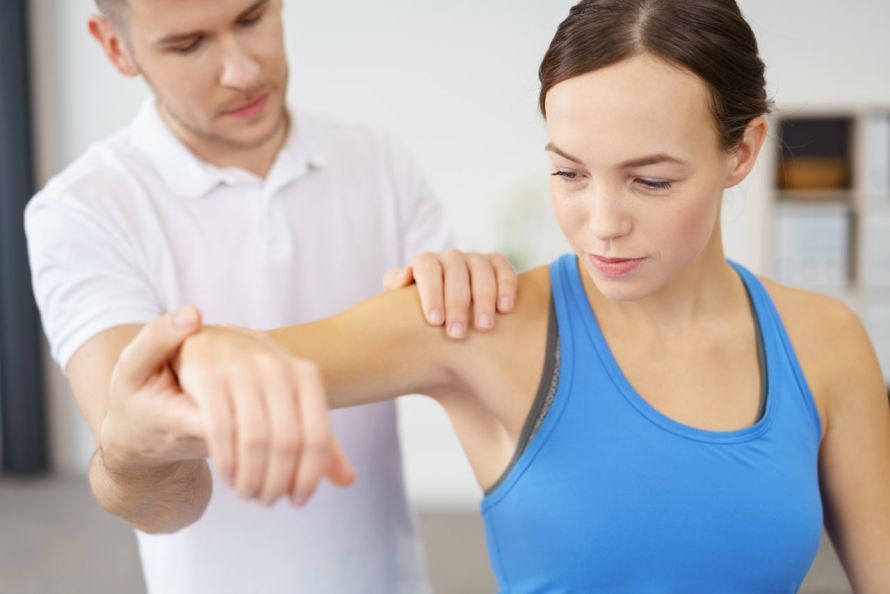
Shoulder rehabilitation often involves more than just exercises. Massages of the surrounding tissues, as well as heat or cold therapy, can also help minimize symptoms or even make certain movements possible.
In the case of a total shoulder replacement (TSR), the focus—just as after any other shoulder surgery—is initially on healing. The intensity of the therapy should therefore not be too high.
Nevertheless, gentle movement through stretching can help advance the recovery process. This promotes blood circulation and provides appropriate stimulation. However, weight training or static exercises using body weight are not recommended during this time.
Due to the ongoing instability, caution is required. In orthopedic rehabilitation, therefore, only small movements and minimal loads are performed initially. As a result, progress and improvement occur only slowly.
Many patients have already had to live with limited mobility for an extended period. The slow recovery in small steps can therefore be frustrating for patients. Nevertheless, they must muster sufficient patience and self-discipline. Overloading the shoulder can lead to complications.
Physical Therapy or a Rehabilitation Clinic?
The choice depends on the specific limitation. For milder symptoms, outpatient appointments at a physical therapy practice are sufficient.
A rehabilitation clinic offers a wider range of options and equipment, allowing for a broader variety of exercises. Here, too, treatments and training can be conducted on an outpatient basis.
Patients with significant limitations can alternatively apply for a therapeutic stay or a rehabilitation program. This allows for multiple treatments per day.
During shoulder rehabilitation at a clinic, specialists are also on site. This ensures that the patient receives the best care at all times. As a result, the therapy is more efficient, and specialists can quickly address any problems that arise.
Duration of Shoulder Rehabilitation
Just as with the structure of the rehabilitation program, the duration is tailored to the individual case. In cases of severe symptoms and weak muscles, treatments and exercises are continued over several months.
Supervised shoulder rehabilitation serves only as a starting point. Repeat sessions and extensions are possible.
If the symptoms are milder, the duration is shorter. It is still advisable, however, to continue the strengthening, loosening, and stretching exercises. You should also have your shoulder position checked regularly to ensure it is optimal.
Adjustments to the exercise regimen are necessary throughout the course of therapy to achieve further progress. It is also important to avoid overcorrections and overexertion. This is why professional supervision of the rehabilitation process is of great importance. This allows specialists to monitor your progress.
This increases the risk of further damage and setbacks in the healing process.
What should patients keep in mind?
The most important prerequisites for successful shoulder rehabilitation are:
- comprehensive and regular assessments of the cause and progression
- Combining treatment with appropriate measures and methods
- Continuing the exercises between training sessions and after rehabilitation ends
Regular exercise is crucial. Be sure to follow the instructions of physical therapists, occupational therapists, and orthopedic specialists.

Sources
- Kibler WB, McMullen J, Uhl T. Shoulder rehabilitation strategies, guidelines, and practice. Orthop Clin North Am. 2001 Jul;32(3):527-38. doi: 10.1016/s0030-5898(05)70222-4. PMID: 11888148.
https://pubmed.ncbi.nlm.nih.gov/11888148/ - Steuri, Ruedi et al. “Effectiveness of conservative interventions including exercise, manual therapy and medical management in adults with shoulder impingement: a systematic review and meta-analysis of RCTs.” British journal of sports medicine vol. 51,18 (2017): 1340-1347. doi:10.1136/bjsports-2016-096515
https://www.ncbi.nlm.nih.gov/pmc/articles/PMC5574390/ - https://www.endoprosthetics-guide.com/schulter/schulterprothese/
- https://www.schoen-klinik.de/berchtesgadener-land/reha-schulter/kalkschulter
- Longo UG, Risi Ambrogioni L, Berton A, Candela V, Carnevale A, Schena E, Gugliemelli E, Denaro V. Physical therapy and precision rehabilitation in shoulder rotator cuff disease. Int Orthop. 2020 May;44(5):893-903. doi: 10.1007/s00264-020-04511-2. Epub 2020 Mar 10. PMID: 32157371.
- https://pubmed.ncbi.nlm.nih.gov/32157371/