If urine cannot be drained through the body’s natural bladder, an artificial solution must be found. A distinction is made between a continent and an incontinent form of urinary diversion. In continent urinary diversion, urine is stored inside the body in an artificial replacement bladder (Mainz pouch). It is then drained through the urethra or an artificial bladder outlet. In incontinent urinary diversion, on the other hand, urine is routed through a section of intestine (conduit) through the abdominal wall to the body’s surface. Outside the body, it is collected in a plastic pouch.
Here you will find further information as well as a selection of urinary diversion specialists and centers.
When is a urinary diversion necessary?
A urinary diversion may be necessary due to
- a malignant tumor in the bladder (bladder cancer),
- a congenital absence of the bladder, or
- a severe impairment of bladder or sphincter function
. If removal or deactivation of the bladder is planned, a urinary diversion must be performed.
What types of urinary diversion are there?
Continent Urinary Diversion
In the “continent” form of urinary diversion, urine is stored inside the body.
A reservoir (also called a pouch) is surgically created from a section of the intestine to serve as a “replacement bladder.” It is modeled after the natural bladder. The pouch can hold approximately 500 ml of urine. It must be emptied at regular intervals.
There are two ways to empty it:
- through the urethra, i.e., the natural route (orthotopic bladder replacement), or
- through a continent stoma located near the navel (continent cutaneous urinary diversion).
There are two variants of continent urinary diversion:
- Mainz Pouch I: orthotopic bladder replacement and continent cutaneous urinary diversion
- Mainz Pouch II: continent anal urinary diversion
In the Mainz-Pouch II method, surgeons reroute the ureters into the rectum. Urine can then be excreted along with stool.
Incontinence Urinary Diversion
In the “incontinent” form of urinary diversion, urine is collected outside the body.
Through a short section of intestine (conduit), urine is routed through the abdominal wall to the body’s surface. There, it is collected in a plastic pouch attached to the skin. The skin opening of the conduit is called a stoma.
What does the preparation for urinary diversion surgery involve?
Before urinary diversion surgery, several tests are necessary, such as
The latter is particularly necessary for the continent forms of urinary diversion. A contrast-enhanced imaging study of the bowel is also important.
In cases of combined urinary and fecal diversion, the surgeon requires a urodynamic evaluation
- of the rectum (rectodynamics) and
- the anal sphincter (anal pressure profile).
The bowel is bypassed from its natural course but remains filled with stool. This stool represents a potential source of infection. Therefore, the bowel must be cleansed prior to the urinary diversion surgery. To do this, the patient must drink approximately 2 to 4 liters of a cleansing solution within a short period of time the day before the procedure.
Before creating an incontinent stoma, the surgeon identifies suitable sites on the patient’s abdomen. He marks these directly on the skin.
As a precaution, the surgeon also does this for patients who are scheduled to receive a continent intestinal reservoir. During the surgery, the team must be prepared for the possibility that the planned procedure may not be feasible. In that case, they must switch to creating an incontinent stoma during the surgery. The markings were placed in advance for this purpose.
Immediately before the procedure, the anesthesiologist inserts a catheter into a central blood vessel via a neck vein. This allows for the administration of fluids and nutrients during the days following surgery.
Incontinence Urinary Diversion: The Ileal Conduit and the Colonic Conduit
First, a longitudinal abdominal incision is made along the midline (known as a median laparotomy).
The surgeons then remove
- the bladder,
- the surrounding lymph nodes, as well as
- in men, the prostate and seminal vesicles, and, if necessary, the urethra.
They then bypass a segment of the small intestine (ileum) or large intestine (colon) approximately 15 cm long. The continuity of the intestine is restored.
One end of the bypassed intestinal segment (known as a conduit) is surgically connected to both ureters. The other end is routed to the outside at the marked site.
The ureters are stented for 10 to 12 days, each with a splint (thin plastic catheter). In addition, a catheter is inserted into the conduit.
Continent Urinary Diversion: The Mainz Pouch I and II
Continent urinary diversion with Mainz Pouch I (reservoir)
This urinary diversion procedure is also performed via a median laparotomy. However, a longer segment of the small and large intestines is now isolated: approximately 20 to 24 cm of small intestine and 10 to 12 cm of large intestine.
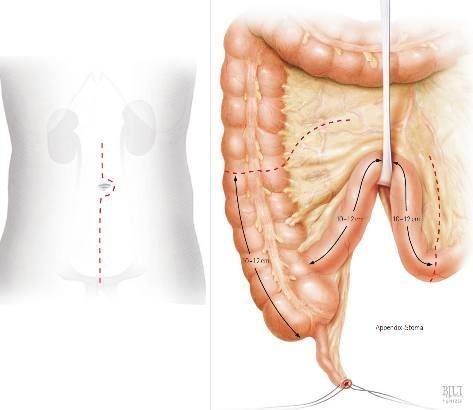
Median laparotomy (left) and intestinal segment used (right) (From: Surgery Illustrated – Surgical Atlas: Mainz pouch continent cutaneous diversion; J. W. Thüroff, H. Riedmiller, M. Fisch, R. Stein, C. Hampel, R. Hohenfellner, BJU 2010)
The remaining intestine is reconnected, just as in the conduit procedure.
The separated tubular segment of intestine is then split lengthwise. The surgeons then suture it to form a “plate.” They fold the edges of this intestinal plate and suture them to create a spherical reservoir (pouch). Finally, both ureters are reimplanted into the pouch.
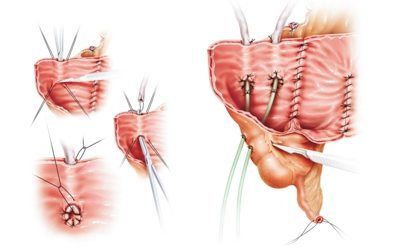
Implantation of the ureters into the pouch (From: Surgery Illustrated – Surgical Atlas: Mainz pouch continent cutaneous diversion; J. W. Thüroff, H. Riedmiller, M. Fisch, R. Stein, C. Hampel, R. Hohenfellner, BJU 2010)
Continent urinary diversion using a Mainz Pouch I with an umbilical stoma (continent cutaneous diversion)
The intestinal reservoir can be connected to the abdominal skin as a continent stoma. The umbilicus is the preferred site for this. To achieve this, the surgeon uses an additional segment of intestine as a catheterizable continence mechanism.
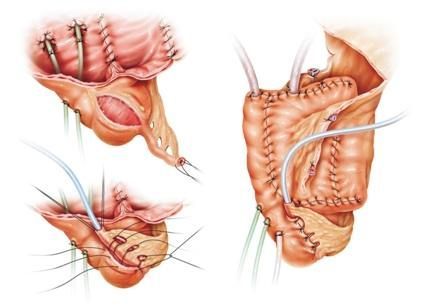
Use of the Appendix as a Stoma (From: Surgery Illustrated – Surgical Atlas: Mainz Pouch Continent Cutaneous Diversion; J. W. Thüroff, H. Riedmiller, M. Fisch, R. Stein, C. Hampel, R. Hohenfellner, BJU 2010)
If the appendix is still present and usable, it is the preferred choice for this purpose. Alternatively, the surgeon may also use another segment of small intestine approximately 8 cm long.
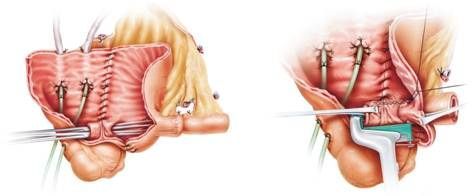
Use of a segment of the small intestine as a stoma (From: Surgery Illustrated – Surgical Atlas: Mainz pouch continent cutaneous diversion; J. W. Thüroff, H. Riedmiller, M. Fisch, R. Stein, C. Hampel, R. Hohenfellner, BJU 2010)
This segment of the intestine is inserted into the pouch and the skin in such a way that spontaneous leakage of urine (incontinence) is not possible. To empty the pouch, a catheter must then be inserted through the continent stoma (the navel).
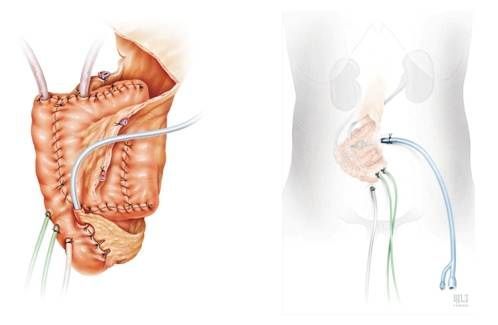
Insertion of a catheter through the continent stoma (From: Surgery Illustrated – Surgical Atlas: Mainz pouch continent cutaneous diversion; J. W. Thüroff, H. Riedmiller, M. Fisch, R. Stein, C. Hampel, R. Hohenfellner, BJU 2010)
In this urinary diversion procedure as well, drains, splints, and a gastrostomy or jejunostomy are created.
Continent urinary diversion with orthotopic Mainz pouch I (replacement bladder connected to the urethra)
If the intestinal reservoir is to be connected to the urethra (artificial bladder), the pouch is now sutured directly to the remaining urethra.
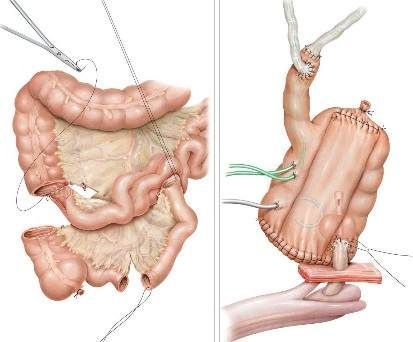
Excluded intestinal segment (left) and completed pouch (right) (From: Surgery Illustrated – Surgical Atlas: Simplified orthotopic ileocaecal pouch (Mainz pouch) for bladder substitution; J. W. Thüroff, L. Franzaring, R. Gillitzer, M. Wöhr, S. Melchior, BJU 2005)
The pelvic floor muscles and the urethral sphincter muscles subsequently prevent spontaneous emptying of the pouch. This means you will regain continence. The replacement bladder is emptied naturally through the urethra by contracting the abdominal muscles.
In this urinary diversion procedure as well, drains and splints are inserted as described above.
Continent Urinary Diversion with Mainz Pouch II (Connection of the Ureters to the Rectum)
In this urinary diversion procedure, the ureters are connected to the rectum. Feces and urine are then excreted together through the rectum.
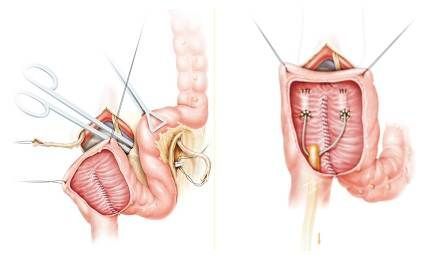
Anastomosis of the ureters to the rectum (From: Surgery Illustrated – Surgical Atlas: Sigma-rectum pouch (Mainz pouch II); M. Fisch, R. Hohenfellner, BJU 2007)
The anal sphincter then ensures continence. This approach is recommended only if sphincter function is good and no impairment is expected. Your doctor can test this before the surgery.
Postoperative Care Following Urinary Diversion Surgery
Following surgery for urinary diversion, a 1- to 3-day stay in the intensive care unit may be required. Afterward, the patient is transferred to the urology recovery unit. Here, the patient’s condition can be monitored more closely than on the general ward.
The first few days after urinary diversion surgery are dedicated to recovery. Gradually, over the course of about 10 days, all drains and splints are removed. During this time, follow-up examinations are conducted, such as
- blood tests and
- a repeat X-ray of the urinary diversion tract.
Follow-up Care for Urinary Diversion with an Ileal Conduit and a Colonic Conduit
After urinary diversion surgery involving collection bags, the patient is taught how to use the urine collection bags. He learns to attach and empty them on his own.
There are no special dietary restrictions for the patient going forward. They should simply ensure adequate fluid intake, which is generally at least 2 liters per day.
Follow-up appointments should initially be scheduled at three and six months. The procedure may lead to dilation of the renal pelvis. The examination should therefore include an ultrasound of the kidneys. However, follow-up care is otherwise primarily determined by the underlying condition.
There are no special restrictions regarding work or leisure activities for the rest of the patient’s life. All usual activities can be resumed. However, excessive strain on the abdominal muscles should be avoided during the first three months. This includes
- lifting heavy objects,
- rowing, and similar activities.
Follow-up Care for Mainz-Pouch I with an Umbilical Stoma
Initially, for about three weeks after discharge,
- a permanent catheter through the umbilical stoma and
- an abdominal wall catheter
in the pouch. These are used to support the healing process. During this time, urine is drained into a bag that the patient can wear on their thigh under their clothing.
In the early stages, the intestine still produces a lot of mucus, which can clog the catheter. Therefore, it is necessary to flush the pouch at regular intervals during this time. Stoma therapists will instruct the patient on this and be available to answer any questions. After this period, an inpatient follow-up examination of the pouch will be performed.
In addition, the patient learns how to insert a catheter through the stoma into the pouch to empty it. Initially, catheterization must be performed every 3 to 4 hours, including at night. Flushing must also be done at regular intervals. Later on, flushing is no longer necessary, and the intervals between catheterizations can be extended.
There are few special considerations regarding diet. Patients should ensure adequate fluid intake, typically 2 to 3 liters per day.
Because parts of the intestine are bypassed, stools are initially softer than usual. This may require dietary adjustments, such as
- eating more bananas or
- taking medication (e.g., Quantalan).
Necessary Follow-Up Examinations
Regular follow-up examinations should be scheduled to detect complications early. In the first year, these are required every three months; thereafter, every six months is sufficient.
This follow-up care includes regular blood tests. This allows metabolic problems affecting the acid-base balance to be detected and treated in a timely manner. For this purpose, a blood gas analysis is performed. Acidosis (base excess below –2.5 mmol/l) is corrected with medication. Options include, for example,
- Acetolyt®
- Uralyt®
- Nephrotrans®
These tests are required for the majority of patients during the first postoperative year. An ultrasound examination of the kidneys is also necessary. This helps detect any possible dilation of the renal pelvis.
In rare cases, it may be necessary to reimplant the ureters into the pouch. In addition, stones may form in the pouch, which must be removed under anesthesia. Sometimes the stoma narrows at the skin site. In such cases, dilation is required. This is performed under anesthesia via a small incision. Follow-up care naturally depends on the underlying condition as well.
There are few restrictions regarding work and leisure activities for the rest of your life. As with other urinary diversions, you can resume almost all activities. However, as with the ileal conduit, avoid excessive strain on the abdominal muscles during the first three months.
The removal of intestinal segments can lead to a vitamin B12 deficiency over the long term. Blood tests are therefore necessary starting in the fifth year after surgery. This allows for the detection of a vitamin deficiency, which can then be corrected with injections.
Follow-up Care for the Orthotopic Mainz Pouch I
For 2 to 3 weeks,
- a permanent catheter in the urethra and
- an abdominal wall catheter
is left in place to drain the pouch. As with the continent pouch with a skin stoma, urine is collected in a bag during this time.
The initial course of care is the same as for the continent pouch with a skin stoma: the patient must flush the pouch at regular intervals. Afterward, the pouch is examined during a hospital stay, and the catheter is removed.
After urination, the remaining urine in the pouch can be drained and measured via the abdominal wall catheter. When residual urine volumes reach 50 to 70 ml, the abdominal wall catheter is also removed.
Initially, it is best for the patient to urinate while sitting. They may need to bear down to completely empty the bladder. Occasionally, patients may leak a small amount of urine at night or need to empty the pouch using a catheter inserted through the urethra.
Initially, the pouch must be emptied every 3 to 4 hours, including at night. Later, the intervals between bladder emptying can be extended.
In terms of diet, follow-up care, work, and leisure activities, the course of recovery is the same as for the continent Mainz Pouch I with a skin stoma (see above).
Follow-up Care for the Mainz Pouch II (Connected to the Rectum)
Immediately after discharge, the patient will feel the urge to have a bowel movement as the pouch empties into the rectum at certain intervals. At that point, the patient should empty the pouch just as they would during a normal bowel movement.
Follow-up care includes blood gas analyses (see the section “Follow-up care for Mainz Pouch I with an umbilical stoma”) are required to detect and treat acidosis, as well as ultrasound examinations of the kidneys to rule out dilation of the renal pelvis and calyces.
With this type of urinary diversion, there is a risk of pyelonephritis accompanied by fever. Pyelonephritis must be treated on an inpatient basis.
After the fifth postoperative year, regular endoscopic examinations of the rectum and the pouch are required. This allows for the timely detection of changes or tumors. The subsequent course of treatment is essentially the same as described above.