Chorionic villus sampling is a prenatal diagnostic procedure in which tissue from the placenta is examined. The test is designed to detect genetic abnormalities or disorders in the fetus. Experienced specialists advise and support expectant mothers and fathers before and during this prenatal test.
Below you will find further information as well as a selection of specialists for chorionic villus sampling.
What is a chorionic villus sampling?
Like amniocentesis, chorionic villus sampling is a form of prenatal diagnosis. This term refers to procedures used to detect diseases while the fetus is still in the womb. Chorionic villus sampling is also known as chorionic biopsy, chorionic centesis, placental puncture, or placenta puncture.
It is considered an invasive diagnostic procedure. This means that it goes beyond simply assessing risk, as is the case with first-trimester screening. During a chorionic villus sampling, tissue cells are collected and examined.
Thus, chorionic villus sampling allows for the definitive exclusion or diagnosis of a genetic disorder, such as Down syndrome.
The tissue cells are taken from the placenta. This tissue is of embryonic origin, even though it is not part of the embryo itself. Therefore, the genetic information in the placental cells is (largely) identical to that of the fetus.
When is a chorionic villus sampling performed?
A chorionic villus sampling can be performed starting in the 12th week of pregnancy. It can therefore be performed much earlier than amniocentesis or umbilical cord puncture.
A chorionic villus sampling is not part of routine prenatal care but is performed only at the express request of the parents.
As a rule, it requires a prior examination, such as
- first-trimester screening or
- a cell-free DNA analysis
with an abnormal result. The test may also be advisable if there is a family history of certain diseases.
Before the procedure, the doctor must inform the parents about
- the possible side effects of the procedure as well as
- the consequences of a diagnosis of a genetic disorder
in detail and in an easily understandable manner. For the disorders that can be detected via chorionic villus sampling, there is generally no causal treatment available yet. Prospective parents should therefore be aware that they may have to make a decision regarding whether to continue the pregnancy.
Nevertheless, the diagnostic test can also be beneficial beyond the decision to continue or terminate the pregnancy. It gives parents who decide to have the child time to prepare and gather information.
In some cases, knowing about the child’s disability or medical condition enables parents and doctors to create better conditions for the child’s optimal development—without delay—both prenatally and during and after delivery. This is the case, for example, with hemophilia or rare metabolic disorders.
How is a chorionic villus sampling performed?
Before the procedure, a thorough ultrasound examination is performed first. It is used to assess the fetal organs and the position of the placenta. The biopsy can generally be performed through
- the vagina (transcervical) or
- through the abdominal wall (transabdominal)
.
Today, the biopsy is predominantly performed transabdominally. Under ultrasound guidance, a thin biopsy needle is inserted through the abdominal wall and past the amniotic sac into the placenta. A small amount of tissue is then aspirated into the needle.
The procedure takes only about 20 seconds and is virtually painless.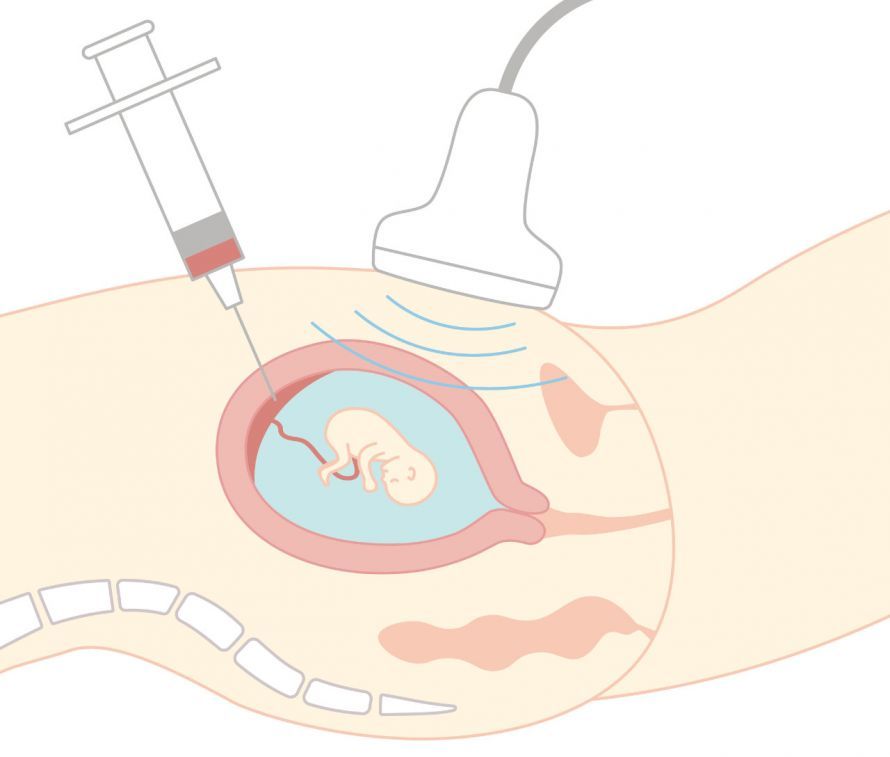
In a chorionic villus sampling, cells are extracted from the placenta under ultrasound guidance © Sora_Kobayashi | AdobeStock
The collected tissue is cultured (multiplied) in the laboratory and examined. Typically, a light microscopic examination of the cells is performed after 24 hours. This allows the number and shape of the chromosomes to be assessed. In this way, abnormalities in chromosome number can be detected:
- Trisomies—certain chromosomes are present in triplicate instead of in duplicate (trisomy 21: Down syndrome, trisomy 18: Edwards syndrome, trisomy 13: Patau syndrome
- Turner syndrome: only one sex chromosome
After a few days, the cell culture can be used for molecular biological DNA analysis.
Important to know: The test only screens for specific genetic abnormalities for which there are reasonable grounds for suspicion. These primarily include fetal malformations and a family history of such conditions. The test does not screen for the entire spectrum of possible genetic disorders. The fetus may therefore have other conditions that cannot be detected during the chorionic villus sampling.
How reliable are the results of chorionic villus sampling?
The results of chorionic villus sampling are generally very reliable. This is particularly true for common chromosomal abnormalities such as Down syndrome.
In very rare cases, the placenta may contain cells with different genetic makeup (the technical term for this is placental mosaicism). In such cases, an additional amniocentesis should be performed for further evaluation.
What are the risks of chorionic villus sampling?
A slightly increased risk of miscarriage is the greatest risk associated with any invasive diagnostic procedure. This risk has decreased significantly in recent years. Current analyses of large datasets show that the additional risk of miscarriage is approximately 0.2 percent. Of course, the examiner’s experience is of great importance here.
For Rh-negative mothers, there is a risk of Rh incompatibility (if the baby is Rh-positive). In such a case, the mother produces antibodies against the fetus as soon as the baby’s blood enters her bloodstream. This can occur when the biopsy needle is withdrawn.
Rh prophylaxis (a type of vaccination) administered immediately after the chorionic villus sampling prevents this immune reaction.