The H2 breath test is a simple and painless diagnostic procedure. It involves analyzing the patient’s exhaled breath. The H2 breath test is the most widely used test for diagnosing lactose intolerance. However, food intolerances such as fructose intolerance, as well as bacterial overgrowth in the small intestine, can also be diagnosed using an H2 breath test.
Here you will find further information as well as a list of selected doctors who perform the H2 breath test.
Definition: What is an H2 breath test?
The H2 breath test—also known as the hydrogen breath test—is a painless and minimally invasive diagnostic procedure. It is used to identify and evaluate various gastrointestinal disorders. The H2 breath test is particularly effective in detecting food intolerances such as
- lactose intolerance (milk sugar intolerance) or
- fructose intolerance (fruit sugar intolerance)
.
Before the test, the patient consumes a special test solution. It contains either lactose or fructose, and in some cases also the sugars
- glucose,
- lactulose, or
- sucrose.
If the test solution is not properly digested and metabolized in the intestine, the intestinal bacteria produce hydrogen (H2). The hydrogen then enters the bloodstream and is eventually exhaled through the lungs.
In an H2 breath test, the doctor measures the hydrogen concentration in the patient’s exhaled breath before and after the solution is administered.
When is an H2 breath test used?
The H2 breath test is used to diagnose and evaluate syndromes and diseases of the gastrointestinal tract.
The H2 breath test can be used to detect, among other things,
- food intolerances, such as the relatively common lactose intolerance or fructose intolerance, as well as
- bacterial overgrowth in the small intestine
. Symptoms that can be evaluated using an H2 breath test include, among others:
- chronic diarrhea
- chronic or recurrent abdominal pain
- non-specific abdominal symptoms such as bloating or nausea
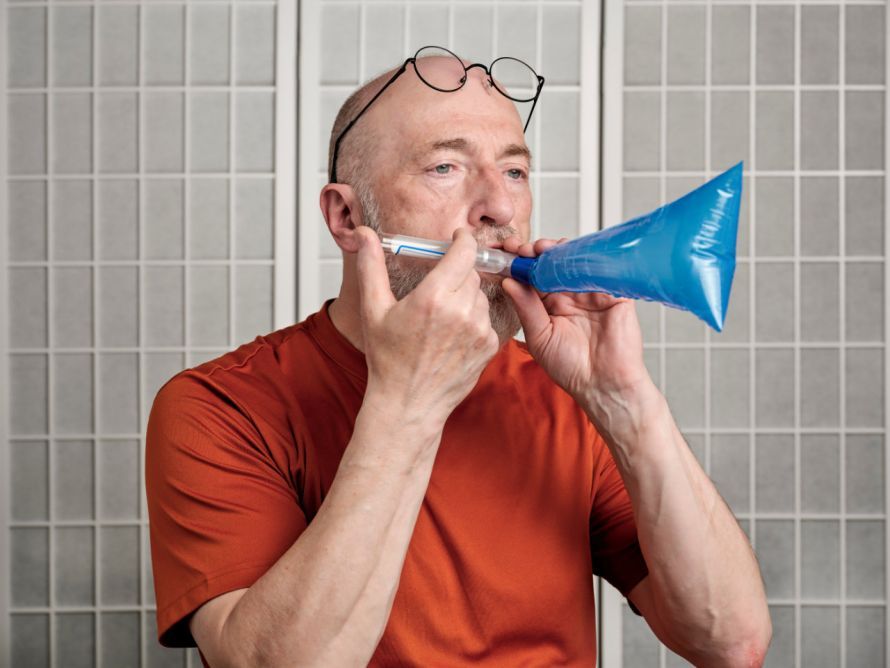
An H2 breath test analyzes the hydrogen concentration in exhaled air © MarekPhotoDesign.com | AdobeStock
What should be considered before performing an H2 breath test?
To undergo an H2 breath test, the patient must have an empty stomach. This means they should not eat anything heavy for about 24 hours before the test, and should
- at all,
- consume no alcoholic beverages, and
- drink only tap water or non-carbonated water.
In addition, the patient must not smoke in the 12 hours before the H2 breath test and should brush their teeth with water only.
In the 4 weeks prior to the H2 breath test, the patient should also not have taken any antibiotics or undergone a colonoscopy.
How is an H2 breath test performed?
For the H2 breath test, the patient drinks a special test solution on an empty stomach. Depending on what is being tested, it contains either
- lactose (approx. 50 grams),
- fructose (approx. 25 grams),
- glucose (approx. 80 grams), or
- other sugars.
The patient must then breathe into a special measuring device at set intervals—roughly every 10 to 15 minutes. The device measures the hydrogen concentration in the patient’s breath. In addition, blood sugar levels may be measured at specific intervals during the H2 breath test.
In addition, throughout the entire H2 breath test, the staff monitors the patient for symptoms such as
- bloating,
- abdominal cramps,
- abdominal pain, or
- diarrhea
. The H2 breath test takes about 2 to 4 hours in total.
What values are measured during an H2 breath test, and how are they interpreted?
An H2 breath test measures the hydrogen concentration in exhaled air. The unit used is parts per million (ppm).
Before drinking the test solution, the value should be measured once and should be below 20 ppm. If the value rises above 20 ppm after drinking the test solution, the result is considered significant. This can be used, for example, to diagnose lactose intolerance.