A stroke (apoplexy) is an acute disturbance of blood flow to the brain and the third leading cause of death in Germany. It is a medical emergency and must be treated as quickly as possible. Many strokes can be prevented through a healthy lifestyle as well as early-detection screenings. These screenings are painless and carry minimal risk.
Below you will find further information as well as a list of selected specialists in stroke screening.
Early detection of stroke minimizes the risk
A stroke usually occurs as a result of a blood clot that has traveled to the brain and blocked an artery there. Another cause can be burst blood vessels, which lead to cerebral hemorrhages and result in a stroke.
A stroke is accompanied by neurological deficits that can vary in severity, such as tremors or numbness. Some are temporary, while others are permanent.
A stroke significantly changes a person’s life: A large proportion of disabilities in patients over the age of 50 are attributable to a stroke.
Preventing Stroke Through Early Detection
Simple but consistently implemented preventive measures could prevent a good 50% of all strokes. To detect a stroke early, it is important to recognize the first signs.
High-risk groups in particular should take advantage of early stroke risk screening. Most public health insurance plans cover this preventive service.
Early detection of changes in the blood vessels that supply the brain is of great importance. Medical professionals also place special emphasis on eliminating risk factors. These can be identified during a medical stroke consultation (preventive checkup).
Major Risk Factors for a Stroke
The more risk factors you have, the more important a stroke check-up is. The most important risk factors for a stroke include
- smoking,
- high blood pressure,
- diabetes mellitus,
- obesity,
- atherosclerosis,
- lipid metabolism disorders,
- advanced age (50 years and older), and
- a family history of strokes.
In many cases, the risk of stroke is increased by a gradual narrowing of the blood vessels. Cerebral ischemia refers to reduced blood flow to the brain, leading to the death of nerve cells. These minor circulatory disturbances in the brain often go unnoticed.
Even the progressive narrowing of the blood vessels (atherosclerosis) is difficult for the affected person to detect on their own. If the initial warning signs go unnoticed, the narrowing of the blood vessels continues to progress. Early detection is therefore part of active prevention and can save lives.
What tests are part of stroke prevention?
Stroke prevention involves a comprehensive examination of the patient’s arteries that supply the brain. This is done using ultrasound (Doppler sonography), which the treating physician uses to check for narrowing of the blood vessels. Doppler sonography is a vascular analysis and a core service provided by neurologists.
This examination method is classified as an IGel service, meaning it is an elective procedure. This means that statutory health insurance plans do not cover the costs if it is performed as a preventive screening. However, if it is used for diagnosis in cases of suspected stroke, the costs are covered.
It is already possible to prevent strokes by taking blood-thinning medications. Another option is surgical vascular dilation, which significantly reduces the risk of stroke.
If necessary, an electroencephalogram (EEG) can provide indications of possible disturbances in brain function in specific regions.
For further diagnosis, doctors also have access to magnetic resonance imaging (MRI). It produces thin cross-sectional images of the brain, is completely painless, and does not use X-rays. The scan reveals even the smallest changes in brain structures.
Not a “Full-Blown” Stroke: The Transient Ischemic Attack (TIA)
Medical professionals have shown that in one-third of all patients, a stroke is preceded by a transient ischemic attack (TIA). A transient ischemic attack is a temporary disruption of blood flow to the brain.
It, too, is a medical emergency. The affected person should also go to a hospital quickly—or, even better, to a specialized clinic.
The attack is caused by a small blood clot that enters the brain via the bloodstream and restricts blood flow.
The attack lasts about half an hour and presents the same symptoms as a “full-blown” stroke:
- double vision,
- sudden loss of vision in one eye,
- unsteadiness when walking,
- paralysis or numbness on one side of the body,
- paralysis or numbness in the limbs,
- speech difficulties,
- ringing in the ears,
- dizziness or fainting.
Normally, the symptoms disappear within a day at the latest, which is why the condition is often misdiagnosed. If a TIA goes untreated, it will recur.
As a warning sign of an impending stroke, it must be taken seriously: The risk of stroke is very high in the four weeks following a TIA. Patients with these symptoms should see their doctor immediately. The doctor will then refer them to a specialist (neurologist) for further evaluation.
Common Cause: Arteriosclerosis of the Carotid Artery
A stroke is often caused by a narrowing of the carotid artery due to plaque buildup (carotid stenosis). This form of atherosclerosis occurs primarily in older adults, after it has developed over many years. It is a major risk factor for stroke.
The major risk factors for atherosclerosis are
- smoking,
- elevated blood lipids, and
- high blood pressure.
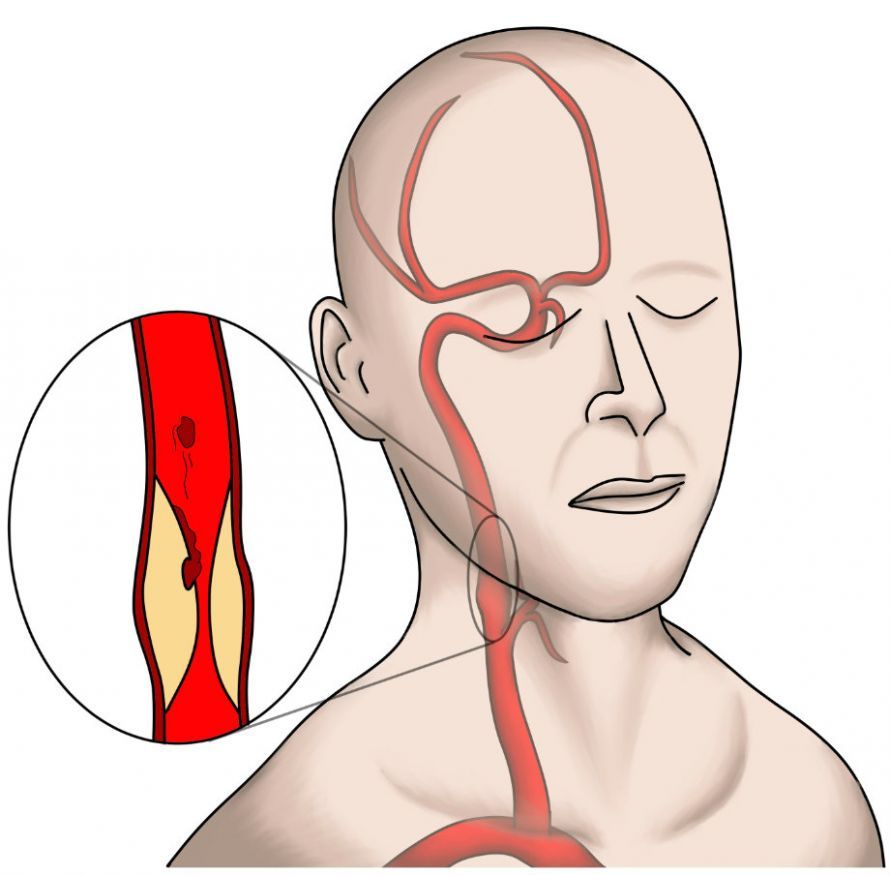
Carotid stenosis is a common cause of stroke © songkram | AdobeStock
The diagnosis is made using
- duplex ultrasound,
- magnetic resonance imaging, or
- CT angiography.
If symptoms are present, the carotid artery examination is covered by health insurance. As part of a stroke screening, the carotid artery examination is an IGeL service for which the patient must pay between 50 and 100 €.
If the carotid stenosis is very severe, surgery is recommended. Neurologists widen the affected vessel or insert a vascular support, known as a stent.
To prevent atherosclerosis from progressing, the risk factors must be treated. Patients should be encouraged to increase their physical activity, lose excess weight, and eat a healthy diet. Smoking must also be stopped.
If the patient has metabolic disorders, these must be treated. Medications are usually prescribed to treat high blood pressure. If the patient follows the doctor’s recommendations, the prognosis is very good.
Treatment of Stroke Patients
Ideally, stroke patients are treated in a stroke unit—a hospital ward specializing in stroke care.
The treatment focuses primarily on neurological symptoms. However, doctors now agree that general medical care is equally important as the foundation of stroke treatment for a good prognosis. This includes
- regular blood pressure checks,
- regular ECGs, and
- the treatment of cardiac arrhythmias with medication.
Close collaboration with the treating internist is therefore desirable.