Infertility is a complex issue that affects many couples who deeply desire to have children but encounter unexpected obstacles along the way. But what exactly does the term mean, how does it differ from sterility, and how can this challenge be addressed both medically and emotionally?
In this comprehensive article, you’ll find a detailed overview of the causes of infertility, the different symptoms in women and men, and the latest treatment options. We’ll also show you how specialized doctors listed in the Leading Medicine Guide can help you on your journey to having the child you’ve always wanted.
Definition: What is the difference between infertility and sterility?
In everyday language, infertility and sterility are often used interchangeably, but medically there are subtle differences, particularly in German-speaking countries compared to English-language medical literature (infertility).
According to the WHO’s definition, infertility refers to a situation in which a couple does not conceive within one year despite regular, unprotected sexual intercourse.
- Sterility: Usually refers to the absolute inability to father a child (in men) or to conceive a child (in women). Fertilization does not occur.
- Infertility: In the narrower medical sense, this often means that a woman can become pregnant but is unable to carry the pregnancy to term (e.g., due to repeated miscarriages).
In practice and in this article, we use these terms—as does the WHO—broadly to refer to involuntary childlessness. It is important to understand that this does not have to be an unchangeable fate. Often, treatable conditions are the underlying cause.
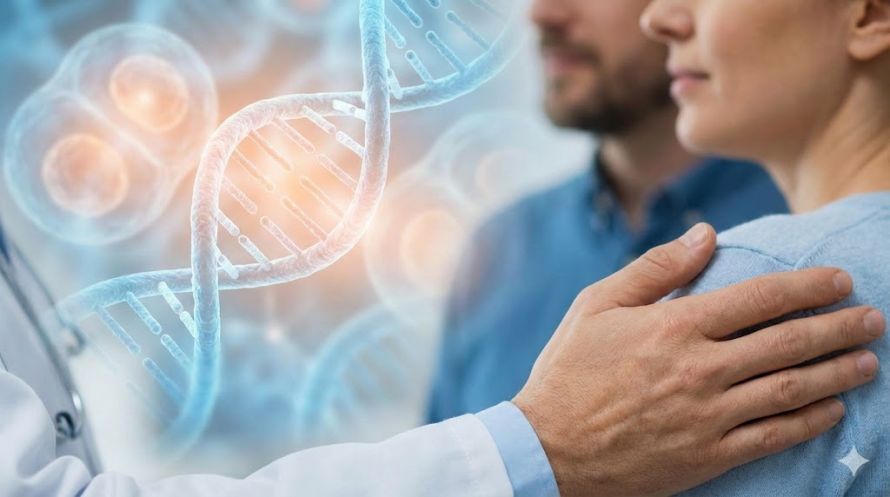
Hope for Those Unable to Conceive: Empathetic support and modern reproductive medicine open up new possibilities.
Female Infertility: Causes and Risk Factors
Female infertility can have a variety of causes. These range from hormonal imbalances to organic barriers.
Hormonal Disorders and PCOS
One of the most common causes is a hormonal imbalance. For pregnancy to occur, the menstrual cycle must proceed regularly and ovulation must take place. PCOS (polycystic ovary syndrome) is a widespread condition in this context. It is often accompanied by hyperandrogenism (an excess of male hormones), which prevents follicles from fully maturing and results in the absence of ovulation. Women often notice this through very irregular or absent menstrual periods. Specialists in gynecology and endocrinology are the appropriate professionals to consult for the diagnosis and treatment of such hormonal causes.
Organic causes: Endometriosis and fallopian tube abnormalities
In addition to hormones, the organs play a central role.
- Endometriosis: In this painful condition, uterine lining tissue grows outside the uterus. These lesions can lead to adhesions and impair the function of the fallopian tubes or ovaries. You can find more information from our experts on endometriosis.
- Blocked fallopian tubes: Following inflammation (e.g., due to a chlamydia infection), the fallopian tubes can become blocked. The egg can then no longer travel to the uterus, and the sperm cannot reach it.
- Uterine problems: Polyps in the uterus or fibroids can prevent the embryo from implanting. Uterine malformations can also be a cause.
The Woman’s Age
A woman’s fertility declines slowly starting at age 30 and drops significantly and rapidly starting at age 35. The quality of the oocytes (eggs) declines, which increases the risk of genetic defects and miscarriages. This is a natural process that must always be taken into account in fertility treatment (“Human Reproduction”).
Causes of Male Infertility
For a long time, fertility treatment focused primarily on the woman. Today we know that in about 30 to 40 percent of cases, the causes lie solely with the man, and in another 20 percent, both partners are affected. Male infertility is often diagnosed late because it usually causes no pain.
Sperm Quality and Azoospermia
The primary diagnostic tool is the semen analysis. This test determines whether there are enough sperm, whether they are sufficiently motile, and whether they have a normal shape.
- OAT syndrome: Too few, immobile, or abnormally shaped sperm.
- Azoospermia: No sperm can be detected in the semen. This may be due to a blockage of the vas deferens or to impaired sperm production in the testicles.
A visit to a specialist in urology or andrology will provide clarity.
Genetic Causes and Lifestyle
A genetic cause may also be present (e.g., Klinefelter syndrome). Undescended testicles in childhood that were not surgically corrected in a timely manner can also cause permanent damage to the testicular tissue. In addition, lifestyle factors influence fertility: smoking, obesity, drug use, and anabolic steroids severely impair sperm quality. Excessive heat (heated seats, hot baths) can also have a negative impact on the testicles.
Diagnosis: Identifying the Causes
If a couple is unable to conceive, they should undergo joint medical evaluation. The diagnostic process includes:
-
Medical history: Questions about previous medical conditions, infections, lifestyle, and frequency of sexual intercourse.
-
Cycle monitoring: Ultrasound and blood tests are used to check whether the woman’s follicles are maturing and ovulation is occurring.
-
Semen analysis: An assessment of male fertility.
-
Fallopian tube patency test: Often performed using contrast-enhanced ultrasound or laparoscopy to rule out endometriosis or adhesions.
-
Genetics: When chromosomal abnormalities or recurrent miscarriages are suspected.
Reproductive medicine specialists coordinate these steps to identify the specific cause of infertility.
Treatment Options: Pathways to Having a Child
Depending on the diagnosis, highly effective therapies are available today. Sometimes, lifestyle adjustments or mild hormonal stimulation (“cycle management”) are sufficient to trigger ovulation and determine the optimal time for intercourse.
For more serious disorders, modern reproductive medicine comes into play:
Insemination
If the sperm are somewhat slow-moving or the cervix is closed, processed sperm from the partner can be inserted directly into the uterine cavity. This increases the likelihood that the sperm and egg will meet.
IVF (In Vitro Fertilization)
In classic “test-tube fertilization,” several eggs are retrieved following hormonal stimulation and placed in a nutrient solution with the sperm. If fertilization occurs, the embryo is transferred back into the uterus after a few days. This method is often used when the fallopian tubes are blocked.
ICSI (Intracytoplasmic Sperm Injection)
ICSI is an extension of IVF and has revolutionized the treatment of male infertility. In this procedure, a single sperm is injected directly into the cytoplasm of the egg. This often allows even men with very poor semen analysis results or even men with azoospermia (when sperm is surgically retrieved from the testicles via TESE) to father a genetically related child.
Treatment Prior to Assisted Reproductive Technology
It is often advisable to address any organic issues before undergoing artificial insemination. Fibroids, polyps, or severe endometriosis lesions should be surgically removed, if necessary, to maximize the chances of fertilization and implantation.
Course and Prognosis
The diagnosis of “infertility” comes as a shock to many couples at first. However, thanks to state-of-the-art medicine, the prognosis is better today than ever before. Time is of the essence: Since ovarian reserve (the supply of eggs) declines with age, couples should not wait too long. For women under 35, the chances of success per IVF/ICSI cycle are about 30–40%. Cumulatively—that is, after several cycles—most couples become pregnant.
The same diagnostic and therapeutic principles apply even in cases of secondary infertility (when a child has already been born, but conception does not occur a second time).
Conclusion
Infertility is not a dead end. Whether the cause is hormonal disorders, PCOS, endometriosis, or poor sperm quality in men—there are now specialized treatment approaches for almost every possible cause. An open approach to the topic, early diagnosis, and care from experienced experts are the most important steps to ensure that the dream of having a child of your own does not remain unfulfilled.
FAQ: Common Questions About Infertility
At what point is infertility considered to require treatment?
Medically speaking, infertility is diagnosed when pregnancy does not occur despite regular, unprotected sexual intercourse over the course of one year. For women over 35, it is recommended to consult a specialist in gynecology or reproductive medicine after just six months. A distinction is also made between primary infertility (never having been pregnant) and secondary infertility (after a previous birth).
Who is “to blame”: Is it more likely the man or the woman?
The question of “blame” is medically unproductive, as infertility often results from a combination of factors in both partners. Statistically, the sole cause of infertility is found in roughly equal proportions among men and women. On the woman’s side, hormonal disorders or blocked fallopian tubes are often relevant, while in men, poor sperm quality is usually the cause of infertility. A thorough examination of both partners is therefore essential.
What medical conditions can lead to infertility?
In addition to hormonal imbalances, infections (e.g., chlamydia) or anatomical problems such as endometriosis can lead to infertility. Mumps in adulthood can also damage testicular tissue in men. People with chronic pre-existing conditions such as diabetes or thyroid disorders also have an increased risk of difficulty conceiving.
Are there any symptoms that indicate infertility?
The main symptom is the failure to become pregnant. However, additional symptoms can provide valuable clues: In women, very painful or irregular menstrual periods often indicate cycle disorders. Men rarely have noticeable symptoms, though pain or swelling in the testicles may occasionally occur. Infertile couples are advised to be sure to mention these accompanying symptoms during their consultation with a doctor.
Can my lifestyle lead to infertility?
Yes, lifestyle has a major impact. Being severely overweight or underweight, smoking, excessive alcohol consumption, and stress can lead to infertility. Adjusting lifestyle habits is often the first step in fertility treatment and can significantly improve the chances of natural conception.
Share this article

Sources
- Deutsche Gesellschaft für Gynäkologie und Geburtshilfe e.V. (DGGG)
- Berufsverband der Frauenärzte e.V. (BVF)
- Deutsche Gesellschaft für Urologie e.V. (DGU)