
And then you ask yourself—half afraid, half hoping for a harmless explanation: Is this just old age? Or is it something else?
As a geriatrician, I hear this question every day. And the honest answer is: The difference between normal aging and the onset of dementia is rarely recognizable in a single moment. It becomes apparent in the pattern. And this is precisely the crucial point—not the fear of the diagnosis, but the question: What changes if we diagnose it early?
What is dementia?
Dementia is a general term for progressive brain disorders in which cognitive abilities such as memory, thinking, orientation, language, and judgment decline so severely that the person can no longer manage daily life independently. That is the key point: the cognitive impairment is so severe that it affects daily life.
Three distinctions are important:
- Normal age-related forgetfulness: Occasional forgetfulness of names or appointments, which are later recalled. No impact on daily functioning.
- Mild Cognitive Impairment (MCI): Measurable deficits in memory tests, but daily life is still largely manageable. About one in two people will develop dementia within five years—the other half will not.
- Delirium: An acute, usually reversible state of confusion—not to be confused with dementia, even though the two can occur together.
→ To distinguish between dementia and acute confusion, we recommend the article on delirium in older adults.
→ For information on the precursor stage MCI and the risks of progression: Mild Cognitive Impairment (MCI).
How common is dementia?
The figures are striking and point to one of the greatest health policy challenges of the 21st century:
- Germany today: Approximately 1.8 million older adults with dementia (German Alzheimer’s Association).
- New cases per year: About 440,000 people are diagnosed with dementia annually.
- Prevalence by age: About 1.5 percent among 65- to 69-year-olds. More than 40 percent among those over 90.
- Worldwide: About 55 million people with dementia—with a projected total of over 130 million by 2050 (WHO).
In my daily work, this means specifically: Dementia is rarely the reason for admission, but it is almost always a concomitant finding. For many of our geriatric patients, cognitive impairment has not been formally diagnosed by the time of admission—it only becomes apparent during the geriatric assessment. And every such late diagnosis represents a lost window of opportunity.
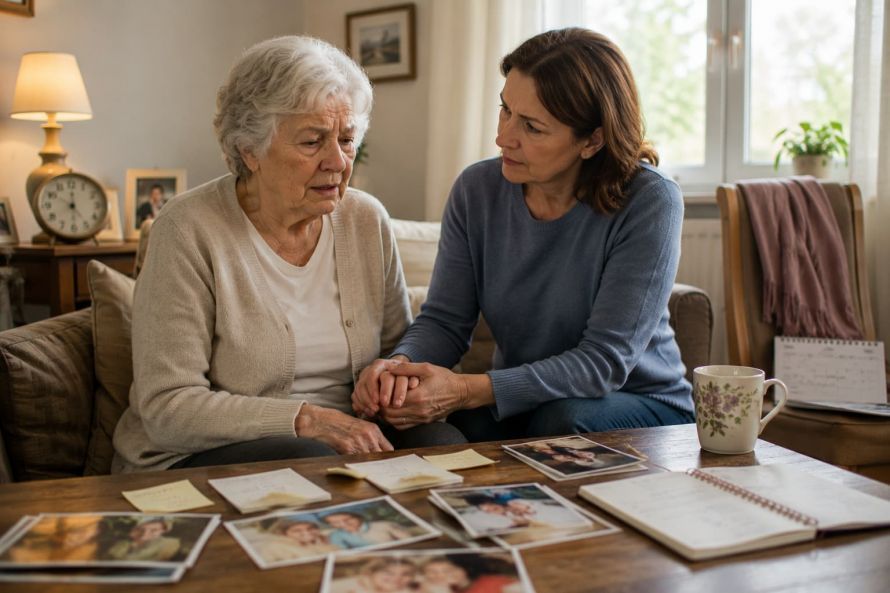
Types of Dementia
Not all cases of dementia are the same. The specific form determines the course of the disease, treatment, and prognosis. In clinical practice, we distinguish five main forms:
1. Alzheimer’s disease (60–70 percent)
The most common form. It begins gradually, typically with impairments in short-term memory. A characteristic feature is the accumulation of beta-amyloid plaques and tau fibrils in the brain—changes that can now be detected using biomarkers in cerebrospinal fluid or via PET scans.
→ For a detailed overview of Alzheimer’s disease: Alzheimer’s — Causes, Course, Treatment.
2. Vascular dementia (15–20 percent)
Caused by circulatory disorders in the brain—small strokes, chronic microcirculatory damage, and vascular changes associated with high blood pressure and diabetes. The progression is often gradual and uneven. Treating cardiovascular risk factors is also the most important preventive measure in this case.
3. Lewy body dementia (5–10 percent)
Characterized by visual hallucinations, significant fluctuations in attention throughout the day, and Parkinson’s-like movement disorders. Lewy body dementia is particularly sensitive to certain medications—especially classic neuroleptics, which can trigger life-threatening side effects. This underscores the importance of a careful medication review in older patients.
4. Frontotemporal dementia (5 percent)
Typically begins earlier than Alzheimer’s—often between the ages of 50 and 70. The primary symptoms are not memory impairments, but rather personality changes, disinhibited behavior, or loss of speech. It is often misdiagnosed for a long time as depression or a psychiatric disorder.
5. Mixed Forms and Rare Forms
In reality, these forms often overlap, especially in very elderly patients. Pure Alzheimer’s dementia after age 85 is the exception, not the rule. In addition, there are rare causes such as normal-pressure hydrocephalus, dementia associated with Parkinson’s disease, and dementia following head injuries—the correct diagnosis of which is crucial because some of these conditions are treatable. Comprehensive information on geriatrics and geriatric medicine helps to make sense of these complex overlaps.
Symptoms and Warning Signs
The global organization Alzheimer’s Disease International has compiled ten early warning signs that family members can also reliably assess:
- Memory lapses that interfere with daily life (not just occasional forgetfulness)
- Difficulty planning and carrying out familiar tasks
- Problems with orientation in familiar surroundings
- Disorientation regarding time—uncertainty about the day, month, or season
- Language problems—words are forgotten, sentences are cut short
- Items are found in unusual places (glasses in the refrigerator)
- Impaired judgment, particularly regarding financial and safety decisions
- Withdrawal from social activities that used to bring joy—a pattern also seen in depression in older adults and one that requires careful differentiation
- Changes in mood and personality
- Changes in visual perception (distances, contrasts)
???? A single symptom proves nothing. A pattern of multiple symptoms over several weeks or months is a concrete reason to seek a specific evaluation—not to wait and see.
Diagnosis: How Is Dementia Diagnosed?
Modern dementia diagnosis operates on three levels:
1. Clinical interview and cognitive tests
The foundation of any diagnosis is a structured interview with the patient and their family members. This is supplemented by validated brief tests:
- MMSE (Mini-Mental State Examination): 30-point scale. Scores below 24 indicate cognitive impairment but are not sensitive enough to detect mild forms.
- MoCA (Montreal Cognitive Assessment): More sensitive to mild cognitive deficits and early-onset forms of dementia. It is currently considered the gold standard in brief screening.
- Clock Drawing Test: Simple, quick, and surprisingly discriminating as a screening tool.
- DemTect: A test developed specifically in Germany with good sensitivity for mild forms.
A supplementary frailty screening can help provide a better assessment of the patient’s overall condition, as cognitive impairments often go hand in hand with physical frailty.
2. Imaging
3. Biomarkers in Cerebrospinal Fluid and Blood
In recent years, there has been a diagnostic revolution: biomarkers in cerebrospinal fluid (beta-amyloid 1-42, tau, phospho-tau) make it possible to distinguish Alzheimer’s disease as early as the initial stage with over 90 percent certainty. Blood-based biomarkers (plasma-based p-Tau217) have been validated with high accuracy in studies since 2024 and are gradually being incorporated into routine clinical practice.
→ Detailed information on the entire diagnostic pathway: Dementia Diagnostics — From the Clock Test to Biomarker Analysis. To distinguish between depression and dementia, we also recommend our article “Dementia or Depression?”
Treatment: What Really Helps
The question all family members ask is: Can dementia be cured? The honest answer: No. But it is possible to slow its progression, alleviate symptoms, and significantly improve quality of life. The biggest mistake would be to forego treatment because of this.
Non-Pharmacological Therapy — The Foundation
The evidence is clear: For most people with dementia, non-pharmacological interventions provide the greatest benefit in daily life.
- Physical activity: Aerobic exercise, strength training, and dance—these slow the progression of the disease and improve mood and sleep. Targeted geriatric early rehabilitation can provide structured support in this area.
- Cognitive stimulation: Targeted programs (CST, Cognitive Stimulation Therapy) have shown effects in studies comparable to those of anti-dementia medications.
- Social participation: Loneliness is an independent risk factor—both for the onset and for the progression of dementia. At the same time, social withdrawal contributes to frailty syndrome.
- Nutrition: The Mediterranean and MIND diets have shown a protective effect in cohort studies. In cases of existing dementia, attention must also be paid to malnutrition in older adults.
- Correcting hearing and vision: According to the Lancet Commission 2024, uncorrected hearing and vision impairments are among the greatest modifiable risk factors.
Pharmacological Therapy
Two classes of drugs have been available for years:
- Cholinesterase inhibitors (donepezil, rivastigmine, galantamine): For mild to moderate Alzheimer’s dementia. They do not cure the disease but typically slow its progression by six to twelve months.
- Memantine (NMDA antagonist): For moderate to severe Alzheimer’s dementia. Often used in combination with cholinesterase inhibitors.
Since 2024/2025, the treatment landscape has expanded: Lecanemab has been approved in the U.S. and select European countries for early-stage Alzheimer’s dementia. It is an anti-amyloid antibody that, in the CLARITY-AD study, demonstrated a 27 percent slowing of clinical progression over 18 months. Donanemab follows this mechanism of action. These therapies are not suitable for all patients—prerequisites include an early stage of the disease, biomarker-confirmed evidence of amyloid pathology, close MRI monitoring, and a willingness to undergo regular infusions. The issue of polypharmacy in older adults must also always be considered when deciding on new therapies.
For other forms of dementia—vascular dementia, Lewy body dementia, and frontotemporal dementia—there are no specific approved drug therapies; treatment in these cases is symptom-oriented and individualized.
→ Our article “Dementia Treatment 2026” provides an in-depth overview of current treatment options.
Living with Dementia: What Caregivers Need to Know
Dementia never affects just one person, but the entire family. The most important recommendations for family members:
- Arrange advance planning early: A power of attorney, living will, and guardianship directive should ideally be drawn up before the diagnosis or immediately afterward, while the patient is still legally competent.
- Apply for a care level: A care level ensures financial and organizational support. The assessment is conducted by the Medical Service and explicitly takes cognitive impairments into account.
- Adapt the living environment: Clear routines, familiar objects, safety measures for the stove and doors, and orientation aids (clock, calendar). Targeted fall prevention in the home is particularly important.
- Provide a daily structure: Regular daily routines, plenty of natural light, and a balance of activity and rest. Chaos is particularly stressful for people with dementia.
- Communication guidelines: Use short sentences, maintain eye contact, and allow plenty of time. Avoid correcting the person unless necessary. Adopt a validating rather than confrontational attitude.
- Recognize your own limits: Family caregivers have a significantly increased risk of depression in old age. Support groups, day care, and respite care are not a sign of weakness, but rather a prerequisite for sustainable care. Palliative care can also significantly relieve the burden on family members in advanced stages of the disease.
→ For dealing with specific dementia-related situations: Care for dementia and behavioral issues.
When should you see a geriatrician?
The following situations are clear indications for a geriatric evaluation—in addition to or as a supplement to care from a primary care physician:
- Multiple early signs from the list above persisting for weeks or months
- Unclear memory impairment while taking multiple medications—some symptoms are medication-related and reversible; targeted deprescribing can help in such cases
- Risk of falls combined with cognitive changes
- Confusion following a hospital stay that does not fully resolve
- Family members are becoming increasingly overwhelmed and are seeking a structured plan
- Surgery is imminent—a preoperative geriatric assessment helps to realistically evaluate surgical risk in older adults
Geriatrics complements primary care and neurology by providing a holistic perspective: not only on the cognitive diagnosis, but on the overall situation—medications, mobility, mood, nutrition, and social circumstances. That is the clinical added value—and it is the reason why a geriatric assessment is beneficial in every dementia evaluation.
→ We describe exactly how a geriatric assessment is conducted in our article on Geriatric Assessment.
Frequently Asked Questions
Is dementia the same as Alzheimer’s?
No. Dementia is an umbrella term for various brain disorders that impair cognitive functions. Alzheimer’s disease is the most common form of dementia, accounting for 60 to 70 percent of cases, but it is not the only one. Other forms include vascular dementia, Lewy body dementia, frontotemporal dementia, as well as mixed and rare forms.
At what age can dementia begin?
Dementia occurs predominantly in people over the age of 65. When it occurs before the age of 65, it is referred to as early-onset dementia (frontotemporal dementia, FTD). Frontotemporal dementia, in particular, often begins between the ages of 50 and 70. After age 85, the prevalence is over one-third.
Can dementia be prevented?
Not completely, but the risk can be significantly reduced. The Lancet Commission 2024 identifies 14 modifiable risk factors that together account for about 45 percent of the risk of dementia—including high blood pressure, diabetes, smoking, physical inactivity, social isolation, uncorrected hearing loss, depressive symptoms, and insufficient education in early life. Prevention is possible and effective; the earlier you start, the better.
Are new drugs like Lecanemab suitable for all forms of dementia?
No. Lecanemab and donanemab are approved exclusively for early-stage Alzheimer’s disease and are only appropriate when amyloid pathology is confirmed by biomarkers. This treatment option is not available for vascular, Lewy body, or frontotemporal dementia. Before any decision is made, a careful risk-benefit assessment is required at specialized centers—also due to potential side effects such as cerebral edema or microbleeds (ARIA).
What is the difference between dementia and delirium?
The most important difference is the timeline. Dementia develops over months to years and is generally irreversible. Delirium develops within hours to days, fluctuates throughout the day, and is treatable in most cases—provided the cause is identified. Both conditions can occur together: delirium in the context of existing dementia is a common combination and requires consideration from both perspectives.
Is forgetfulness in old age always a sign of early-stage dementia?
No. Occasionally forgetting names, appointments, or words is a normal part of aging. The key difference: With normal age-related forgetfulness, daily life is not significantly impaired, information can be recalled with prompts, and abilities remain stable over time. If several of the ten early warning signs occur simultaneously and progressively, a structured evaluation is advisable—including, if necessary, a screening to distinguish between dementia and depression.
Share this article
Sources
- Livingston G, Huntley J, Liu KY et al. (2024): Dementia prevention, intervention, and care: 2024 report of the Lancet standing Commission. The Lancet. DOI: 10.1016/S0140-6736(24)01296-0
- van Dyck CH et al. (2023): Lecanemab in early Alzheimer’s disease (CLARITY-AD). New England Journal of Medicine. DOI: 10.1056/NEJMoa2212948
- German Alzheimer Society (2024): The frequency of dementia disorders. Information sheet.
- S3 Guideline “Dementias”, German Association for Psychiatry, Psychotherapy and Psychosomatics (DGPPN) and German Society of Neurology (DGN). AWMF Register 038-013, current version.
