Computed tomography (CT for short) is an imaging technique used primarily for diagnostic purposes. It produces axial cross-sectional images of body regions using X-rays and then analyzes these images with the aid of a computer.
Here you will find further information as well as a selection of CT specialists.
Computed tomography is a computer-assisted procedure for generating cross-sectional images of the body using X-rays. A cross-sectional image is a representation of organs, tissues, and other structures within a specific straight plane or slice.
The thickness of the slice depicted depends on the specific clinical question and can vary. Today, slice thicknesses of less than one millimeter are possible.
This imaging technique enables the diagnosis of many diseases and pathological tissue changes, such as tumors. The technique was developed in the late 1960s by a team led by Godfrey Hounsfield, an English physicist. It has been in clinical use since the mid-1970s.
How Computed Tomography (CT) Scanners Work
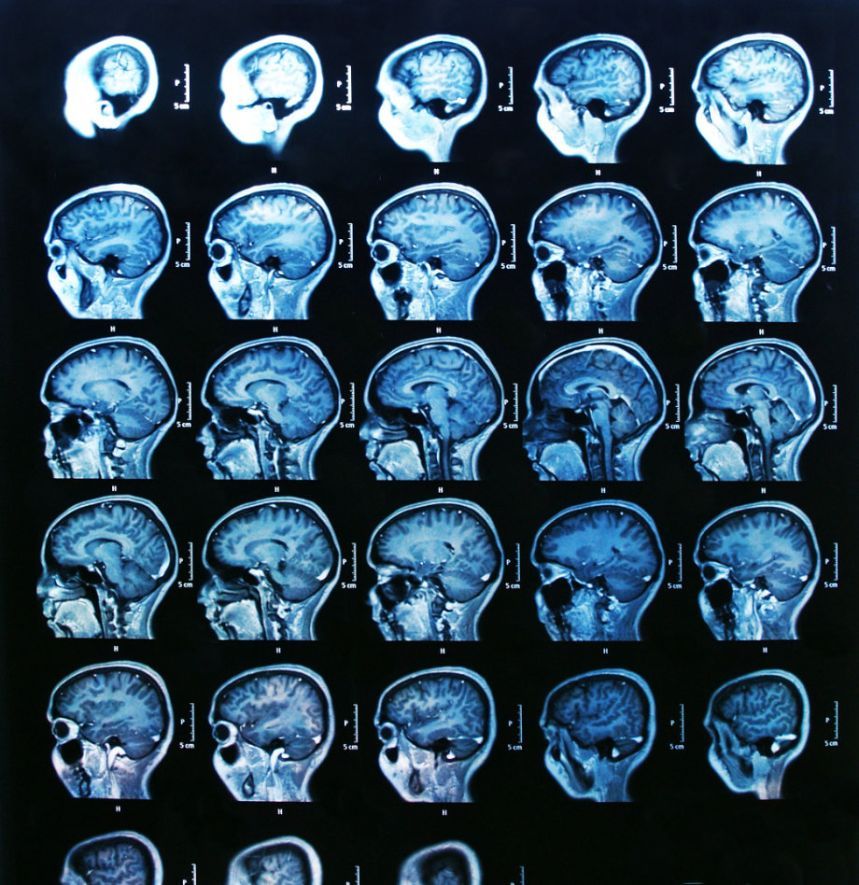
During imaging, an X-ray tube rotates around the patient, who is positioned inside the so-called gantry. The gantry is the most important component of the CT scanner: the X-ray tube is located on one side of this rotating, ring-shaped tunnel. A detector is mounted on the other side.
During the examination, the X-ray tube emits X-rays in a fan-shaped pattern. The X-rays are attenuated to varying degrees by the body tissues they pass through. The detector on the opposite side captures them and converts them into image data based on their intensity.
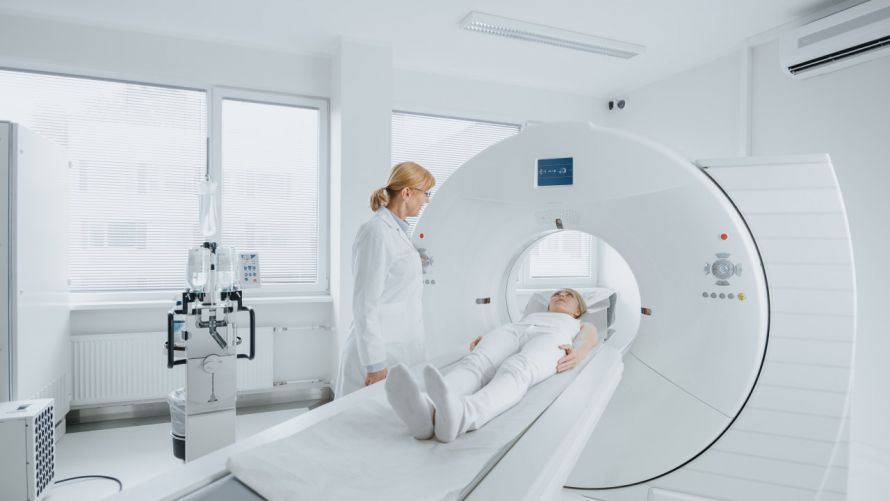
The attenuation of the X-rays in the specific body layer being examined is represented in shades of gray.
The density or attenuation of a tissue is expressed in Hounsfield units (HU). By definition, water is assigned a value of 0 and air a value of -1000.
The Hounsfield units for various tissue types in CT diagnostics are as follows:
- Air: -1000 HU
- Lung tissue: between -500 and -700 HU
- Adipose tissue: up to -100 HU
- Water: 0 HU
- Muscle tissue: approximately 45 HE
- Liver tissue: between 40 and 60 HE
- Blood: between 65 and 80 HE
- Bone tissue: over 1000 HE
Selective visualization of the body regions to be examined using the windowing technique
The human eye can distinguish only 20 to 40 shades of gray. Therefore, a cross-sectional image does not reproduce the entire range of possible density values in the corresponding gray scales.
Instead, the
- window width and
- the window position is used to define the mean density value
. This window position is displayed as the mid-gray tone. A limited number of gray levels are then distributed across the selected window width. Density values above the window are rendered in white, and those below the window are rendered in black.
For example, when visualizing the lungs, the window width is 100 and the window position is -600.
Multidetector systems allow for short scan times and 3D reconstruction
In most cases, spiral computed tomography (CT) scanners with a continuously rotating X-ray tube and an examination table that moves smoothly through the gantry are used. These are multidetector systems with multiple rotating detector rows. These multislice spiral CT scanners can process up to 320 slices. They enable whole-body examinations of patients with multiple trauma in just a few seconds.
In dual-source computed tomography, two X-ray systems rotate simultaneously at right angles around the object being examined. The CT scanner can acquire twice as many slices per rotation of the X-ray tubes in the same amount of time. This shortens the scan time and improves temporal resolution. Moving objects, such as a beating heart, can thus be visualized within very short scan times (volumetric CT).
The very thin-slice axial scanning technique enables multiplanar reconstruction (MPR). This is the 3D reconstruction of scanned tissue from the axial slice scans, allowing the body region to be viewed from different planes.
Why Contrast Agents Are Used in Computed Tomography
Contrast agents are used to
- better visualization of tissue contrast and
- to better differentiate pathological changes
. These highly iodinated substances are administered intravenously and excreted by the kidneys after the examination.
Multiphase examination protocols have proven particularly effective in the abdominal region. Diseased tissue, such as that of the liver or pancreas, absorbs the contrast agent differently over time than healthy tissue. A distinction is made here between the
- arterial phase (approximately 20 to 25 seconds after contrast agent injection),
- the portal venous phase (50 to 70 seconds after contrast agent injection), and
- venous phase (beginning around the 90th minute after contrast agent injection).
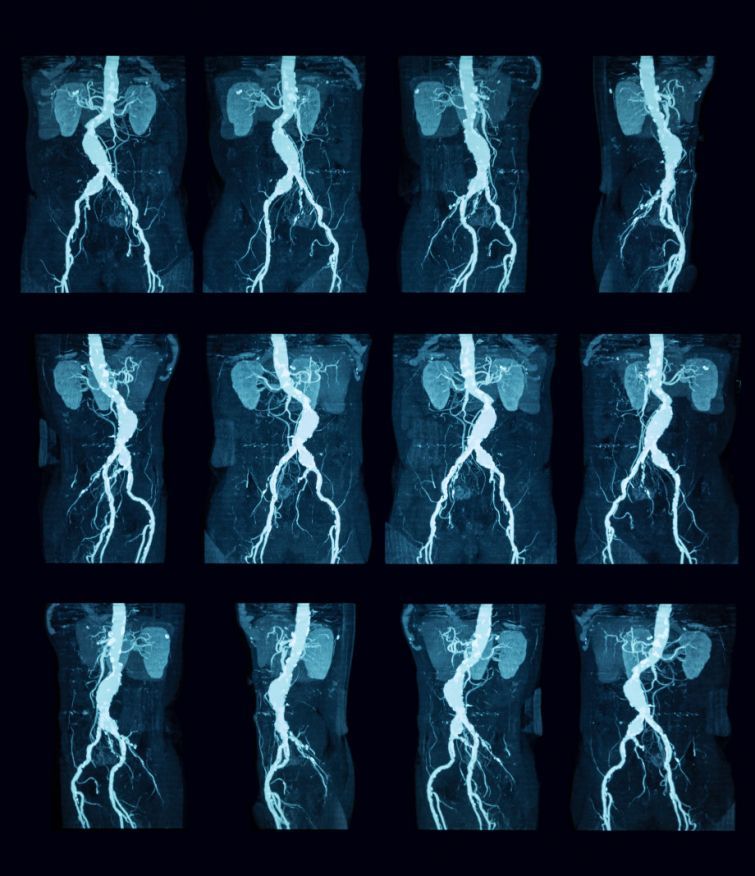
CT angiography utilizes the specific phases of contrast agent flow to specifically examine arterial and venous vessels.
Applications of Computed Tomography
Computed tomography provides layer-by-layer, interference-free images of the organs of interest. This makes it easier to detect pathological changes. For this reason, CT diagnostics is used to investigate disease-related changes in organ structures.
Computed tomography can be used to visualize blood vessels and soft tissues such as
- internal organs or
- muscles
than conventional X-ray technology. However, certain types of tissue, such as cartilage or ligaments, are better visualized using magnetic resonance imaging (MRI).
Among the most important applications of computed tomography are:
- Tumor diagnosis: Visualization and assessment of the location, size, and extent of tumors and metastases as small as a few millimeters. It is also used for monitoring the course of cancer treatment and as part of cancer screening for the early detection of lung and colorectal cancer.
- Cranial computed tomography (head CT): Used when bleeding, an aneurysm (abnormal dilation of a cerebral artery), cerebral edema (swelling), stroke, or a skull fracture is suspected.
- Abdominal computed tomography (abdominal CT): Used when pathological tissue changes in the abdominal cavity are suspected, such as pancreatitis (inflammation of the pancreas), cancer (e.g., liver cancer), or traumatic injuries to the abdominal organs.
- Computed tomography of the skeletal system: Assessment of complex bone fractures and injuries to the spine. Also, measurement of bone density in cases of osteoporosis.
- Thoracic computed tomography (chest CT): When pathological changes in lung tissue, blood vessels, or lymph nodes in the chest are suspected.
Furthermore, computed tomography is used in many cases to plan and perform diagnostic or therapeutic procedures. Diagnostic procedures include biopsies or tissue samples. Therapeutic procedures performed with CT guidance include
- surgery,
- radiation therapy,
- punctures, and
- drainage systems.