
That’s the difference between a fall as an accident and a fall as a clinical sign. When an older person who has been walking steadily until now falls, it almost always means that something has changed somewhere. A medication, blood pressure, an infection, muscle strength—often several things at once.
As a geriatrician, I encounter falls every day. And time and again, I see that the first fall opens the most critical window of opportunity in all of geriatric medicine: the window during which the underlying causes can still be identified and treated before the second fall occurs, leading to a fracture, a hospital stay, and loss of function.
Why a Fall in Old Age Is Never Just a Fall
In geriatric medicine, we call this the geriatric cascade. A first fall that ends without serious injury is, medically speaking, a blessing. It is the only moment when the chain of events can still be broken. Studies clearly show that anyone who has fallen once is three times more likely to fall again within the next twelve months.
The typical sequence of untreated fall risk is predictable: from a fall to a fracture, from a fracture to immobility in old age, from immobility to muscle loss and the risk of delirium, and from loss of function to the need for long-term care. One-year mortality following a femoral neck fracture ranges between 20 and 30 percent, depending on the study. Among those over 90 years of age who underwent total hip replacement (THR), it reached 26.5 percent in the SOG study.
At my own hospital, the Main-Kinzig-Kliniken Schlüchtern, the number of hip fractures has nearly doubled within six years—from 109 cases in 2019 to 217 cases in 2025. That represents a 99.1 percent increase over a period in which the aging of our catchment area’s population has not grown nearly as rapidly. Demographic aging does not explain everything. A significant portion of the increase is attributable to preventable falls.
→ We explain exactly what happens medically after a hip fracture—and why care is interdisciplinary—in our article on geriatric traumatology and in the article on femoral neck fractures in older adults.
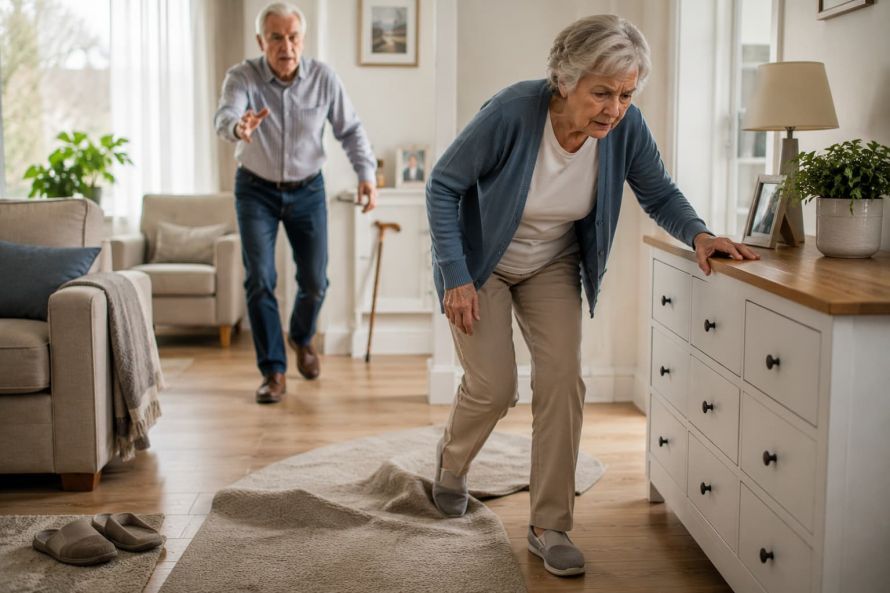
Medications as a Trigger for Falls: The Silent Epidemic
If I could share just one sentence today, it would be this: The most common cause of falls among older adults is not a tripping hazard in the living room. It’s the pill organizer on the kitchen table.
Polypharmacy in older adults—taking five or more medications at the same time—affects more than 40 percent of people over 65 in Germany. Every additional medication disproportionately increases the risk of drug interactions and side effects. And not every medication that was appropriate ten years ago is still appropriate today.
A case study from my clinic
An 81-year-old female patient was admitted to our hospital due to repeated falls and increasing confusion. Her initial medication regimen included 19 different drugs—heart medications, blood pressure medications, stomach protectants, sleep aids, a benzodiazepine, an SSRI, an opioid patch for back pain, and four different dietary supplements. Each one had been justified at some point. Taken together, they caused what we refer to as pharmacogenic delirium with a risk of falls.
After a systematic medication review based on PRISCUS and FORTA criteria, we reduced her regimen over three weeks to six medications that were truly indicated. The patient went home walking upright, lucid, and without a cane. This is not an exception, but rather the norm for us. At our clinic, we achieve average reductions of 30 to 50 percent in the number of medications for patients undergoing geriatric medication reduction—almost always without compromising their health.
???? The most important question you, as a family member, should ask the primary care physician or geriatrician is: “Which of these medications really needs to be continued today—and which ones were last deemed appropriate several years ago and have never been reviewed?”
→ For more details on the topic of too many medications and how to systematically reduce them: Polypharmacy in Older Adults and Deprescribing—Understanding the PRISCUS List.
What a Geriatrician Does Differently: The Comprehensive Assessment
A geriatrician does not replace the family doctor, orthopedist, cardiologist, or neurologist. Geriatrics is the specialty that determines which of these perspectives takes priority in each individual case—and that systematically identifies what the individual specialties overlook because they view the patient through their respective “organ-specific lenses.”
The tool used for this is called the Comprehensive Geriatric Assessment (CGA)—a structured assessment procedure that evaluates five dimensions over the course of one or more sessions: medical status, functional status, cognitive status, and emotional and social status. Four test procedures are particularly well-established for fall risk assessment:
- Timed Up and Go (TUG): The patient stands up from a chair, walks three meters, turns around, and sits back down. A time under 10 seconds is normal; over 13.5 seconds indicates a significant risk of falling.
- Tinetti Test (POMA): A 28-point scale for balance and gait. A score below 19 indicates a high risk of falling.
- Chair Rise Test: Standing up from a chair five times without using the arms for support. If it takes longer than 15 seconds, sarcopenia is suspected.
- Medication review according to PRISCUS/FORTA: Systematic review of each individual medication, including its indication, alternatives, and options for discontinuation.
→ We describe the full scope of the assessment, including all seven dimensions, in our article on geriatric assessment.
Fall Prevention: What the Evidence Really Recommends
The good news to conclude: Fall prevention works. The comprehensive Cochrane review by Gillespie and colleagues, which included more than 150 individual studies, reaches a clear conclusion: Multifactorial interventions—programs that address multiple risk factors simultaneously—reduce the fall rate among older adults living at home by an average of 23 percent.
What Has Been Proven to Work
- Group-based exercise programs focusing on strength and balance (Otago Program, Tai Chi)—up to a 40 percent reduction in falls
- Individualized physical therapy program following a geriatric assessment
- Systematic medication review with discontinuation or dose adjustment of high-risk medications—more on this: deprescribing
- Treatment of orthostatic hypotension (adjustment of antihypertensive medications, compression stockings, fluid intake)
- Cataract surgery when indicated — up to a 30 percent reduction in falls in the operated eye
- Vitamin D supplementation in cases of confirmed deficiency (not routinely administered to everyone) — also relevant in the context of osteoporosis in older adults
- Home modifications: grab bars in the bathroom, lighting along the path to the toilet, non-slip mats, flat, closed-toe shoes
- Hip protectors for institutionalized high-risk patients
What’s Less Effective Than You Might Think
Vitamin D supplementation without a confirmed deficiency offers no preventive benefit and, in high-dose studies, even increases the risk of falls. Home modifications alone, without exercise, are less effective than combined programs. The effect of a single measure is limited—the benefit arises from a structured combination of measures, and that is precisely the domain of the geriatric treatment approach.
→ You can find concrete, action-oriented steps for fall prevention in your own environment in the article of the same name.
When should you consult a geriatrician?
The following situations are specific occasions to supplement primary care with a geriatric second opinion—not as a replacement, but as a complement:
- First fall, even without a serious injury
- More than one fall in twelve months
- Five or more long-term medications (polypharmacy)
- Newly developed unsteadiness while walking, even if subtle
- Unexplained episodes of weakness, drowsiness, or dizziness
- Increasing forgetfulness combined with changes in movement—a possible sign of mild cognitive impairment (MCI)
- Before scheduled surgeries (preoperative geriatric assessment) — more on this: Surgical risk in older adults
- After a hospital stay with new functional loss — early geriatric rehabilitation can help here
The most common mistake I see is waiting too long. An evaluation after the first fall is far more effective than the same evaluation after the third fall resulting in a hip fracture. A fall with no consequences is not a reason to relax—it’s a warning sign.
→ If you’d like to know how your physical capacity is assessed before a planned surgical procedure, you’ll find all the information in the article on Surgical Risk in Older Adults.
Frequently Asked Questions
Is a fall in older age always a reason to see a doctor?
Yes. Even if the fall appears to have had no consequences, the cause should be investigated—especially in older adults. Studies show that the risk of another fall triples after the first incident. The first fall is the diagnostic window of opportunity before a fracture occurs. A visit to your primary care physician, ideally with a referral to a geriatric outpatient clinic, is the right step to take.
Which medications increase the risk of falling the most?
Benzodiazepines and Z-drugs (sleeping pills and sedatives), tricyclic antidepressants, potent anticholinergic agents, opioids, aggressively dosed antihypertensives, and diuretics are the main groups. The PRISCUS list and the FORTA classification provide structured overviews of these. Important: Never stop taking medications on your own—always do so under a doctor’s supervision. More on systematic medication reduction: Deprescribing.
Does vitamin D help prevent falls?
Only in cases of proven vitamin D deficiency. If levels are sufficient, supplementation offers no preventive benefit; high-dose studies have even shown an increased risk of falls. The decision should be based on blood levels, not on blanket prophylaxis.
What is the difference between a geriatrician and a primary care physician?
The primary care physician provides ongoing care for the patient and is most familiar with the patient’s individual medical history. The geriatrician is a specialist in geriatrics and geriatric medicine and brings an additional, structured perspective: the Comprehensive Geriatric Assessment. They are not a replacement but a complement—typically for specific issues such as fall risk assessment, medication review, preoperative evaluation, or follow-up after a hospital stay.
Can falls be completely prevented?
No—and no one should make that promise. But structured programs have been shown to reduce the fall rate by 20 to 40 percent, and the severity of fall-related consequences can be significantly reduced. The goal is not to avoid falls at all costs, but to maintain independence and quality of life for as long as possible—as part of a comprehensive fall prevention strategy.
Share this article
Sources
- Gillespie LD, Robertson MC, Gillespie WJ, et al. (2019): Interventions for preventing falls in older people living in the community. Cochrane Database of Systematic Reviews. DOI: 10.1002/14651858.CD007146
- Mann NK, Mathes T, Sönnichsen A, et al. (2023): Potentially inadequate medications in the elderly: PRISCUS 2.0. Deutsches Ärzteblatt International. DOI: 10.3238/arztebl.m2022.0377
- Pazan F, Wehling M (2022): The FORTA (Fit fOR The Aged) List: Evidence-based assistance for physicians to use safe medications in older adults. Drugs & Aging.
- German Society for Geriatrics (DGG): S3 Guideline on Fall Prevention in Older People. AWMF Register 084-002, current version.
- Main-Kinzig-Kliniken Schlüchtern, Department of Geriatrics: Internal analysis of the development of proximal femoral fracture case numbers 2019–2025.
