
From that moment on, two clocks run in parallel. One tracks the surgical process: anesthesia, the procedure, wound healing. The other tracks something less visible but that determines the rest of her life: How quickly will she be mobilized? How carefully will her medications be monitored? Will delirium be recognized? Does rehabilitation begin on the first day or the tenth?
As a geriatrician, I regularly see how much the answers to this second set of questions determine a patient’s fate—often more than the surgical technique itself. The good news: We know very precisely today what works. The not-so-good news: It isn’t systematically implemented everywhere.
How common are femoral neck fractures?
- Germany: Approximately 150,000 proximal femur fractures per year.
- Age distribution: Over 80 percent of those affected are over 75 years old.
- Gender ratio: Women are three times more likely to be affected than men, primarily due to postmenopausal osteoporosis in older age.
- Lifetime risk: About one in four women and one in ten men over the age of 70 will suffer a fracture near the hip at some point in their lives.
At my own hospital, the Main-Kinzig-Kliniken Schlüchtern, the number of cases nearly doubled between 2019 and 2025—from 109 to 217 cases per year. This represents a 99.1 percent increase over six years. The aging population in our catchment area explains only part of this trend; the other part is attributable to preventable falls among the elderly. These figures have two consequences: We have expanded our geriatric early rehabilitation program accordingly—and we have made delirium prevention, medication reviews, and preoperative assessments part of our standard process, rather than the exception.
→ Why falls in older adults are rarely “just” falls—and what lies behind them: Falls in Older Adults.
Why the Fracture Has Such Far-Reaching Consequences
A femoral neck fracture is a serious injury at any age, but for older adults, there’s more to it: The fracture itself is usually the visible event—the real challenge begins afterward. The relevant statistics:
- 1-year mortality: 20 to 30 percent, depending on baseline condition and quality of care. This is higher than after most cancers in geriatric medicine.
- Loss of function: Only about 40 to 50 percent of patients fully regain their pre-fracture level of mobility.
- Need for long-term care: 20 to 30 percent of patients who previously lived independently require inpatient long-term care following a fracture.
- Delirium rate: 30 to 50 percent of patients develop signs of delirium postoperatively—for more information, see Delirium Prevention.
- Risk of re-fracture: Following a hip fracture, the risk of a second fracture on the opposite side is significantly increased within a few years.
These figures sound alarming—and they are. However, they are not immutable laws of nature. They vary considerably depending on the quality of care. Frailty syndrome is a key factor here: Patients with pre-existing frailty have a significantly higher risk of complications.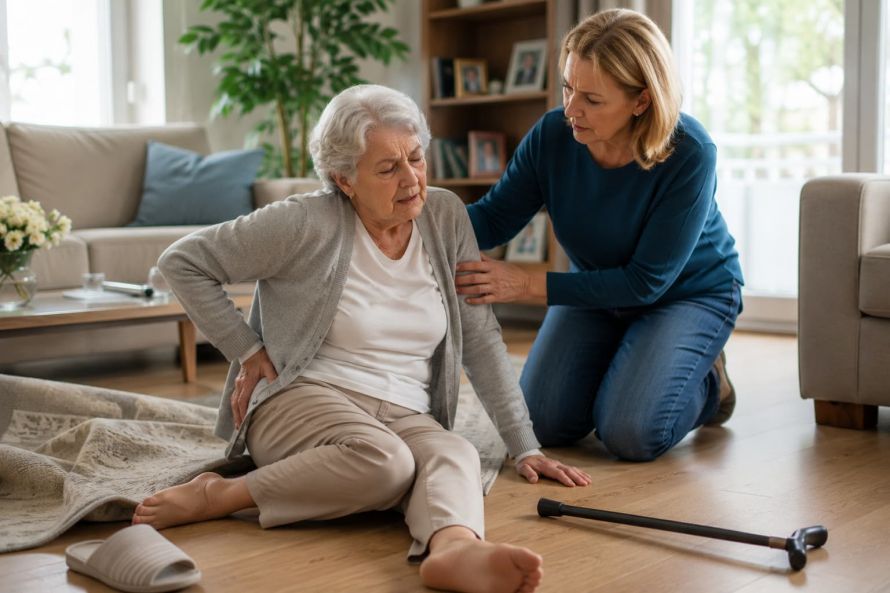
Surgery: An Overview of Procedures
Surgical treatment is now the standard of care in geriatric traumatology. Non-surgical treatment is only considered in clearly defined exceptions (patients in palliative care, conditions that preclude surgery). The choice of procedure depends on the fracture location and the patient’s activity level:
Total Hip Replacement (THR)
The damaged femoral head is replaced with a prosthesis made of metal and plastic. Preferred for active patients with a good life expectancy and pre-existing hip osteoarthritis. Long-lasting solution, high functional load-bearing capacity.
Hemiarthroplasty (bipartite prosthesis)
Only the femoral head is replaced; the acetabulum is preserved. Shorter surgery time, less invasive procedure. Preferred for older, less active patients without pre-existing osteoarthritis.
Osteosynthesis (screw fixation or intramedullary nail)
The fracture is stabilized with screws, plates, or an intramedullary nail; the patient’s own bone is preserved. Used for stable, non-displaced fractures and fractures in the trochanteric region.
The decision between these procedures is made on a case-by-case basis by the surgical team. Important for patients and their families to know: The choice of implant alone does not determine the outcome. Postoperative mobilization and geriatric care are at least as important.
→ More on joint replacement in older adults — what older patients should know.
→ Specifically on hip replacement: Total hip replacement (THR) for patients aged 80 and older.
The critical time factor: Surgery within 24 to 48 hours
One of the best-documented findings in recent years: The time to surgery is an independent predictor of mortality and functional loss. The AWMF’s S3 guideline and international guidelines recommend surgical intervention within 24 hours, but no later than 48 hours after admission. Reasons:
- Longer waiting times increase the rates of pneumonia, thrombosis, delirium, and pressure ulcers
- Prolonged bed rest before surgery leads to muscle loss (sarcopenia) and cardiovascular deconditioning
- Pain is often significant at rest, even when lying down—pain relief comes primarily from the surgery
In Germany, 24-hour care is not yet universally available, even though it is increasingly becoming the standard in specialized geriatric medicine centers.
Geriatric Co-Management (Orthogeriatric Co-Management)
Orthogeriatrics—the structured collaboration between trauma surgery and geriatrics—is one of the best-documented organizational models in modern geriatric medicine. Studies show:
- A reduction in 1-year mortality of up to 30 percent
- Shorter hospital stays
- A significant reduction in postoperative complications (delirium, pneumonia, thrombosis)
- Higher rate of return to the patient’s own home
The geriatrician does not perform the surgery but rather takes overall responsibility for managing the ancillary aspects that determine the actual course of treatment: pain management, fluid and nutritional management, delirium prevention, mobilization planning, medication review to address polypharmacy in older adults, and secondary prevention of further fractures.
???? For every hospital admission due to a fracture near the hip: Actively ask whether geriatric co-management is offered. In centers with an orthogeriatric structure, this is standard practice—in other facilities, it must be explicitly requested.
Early Rehabilitation: The First Three Weeks
After surgery, geriatric early rehabilitation ideally begins on the first postoperative day. The typical course:
Days 1–2: Initial mobilization to the edge of the bed, respiratory therapy, secretion clearance, and thrombosis prophylaxis. Adequate pain medication, but opioids should be used sparingly whenever possible.
Days 3–7: First attempts at walking with a rollator or walker. Start of occupational therapy for activities of daily living. Initial assessment using the Barthel and Tinetti scales. Delirium screening.
Days 8–14: Gradual increase in walking distance. Training in activities of daily living (dressing, washing, using the restroom). Climbing stairs. Planning for discharge.
Days 14–21: Discharge preparation with final assessment. Provision of assistive devices, home modifications, organization of home care services or physical therapy at home, secondary prevention plan.
→ Detailed information on the process: Geriatric Early Rehabilitation.
Secondary Prevention: Preventing a Second Fracture
A fracture near the hip significantly increases the risk of a second fracture. This is not medically inevitable—it is preventable. Secondary prevention consists of three components:
- Osteoporosis diagnosis and treatment: bone density measurement, vitamin D testing, laboratory tests. If indicated: bisphosphonates, denosumab, or, in cases of severe osteoporosis in the elderly, romosozumab. Antiresorptive therapy reduces the risk of re-fracture by 40 to 50 percent.
- Fall assessment and prevention: Systematic analysis of the causes of falls—medications, vision, mobility, living environment—and targeted interventions. More on this: Fall prevention.
- Muscle and strength building: Continuation of training beyond rehabilitation. Without structured strength and balance training, the risk of relapse is high—closely linked to the prevention of sarcopenia.
→ On osteoporosis and antiresorptive therapy: Osteoporosis in older adults.
→ On structured fall prevention: Fall prevention—what really works.
→ On the role of medication review after a fracture: Polypharmacy in older adults.
What can family members do?
- Invest time in the first few days: Familiar faces reduce delirium and provide motivation.
- Bring glasses, hearing aids, and dentures: Sensory impairments increase confusion and hinder mobility.
- Bring a current medication list upon admission: including over-the-counter and herbal supplements. A complete list is especially crucial in cases of polypharmacy.
- Ask about delirium screening and geriatric co-management: Both should be addressed from the very beginning. More on this: Delirium prevention.
- Be involved in discharge planning: The sooner you are involved, the smoother the transition home will be.
- Prepare the home environment: Install grab bars, provide night lighting, and remove tripping hazards—this is often helpful to do in parallel with rehabilitation and is part of fall prevention.
When should you consult a geriatrician?
In hospitals with an orthogeriatric program, a geriatrician is automatically involved. In other facilities—and especially after discharge—geriatric follow-up care is part of good patient care. Specifically:
- During the hospital stay, if there is no automatic co-management
- After discharge, if unsteadiness, weakness, or confusion persists
- Three to six months after the fracture to evaluate secondary prevention
- In the event of new falls in older adults following surgery
- If medication has not been systematically reviewed following the fracture
→ How a comprehensive geriatric assessment supports further planning.
Share this article
Sources
- AWMF S3 Guideline “Prophylaxis, Diagnosis and Therapy of Osteoporosis”. Dachverband Osteologie (DVO), current version.
- Grigoryan KV, Javedan H, Rudolph JL (2014): Orthogeriatric care models and outcomes in hip fracture patients: a systematic review and meta-analysis. Journal of Orthopedic Trauma. DOI: 10.1097/BOT.0b013e3182a5a045
- Pincus D, Ravi B, Wasserstein D et al. (2017): Association Between Wait Time and 30-Day Mortality in Adults Undergoing Hip Fracture Surgery. JAMA. DOI: 10.1001/jama.2017.17606
- Klestil T, Röder C, Stotter C et al. (2018): Impact of timing of surgery in elderly hip fracture patients: a systematic review and meta-analysis. Scientific Reports. DOI: 10.1038/s41598-018-32098-7
- Main-Kinzig-Kliniken Schlüchtern, Department of Geriatrics: Development of proximal femoral fracture case numbers 2019–2025 (internal data).
