
This pattern is one of the most common in geriatrics. The underlying condition that led to hospitalization is treated. But during this treatment, the patient loses so much strength and coordination in just a few days that returning to their previous level of independence becomes difficult. Medicine has defeated the infection but, in doing so, has weakened the patient.
As a geriatrician, I battle this paradox every day—and my weapon is not high-tech medicine, but consistent mobilization. The phrase “Just to be on the safe side, he’ll stay in bed for a few more days” is one of the most dangerous phrases in geriatric medicine.
What is immobility?
Immobility in older adults refers to a state of severely reduced physical activity—complete bed rest, limited mobility, wheelchair dependence, and dependence on others for daily activities. It is rarely the result of a single event, but rather the outcome of a cascade of events:
- Acute illness requiring hospitalization
- Pain following surgery or a fracture—e.g., after a femoral neck fracture in older adults
- Fear following a fall in old age
- Progressive neurological disease
- Dementia in older adults with disorientation
- Chronic heart or lung disease with reduced exercise tolerance—especially heart failure in older adults
- Depression in older adults and loss of motivation
- Social isolation and lack of motivation to be active
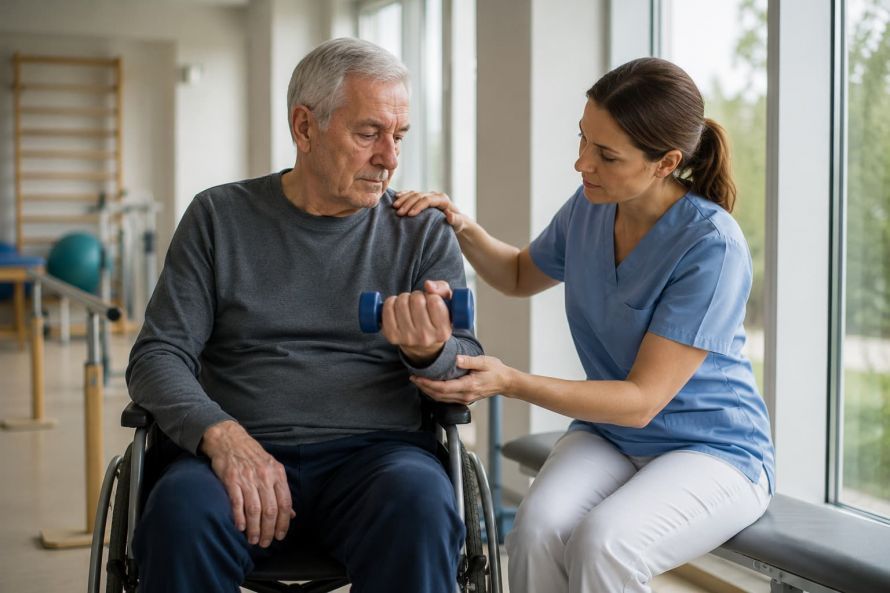
Deconditioning: What Happens in the Body
Every day spent in bed or in an armchair causes measurable changes in the body. The most significant changes:
Muscle loss
Up to 1 to 3 percent of muscle mass per day with strict bed rest. An older patient who is bedridden for a week can lose up to 10 percent of their muscle mass. Regeneration takes two to three times as long as the loss. This process is closely linked to the development of sarcopenia.
Loss of bone density
During prolonged immobilization, bone density decreases measurably—bone remodeling responds to stress. No stress, no growth. This increases the risk of fractures after getting back on one’s feet and can significantly worsen existing osteoporosis in older adults.
Circulatory changes
The cardiovascular system rapidly loses its efficiency during immobilization. Orthostatic dysregulation—a drop in blood pressure upon standing—develops within a few days and leads to dizziness and falls when attempting to move.
Lung function
Shallow breathing while lying down, reduced diaphragmatic movement, and accumulation of secretions in the lower lobes of the lungs—the conditions for pneumonia in older adults can develop after just a few days of bed rest.
Coagulation System
Venous stasis during immobility significantly increases the risk of deep vein thrombosis and pulmonary embolism. Therefore, thrombosis prophylaxis is standard practice in the hospital for bedridden older patients—especially when anticoagulation therapy is also being administered.
Skin
Pressure on the heels, tailbone, and shoulder blades for hours leads to pressure ulcers (decubitus ulcers). This occurs particularly quickly in older adults due to thin skin and reduced blood flow.
Digestion
Constipation is the rule, not the exception. Reduced activity, lower fluid intake, medication side effects, and changes in dietary intake—all of these factors contribute. There is an additional risk of malnutrition in older adults.
Cognition and Mental Health
Immobility increases the risk of delirium, depression in older adults, and cognitive deficits. People who are no longer active receive fewer stimuli—and the brain reacts to this.
→ On the central role of muscle loss: Sarcopenia in older adults.
→ On preventing delirium through mobilization: Delirium prevention.
→ On pneumonia prevention: Pneumonia in older adults.
The most common triggers of the immobility cascade
- Hospitalization: Often more inactivity than necessary. Studies show that older patients spend up to 83 percent of their time in the hospital in bed—usually without a medical reason.
- Surgery: Especially orthopedic surgery, but also abdominal surgery. Pain, catheters, drains, and anxiety contribute to bed rest. Surgical risk in older adults increases significantly with pre-existing immobility.
- Falls: After a fall, many patients develop a fear of falling again—known as post-fall syndrome. More on this: Falls in older adults.
- Chronic pain: When pain is inadequately treated, patients avoid movement—thereby worsening their condition.
- Stroke: Hemiparesis and spasticity require targeted rehabilitation; otherwise, progressive immobility develops rapidly.
- Dementia: Disorientation, fear of the surroundings, and impaired planning of actions. More on this: Dementia in older adults.
- Depression: Loss of motivation in one in three older patients with severe depression in old age.
→ For fall assessment and follow-up care: Falls in older adults and fall prevention.
→ On depression as a barrier to mobility: Depression in older adults.
The Benefits of Early Mobilization
The evidence is overwhelming. Early mobilization—not a cautious “wait-and-see” approach—has been proven to reduce:
- Pneumonia rates by 30 to 50 percent
- Thromboembolism
- Pressure ulcers
- Incidence of delirium
- Length of hospital stay by 1 to 3 days
- Admissions to nursing homes following hospitalization
- Mortality following hip fracture and severe illness
Modern fast-track approaches following surgery—mobilization on the day of surgery or by Day 1 at the latest—have dramatically shortened recovery times. What was long considered risky (getting out of bed on the day of surgery) is now the gold standard of care—and also the core of geriatric early rehabilitation.
Specific stages of mobilization
- Step 1: Elevate the head of the bed; sit on the edge of the bed
- Step 2: Standing briefly with assistance
- Step 3: Taking a few steps in the room with a walker and assistance
- Step 4: Eating meals while seated at the table instead of in bed
- Step 5: Structured walking exercises in the hallway, then without assistance
- Step 6: Small independent activities—washing, brushing teeth, getting dressed
???? The most important rule for mobility in the hospital: “Eat while sitting, not lying down.” Following this one rule reduces the risk of aspiration, promotes breathing, good posture, and independence—and marks the first step toward increased mobility every day.
Prevention at Home
Most cascades of immobility don’t start in the hospital, but in everyday life. Preventing your range of motion from shrinking at home often stops the first domino from falling:
- Regular physical activity: Daily walks, targeted strength and balance training two to three times a week—also effective against frailty.
- Social engagement: When people go out, they move. When they have visitors, they get up. Senior centers, club activities, and volunteer work all have a physical impact.
- Optimize pain management: Uncontrolled pain leads to inactivity and, consequently, to physical decline. Targeted therapy that enables movement is more effective.
- Fall assessment after the first fall: Identify the cause and provide training before fear spirals out of control. More on this: Fall prevention.
- Medication review: Sedative medications that contribute to unsteady gait are often underestimated. Structured deprescribing can be crucial here.
- Provision of assistive devices: A well-fitted rollator enables mobility—a poorly fitted rollator increases the risk of falls. Guidance from physical therapy is not a luxury.
Immobility in patients requiring care
For people who require long-term care or are bedridden, the goal is not full mobility, but rather maintaining every available function:
- Position changes at least every 2 to 4 hours to prevent pressure ulcers
- Passive range-of-motion exercises performed by caregivers or physical therapists to prevent contractures
- Sitting up in bed, daily if possible
- Transfer to a chair or wheelchair for meals
- Structured respiratory therapy to prevent pneumonia
- Thrombosis prevention with medication and compression stockings
- Oral care to prevent pneumonia—often underestimated, but very effective
The Role of Early Geriatric Rehabilitation
For patients who have suffered significant functional loss due to an acute illness, early geriatric rehabilitation is the most effective tool. It combines medical care with intensive physical therapy, occupational therapy, speech therapy, and nursing care—all with the goal of helping patients transition from immobility back to everyday life. In many cases, it makes the difference between returning home and moving to a nursing home. The geriatric assessment forms the basis for the individual rehabilitation plan.
→ Learn more about early geriatric rehabilitation.
What Family Members Can Do
- Be active in the hospital: Take a few steps together, encourage the patient to move around, and help them sit up during meals.
- Ask questions and advocate: If the patient is bedridden every day, ask about physical therapy, a mobilization plan, and early rehabilitation.
- Encourage movement at home: Take walks together, have them do small tasks like emptying the mailbox, and go shopping together.
- Have assistive devices adjusted: Not just any walker—one that’s properly adjusted. Involve a physical therapist or medical supply store.
- After a fall, don’t rest—get an evaluation: Followed by structured training.
- Avoid overexertion: The intensity must be tailored to the individual. Adjust, don’t overexert.
When should you consult a doctor or geriatrician?
- If there is increasing unsteadiness while walking, a tendency to fall, or fear of falling
- After a hospital stay with significant loss of function
- If a cascade of immobility begins (spending more time sitting, fewer activities)
- In cases of unexplained weakness, fatigue, or decreased stamina—possible signs of frailty syndrome
- If you have pain that limits your movement
- In cases of a combination of multiple problems—heart disease in older adults, depression, polypharmacy in older adults
→ For a structured comprehensive evaluation: Geriatric Assessment.
→ On the role of frailty as a basis for mobility: Frailty syndrome.
Share this article
Sources
- Kortebein P, Ferrando A, Lombeida J et al. (2007): Effect of 10 Days of Bed Rest on Skeletal Muscle in Healthy Older Adults. JAMA. DOI: 10.1001/jama.297.16.1772-b
- Brown CJ, Redden DT, Flood KL, Allman RM (2009): The Underrecognized Epidemic of Low Mobility During Hospitalization of Older Adults. Journal of the American Geriatrics Society. DOI: 10.1111/j.1532-5415.2009.02393.x
- Kehler DS, Theou O (2019): The impact of physical activity and sedentary behaviors on frailty levels. Mechanisms of Aging and Development.
- German Society for Geriatrics (DGG): Recommendations on early mobilization in hospital. Current version.
