Bruxism is commonly known as teeth grinding. People with this condition unconsciously clench and grind their teeth repeatedly. This can cause serious damage to tooth structure. Teeth grinding can affect people of all ages. The cause of constant grinding is often severe psychological stress. Grinding typically occurs at night when the brain is processing the day’s events.
However, a misalignment of the jaw can also be a cause. In most cases, this can be treated more easily and quickly than physical tension and stress. Night guards (also called occlusal splints) often provide relief. Here you’ll find further information as well as bruxism specialists and treatment centers.
What is teeth grinding (bruxism)?
Constant teeth grinding and clenching is not considered a disease in its own right. Teeth grinding, or bruxism, is a symptom of another, underlying medical condition. If the cause of the bruxism is eliminated, the constant teeth grinding will also subside. Possible causes include, for example, a misalignment of the jaw or stress.
Human teeth can exert enormous force. Men, for example, can generate up to 400 kg of pressure with their teeth, while women can generate up to 300 kg. When grinding teeth, this force is directed against one’s own teeth. Over time, this causes damage to the teeth and the periodontium.
Teeth grinding is usually an unconscious process and often occurs in stressful situations as a way to relieve internal tension. Bruxism has also been scientifically studied in sleep labs during the REM phases of sleep (the lighter stages of sleep).
Unfortunately, teeth grinding itself often goes undetected for a long time. It is frequently not diagnosed until the teeth have already been damaged.
Up to 90 percent of the population has ground their teeth in the past or still does so today. Teeth grinding is therefore by no means a rare problem.

People affected by bruxism often grind their teeth unconsciously at night © gballgiggs | AdobeStock
Causes of Bruxism
The causes of teeth grinding are extremely varied. On the one hand, misalignments in the head region can trigger bruxism; on the other hand, psychological causes may also be a factor.
Physical risk factors include
- a misalignment of the head and jaw (known as craniomandibular dysfunction),
- a misalignment of the upper jaw relative to the lower jaw, or
- simple misalignment of the teeth (including crowns, bridges, and implants).
However, the most important factor in unconscious teeth grinding appears to be psychological stress. Studies have shown that many people grind their teeth more frequently in stressful situations. Teeth grinding also continues during sleep, when the subconscious processes the day’s stress.
Malocclusions of the jaw and teeth should also not be underestimated. Common causes of teeth grinding:
- A dental crown or bridge is positioned too high compared to the rest of the teeth
- Teeth that have grown crooked and do not align well with their counterparts on the other side of the jaw
- Malalignments of the entire temporomandibular joint following injuries or due to cartilage loss in the joint (temporomandibular joint osteoarthritis). This impairs the mobility of the temporomandibular joint, causing the teeth to rub against each other unnaturally.
If all possible physical causes of teeth grinding have been ruled out, the search should turn to psychological causes. In this case, your dentist will refer you to a suitable psychotherapist for further treatment.
Symptoms of Teeth Grinding
Teeth grinding often indicates other medical conditions. For this reason, it usually occurs alongside other symptoms:
- Muscle soreness in the jaw muscles due to muscle tension during unconscious teeth grinding
- Tension in the neck muscles and tension headaches caused by tension in the jaw muscles
Changes and conditions affecting the teeth
Typical signs of teeth grinding also include so-called grinding grooves on the teeth. The constant grinding of the teeth quickly wears down the enamel, creating grooves and furrows on the surfaces of the teeth. These are the first signs of enamel damage.
If grinding and clenching continue, the enamel may be completely destroyed. At this point, a whole new symptom may suddenly appear: With the enamel destroyed, bacteria have free rein and can settle unhindered directly on the unprotected tooth surface.
This often leads to the development of cavities. If the bacteria travel through the fine dentinal tubules into the interior of the tooth, they can
- cause pulpitis (inflammation of the dental pulp) or
- periodontitis
.
Very severe teeth grinding can lead to total tooth loss. If the teeth are clenched too tightly against each other over a long period of time, the tooth may split and break lengthwise. If the tooth splits only at the crown, a prompt visit to the dentist and a complex repair can still save the tooth.
However, if it fractures all the way down to the root, the tooth is completely lost and must be extracted. The resulting gap prevents the teeth in the upper and lower jaws from fitting together seamlessly. This, in turn, leads to increased teeth grinding. This creates a vicious cycle that can only be broken through complex and expensive treatments. That’s why you shouldn’t let it get to that point in the first place.
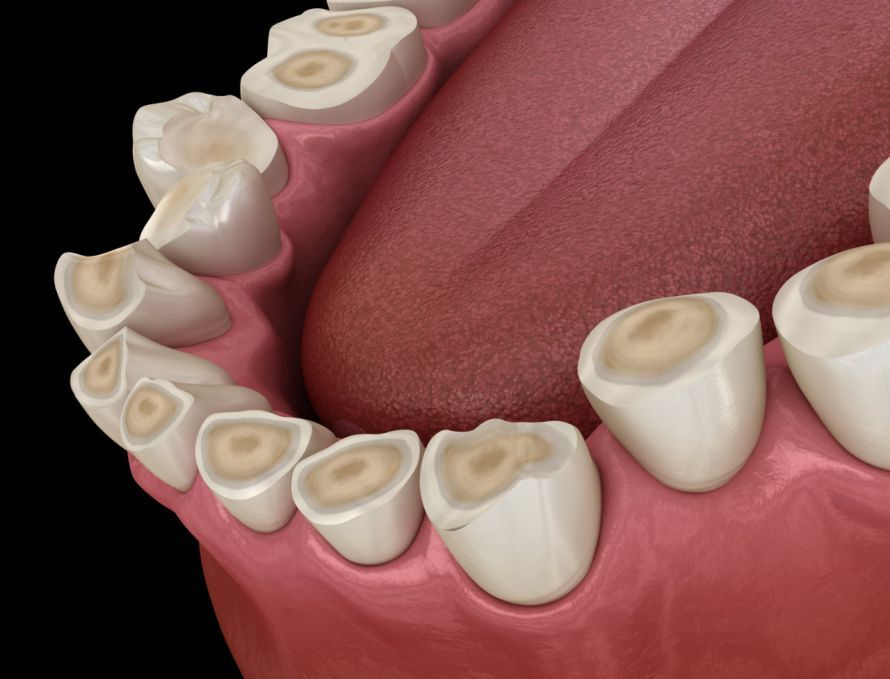
In the worst-case scenario, teeth can be completely worn down or destroyed by teeth grinding © Alexandr Mitiuc | AdobeStock
Changes to the temporomandibular joint
The constant strain on the temporomandibular joint caused by bruxism can also lead to associated symptoms in this area. However, tension and soreness in the jaw muscles are only the least of the problems. The constant strain causes changes in the jawbone, which can lead to the displacement of the articular disc in the temporomandibular joint.
The joint can no longer move normally and becomes locked when opening and closing the mouth. The consequences include clicking sounds during mouth movement or a restricted range of motion when opening the mouth.
The temporomandibular joint is also highly susceptible to inflammation under constant strain. With chronic teeth grinding,
- the joint capsules,
- the ligaments,
- the tendons, and
- the muscles
can quickly become inflamed. This is very painful for the person affected.
Diagnosis of Bruxism
In most cases, a diagnosis of teeth grinding is made purely by chance during a routine dental checkup. During the medical history interview, doctors should therefore also ask about symptoms that may not initially seem related to the teeth:
- frequent headaches,
- tension in the neck muscles,
- sore muscles in the masticatory muscles,
- increased stress at work and at home.
If increased wear and small grooves are visible during the dental exam, a preliminary diagnosis of bruxism can already be made. In order to prescribe appropriate treatment, the dentist must first determine the cause of the teeth grinding.
The dentist will then examine the mouth and jaw area to look for physical causes of teeth grinding. He or she will check how far and exactly where the teeth touch after the jaw is closed.
If there is
- a tooth,
- a dental crown,
- a dental bridge, or
- an implant (or even several)
that protrudes above the level of the other teeth, this can be a cause of bruxism.
By palpating the jawbone from the outside and inside, the dentist can also determine whether there is a misalignment. If touching the area causes additional pain, the dentist may, after a more thorough examination, diagnose inflammation in the temporomandibular joint. This inflammation can be either a cause of or a symptom accompanying teeth grinding.
The dentist can rule out most physical causes during an examination. If the dentist is unable to reach a conclusion, they will refer the patient to a psychotherapist for a more detailed evaluation.
Treatment for Teeth Grinding (Bruxism)
The treatment of bruxism depends primarily on the cause.
If misalignments in the mouth are causing the constant grinding, these must be corrected.
- Tooth crowns and bridges that are too high are ground down,
- ill-fitting dentures and implants are adjusted,
- and misaligned teeth are straightened by an orthodontist.
If the causes of teeth grinding lie in the temporomandibular joint (TMJ) area, the specific treatment becomes more difficult. The misalignment of the TMJ that causes teeth grinding is often the result of cartilage loss (osteoarthritis) in the joint.
However, this cannot be successfully treated. To date, there are no medical methods for regenerating destroyed cartilage. In this case, only the symptoms can be treated. Therefore, targeted exercises are used to consciously achieve the correct alignment of the teeth. If this is successful, the teeth of the upper and lower jaws no longer touch, and the teeth grinding stops.
If the causes of teeth grinding are psychological in nature, psychotherapy should be considered. The psychotherapist will help with stress management and teach techniques for stress reduction and relaxation.
Other helpful measures include, among others,
- yoga,
- progressive muscle relaxation, and
- exercise to help the body recover and regain balance.
The Night Guard for Teeth Grinding (Bruxism)
To immediately stop the harmful effects of teeth grinding, a mouthguard is often used. Treatment targeting the underlying cause rarely leads to the desired results very quickly. A mouthguard can prevent further damage to the teeth.
For this purpose, there are bite splints, also known as night guards. They are usually made of clear plastic and are placed over the teeth of the lower jaw. By acting as a barrier between the teeth, they prevent the tooth surfaces from wearing down during teeth grinding. Thus, they do not prevent teeth grinding itself, but only the destruction of the tooth enamel.
Night guards must be worn when the person is grinding their teeth. A guard worn at night is not helpful if the patient primarily grinds their teeth during the day.
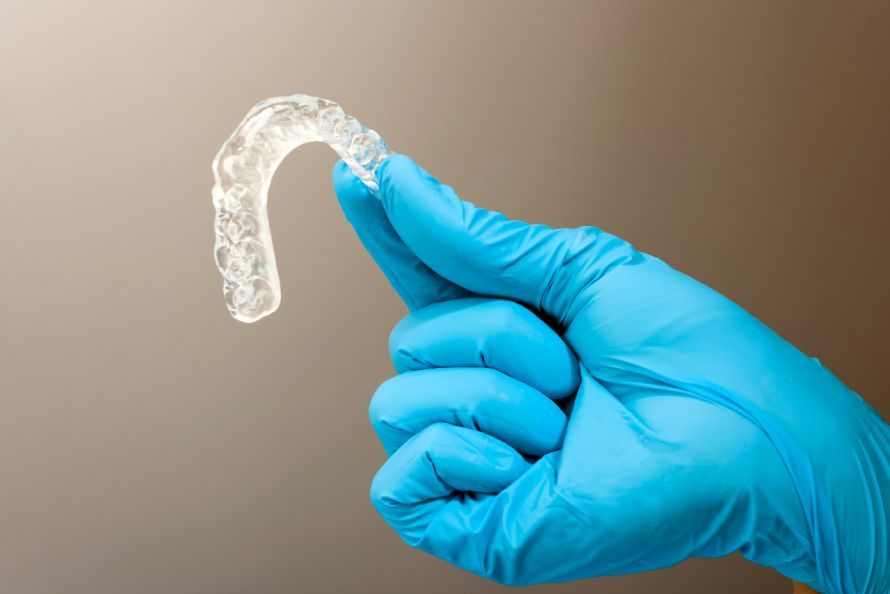
A bite guard prevents the teeth from rubbing directly against each other © Joaquin Corbalan | AdobeStock
The cost of a basic nightguard is usually covered by public health insurance. However, these guards are not custom-fitted to the jaw and therefore do not target the specific teeth that are most affected by grinding and clenching. As a result, they often do not fit well, slip over the teeth, and—especially at night—fall out of the mouth.
In most cases, statutory health insurance plans do not cover the cost of custom-fitted bite guards. If you have supplemental dental insurance, it’s worth calling your insurance provider. Most supplemental insurers already cover a portion of the costs.
Share this article