Pulpitis is an inflammatory condition of the dental pulp. It affects the soft inner part of the tooth (the dental pulp). The most common cause of inflammation of the dental pulp is tooth decay. Simple, reversible pulpitis can often be treated with anti-inflammatory medications. Severe or chronic, irreversible pulpitis, on the other hand, requires root canal treatment to save the tooth.
Here you will find further information as well as a selection of pulpitis specialists and centers.
What is pulpitis?
Pulpitis is an inflammation of the dental pulp inside the tooth. It is caused by
- mechanical, thermal, or chemical irritation—such as that which occurs during dental treatment—or
- bacteria that enter the tooth through cavities or cracks in the tooth’s surface
. The inflammatory process can spread into the root canal and the jawbone. In the worst-case scenario, complete tooth loss may result.
Colloquially, pulpitis is also referred to as “tooth nerve inflammation.” However, this is only partially correct. It is not just the tooth nerve that is inflamed, but the entire dental pulp inside the tooth. Blood vessels and lymphatic vessels also run through this area.
Generally, a distinction is made between reversible and irreversible pulpitis.
If the irritation of the dental pulp is short-lived and treated promptly, improvement often occurs quickly. The pulpitis can then be completely cured; it is, therefore, reversible.
If pulpitis is left untreated, the dental pulp is exposed to ongoing irritation. The inflammation then becomes chronic, and in many cases, the pulpitis becomes irreversible. As a result, localized
- infarcts,
- necrosis, and finally
- microabscesses form in the pulp.
The tissue inside the tooth dies. If the tooth is to be preserved—that is, if it is not to be extracted—root canal treatment is then necessary. The procedure is complex and quite painful. During the procedure, the dead nerve and other tissue inside the tooth are removed, and the cavities are sealed.
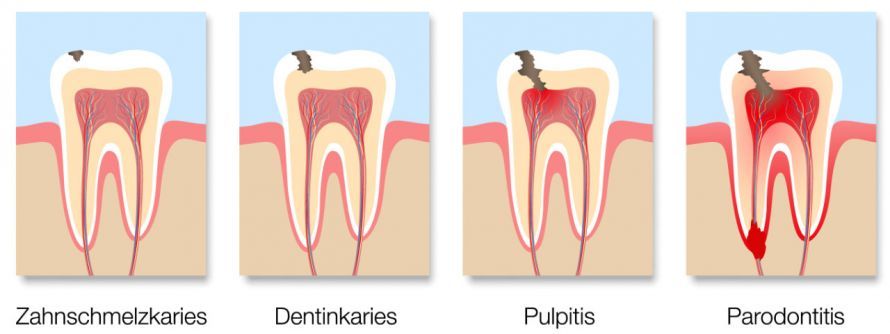
Causes of pulpitis
Pulpitis can have many different causes. In about 95 percent of cases, tooth decay is by far the most common trigger for inflammation of the pulp.
Deep tooth decay creates cavities in the tooth. These cavities extend all the way to the pulp, allowing bacteria unhindered access to the sensitive dental pulp.
Much less commonly, pulpitis results from a tooth injury or an open dental procedure. The pulp can also be exposed and attacked by bacteria as a result of accidents or during dental treatments.
Open dental injuries should therefore be treated as soon as possible to prevent secondary damage such as pulpitis.
Symptoms of Pulp Inflammation
Acute pulpitis is painless in its early stages. The affected person is merely sensitive to external stimuli such as
- cold and heat,
- sweet and sour foods.
If pulpitis goes undetected and untreated, the dental pulp reacts to the inflammation. Blood flow to the tissue increases to counteract the inflammatory changes. As a result, more serum leaks from the small blood vessels in the pulp into the surrounding tissue. This leads to swelling of the dental pulp.
However, because of the hard tooth walls, the dental pulp cannot expand indefinitely. This leads to a significant buildup of pressure inside the tooth. Nerves, lymphatic vessels, and blood vessels are compressed. This causes spontaneous pain that is sometimes throbbing or pulsating. Initially, the pain occurs in intense but relatively brief episodes.
In most cases, the pain radiates in all directions within the jaw. This makes it very difficult to pinpoint the exact location. Many patients can only identify the affected side of the face as the source of the pain, not the specific tooth involved.
Over time, however, the pain-free intervals between episodes of pain become increasingly shorter. This is followed by a persistent, throbbing, and very severe pain.
If pulpitis is not treated at this stage, it can lead to pulp necrosis. This refers to the complete death of the dental pulp. When the nerve in the tooth dies, it can no longer transmit pain. Consequently, the pain subsides and disappears entirely. While this provides relief for the patient, it is actually a negative sign indicating a severe, active inflammation.
In cases of severe pulpitis that has already spread to the tooth’s root canal, pus may also form inside the tooth. The pus subsequently breaks through to the outside, causing bad breath and an unpleasant taste in the mouth.
If the inflammation spreads into the jawbone, an abscess may form there. The pus eats into the bone tissue, which is associated with severe pain. It also causes damage to the periodontium and the jawbone.
As a result, the tooth may become loose and fall out. If left untreated, in extreme cases the infection can spread. This means the entire oral cavity can become inflamed, or even lead to blood poisoning.
Diagnosis of Pulpitis
In general, you should see a dentist if you have a toothache. During the initial consultation, the dentist will ask you about your exact symptoms and any underlying medical conditions.
During the subsequent examination, the dentist will check the affected tooth for abnormalities such as
- cavities and
- tenderness.
Using a dental probe, the dentist will gently tap the tooth. A healthy dental nerve will only register the tapping. An inflamed dental nerve, however, will react to even the slightest touch with a pain response.
During the examination, the dentist must rule out other possible causes of the symptoms. Similar symptoms can occur, for example, with
- periodontitis or
- simple tooth decay without inflammation of the dental pulp.
For further diagnosis and to determine the extent of the pulpitis, an X-ray is taken. It quickly reveals
Treatment of Root Canal Inflammation
Early Treatment of Acute Pulpitis
In cases of acute, non-chronic inflammation of the dental pulp, treatment is still relatively simple. In many cases, treating the underlying condition is sufficient. It is then enough to remove the decay from the tooth and properly fill the resulting cavity. The dental pulp is then no longer exposed to direct irritants. In most cases, the inflammation subsides on its own.
Anti-inflammatory medications may be prescribed to support the healing process. They are available in the form of tablets or gels for topical application.
Treatment of Chronic Pulpitis
In cases of advanced, chronic pulpitis, treatment is no longer quite as simple. In most cases, the only effective solution is root canal therapy and the removal of the entire pulp.
The tooth is opened under local anesthesia. The dentist removes the pulp, along with the source of inflammation, from inside the tooth. The resulting cavity is cleaned and carefully filled with a special filling material to ensure it is bacteria-proof. The opening in the tooth is then sealed again.
It may be sufficient to first seal the opening into the tooth’s interior with cement for protection and then restore the tooth with an amalgam or composite filling.
If this method cannot fully ensure the tooth’s stability, the tooth must be covered with a dental crown. This decision depends on how much healthy dentin had to be removed.
Removing the dental pulp can prevent the infection from spreading to the periodontium and the jawbone. This makes it possible to save the tooth.
Treatment for an Additional Localized Abscess
If a local abscess also develops, it may need to be incised and the pus drained in some cases. This prevents the infection from spreading to other parts of the dentition.
In addition, antibiotics are required as part of a comprehensive treatment plan. Antibiotic treatment is administered
- either in the form of tablets, if the pus is located in a closed chamber and cannot be easily removed, or
- locally in the form of solutions or so-called antibiotic strips, which are placed directly into the wound. After some time, they are removed and replaced as needed.
Share this article