
Doctors use the term “vasculitis” to describe a complex group of diseases characterized by inflammation of the blood vessels. This vascular inflammation can affect blood vessels of all sizes—from large arteries to the smallest capillaries—and thus damage various organs. Since vasculitis often occurs as a systemic disease, the lungs, kidneys, or nervous system may be affected. Vasculitis frequently arises primarily due to a malfunction of the immune system, but it can also develop secondarily as a result of another underlying condition. Whether it is giant cell arteritis, granulomatosis with polyangiitis, or cerebral vasculitis, prompt diagnosis and consistent treatment are crucial to preventing complications such as stroke or organ failure.
What is vasculitis?
The medical umbrella term “vasculitis” encompasses a variety of conditions. They have different causes and courses. A distinction is made between primary and secondary vasculitides:
- Primary vasculitis is a vascular disease that occurs on its own.
- Secondary vasculitides develop in the context of certain underlying diseases or as side effects of medications and certain substances.
The inflamed blood vessels swell, which increasingly impairs the supply of oxygen and essential nutrients to the organs.
Types of Vasculitis
Vascular inflammation can affect blood vessels of various types and sizes:
- small blood vessels (capillaries): Wegener’s disease or Wegener’s granulomatosis (possibly also affecting medium-sized vessels)
- medium-sized blood vessels (arterioles, venules): Kawasaki syndrome
- large blood vessels (arteries, veins): Takayasu arteritis or giant cell arteritis
In the vasculitides Behçet’s disease and Cogan’s syndrome, blood vessels of all types can be affected.
Giant-cell arteritis (cranial arteritis) is the most common of all vasculitides. It primarily affects the temporal arteries. Patients with this condition are generally older. They also often suffer from polymyalgia (a rheumatic disease characterized by severe muscle pain).
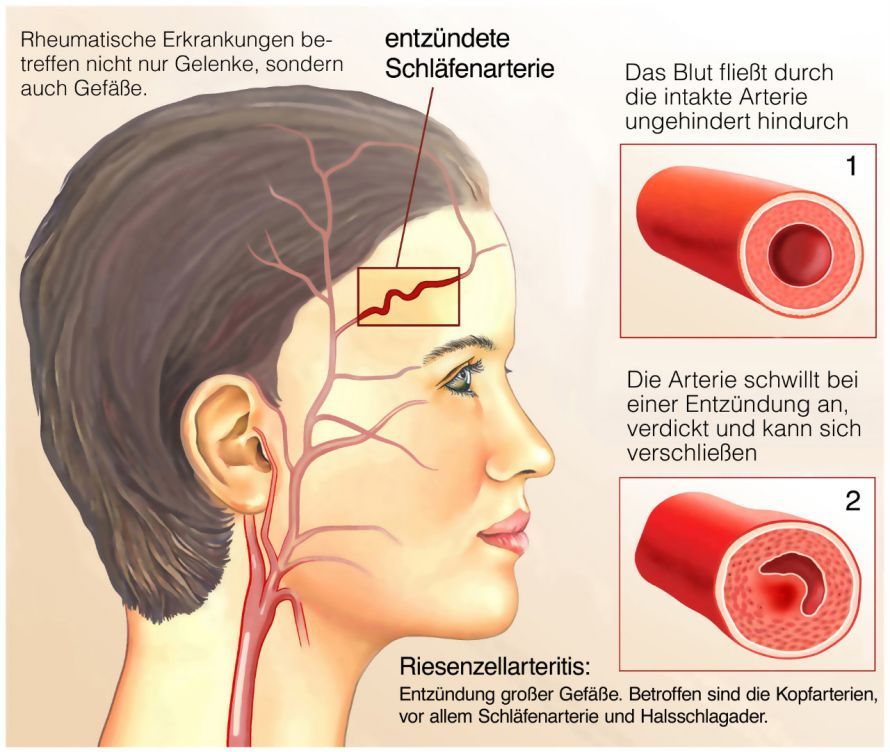
If the aorta and its major branches are inflamed, the condition is referred to as Takayasu arteritis.
Wegener’s granulomatosis has a distinctive anatomical feature: the inflamed blood vessels—usually arterioles in the kidneys and lungs—exhibit coarse, nodular changes. In the early stages, it is found only in the respiratory organs. As the disease progresses, the granulomatosis spreads to other organs as well.
Kawasaki syndrome primarily affects young children under the age of 5.
Behcet’s disease is particularly prevalent in Turkey and Japan. The inflammation can be life-threatening if it spreads to the lungs, heart, or central nervous system (brain and spinal cord).
Secondary vasculitides generally affect only small blood vessels. Vasculitis allergica, for example, is a type of vasculitis caused by certain medications. It is triggered by allergy medications and asthma inhalers.
Causes of Vasculitis
Primary vasculitis is usually the result of an autoimmune reaction. This is an excessively strong reaction by the body’s immune system to its own structures.
It first damages the inner walls of the affected blood vessels. Subsequently, the inflammatory processes spread to nearby organs.
Exactly what leads to this vascular inflammation remains unclear. It is believed to be a combination of genetic predisposition and external factors. Infection with Staphylococcus aureus bacteria is suspected to be a risk factor.
Secondary vasculitides are often
- infectious diseases (HIV/AIDS, hepatitis)
- autoimmune diseases (rheumatoid arthritis, connective tissue inflammation)
- Cancer
- certain medications
as their cause. For example, the side effects of some antibiotics can trigger vasculitis.
Symptoms and Diagnosis of Vasculitis
The various types of vasculitis differ in terms of the specific symptoms that patients experience.
General signs of all forms of vasculitis include, for example,
- loss of appetite,
- weight loss,
- exhaustion,
- decreased energy,
- fever,
- joint pain,
- night sweats.
Depending on the form and severity, specific symptoms may also be present. These can include:
- open sores,
- patchy redness of the skin,
- vascular occlusion,
- visual disturbances and red eyes in cases of ocular vasculitis,
- nerve pain,
- paralysis.
Patients who suspect they have vasculitis should see a doctor as soon as possible. Specialists in this field are physicians who specialize in vascular diseases (angiologists or phlebologists).
If the suspicion is confirmed during the examination, a blood sample will be taken. This allows the laboratory to test for ANCA antibodies and elevated inflammatory markers.
An X-ray of the affected organs or an angiogram (X-ray of the blood vessels) provides further clues. A tissue sample (biopsy) taken from
- the skin,
- the kidneys, or
- the temporal artery
can be helpful in diagnosing vasculitis.
Treatment Options for Vasculitis
Treatment with immunosuppressive medications provides relief for many patients. These medications inhibit the excessive immune response and thus slow the progression of the disease in the body.
In addition, specific medications are used in the treatment of vasculitis to target the particular form of the disease. These primarily include corticosteroids. The patient receives high doses at the start of treatment, which are then gradually reduced over time.
In severe cases, cytostatic drugs such as cyclophosphamide are also used. Antibodies have recently become available for certain forms of vasculitis.
Vasculitis itself is incurable. Nevertheless, people affected by it can lead a largely symptom-free life.
However, relapses do sometimes occur. They should be detected and treated promptly.
FAQ: The 8 Most Important Questions About Vasculitis and Vascular Inflammation
What are the first signs of vasculitis?
The symptoms of vasculitis are often nonspecific at first, which makes diagnosing the condition difficult. Patients frequently complain of general symptoms such as fever, night sweats, weight loss, and fatigue, which indicate an inflammatory response in the body. Depending on which organ or blood vessel is affected, specific symptoms may also be present. In giant cell arteritis, these often include one-sided headaches and visual disturbances, while cutaneous vasculitis manifests as small hemorrhages (purpura) or ulcers.
What forms of vasculitis are there?
There are many different forms of vasculitis, which are classified according to the size of the affected blood vessels. The 2012 Revised International Chapel Hill Consensus Conference standardized this classification. Vasculitides affecting large vessels include giant cell arteritis (temporal arteritis). Small and medium-sized vessels are often affected in granulomatosis with polyangiitis or cryoglobulinemic vasculitis. A special form is cerebral vasculitis, which affects only the vessels in the brain and spinal cord.
What is ANCA-associated vasculitis?
This is a group of primary vasculitides in which certain antibodies (ANCA) are produced against the body’s own immune cells. These autoantibodies lead to inflammation of the small blood vessels. This group includes granulomatosis with polyangiitis, microscopic polyangiitis, and eosinophilic granulomatosis with polyangiitis. This form of vasculitis frequently affects the kidneys and lungs.
How does secondary vasculitis develop?
Secondary vasculitis does not occur on its own but is the result of another underlying cause. Triggers can include an infection (e.g., hepatitis), certain medications, or rheumatic diseases such as rheumatoid arthritis or systemic lupus erythematosus. In these cases, treatment is primarily aimed at the underlying disease in order to alleviate the vascular inflammation.
How dangerous is cerebral vasculitis?
Cerebral vasculitis (or primary CNS angiitis) is a serious condition because it narrows the blood vessels in the brain. This can lead to circulatory disorders, headaches, and neurological deficits, and may even result in a stroke. Diagnosis is complex and often requires an MRI and cerebrospinal fluid analysis. Cerebral involvement is also possible in systemic vasculitides and requires aggressive drug therapy.
How is vasculitis treated?
Treatment for vasculitis depends on the severity and type of the condition. Drug therapy aims to suppress the overactive immune system. The drugs of choice are glucocorticoids (cortisone) in combination with immunosuppressants (e.g., cyclophosphamide, methotrexate) or biologics (e.g., rituximab), particularly in cases of ANCA-associated vasculitis. Since this treatment often involves many side effects, it must be closely monitored.
What is granulomatosis with polyangiitis?
Formerly known as Wegener’s disease, this is a necrotizing vasculitis that affects small to medium-sized blood vessels. It often begins in the ENT region (chronic rhinitis, sinusitis) and later spreads to the lungs and kidneys. Without treatment for vasculitis, this condition can be life-threatening, but it responds well to modern immunosuppressants.
Is vasculitis curable?
Many forms of vasculitis are chronic or occur in flare-ups. A complete cure is often not possible, but with the right treatment, remission (absence of symptoms) can usually be achieved. Since vasculitis can often flare up again (recurrence), patients require lifelong care. If a flare-up is suspected, a doctor should immediately consider the possibility of vasculitis.
Share this article
Sources
- S1-Leitlinie „Zerebrale Vaskulitis und zerebrale Beteiligung bei systemischen Vaskulitiden und rheumatischen Grunderkrankungen“; AWMF-Registernummer: 030/085
- vaskulitis.org