Expert Interviews
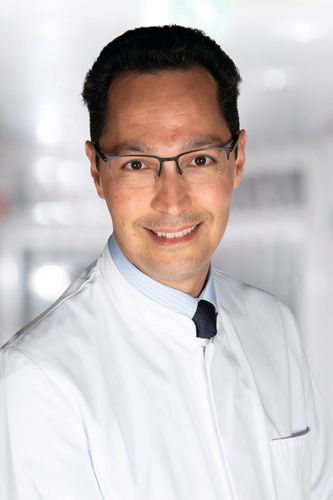
Precise Liver Surgery with Robotic Assistance: The Future of Liver Treatment—An Expert Interview with Prof. Kollmar

Alexandra Pfitzmann ·
The Clarunis Liver and Liver Cancer Center is led by Prof. Dr. med. Otto Kollmar, who brings expertise and outstanding competence to the role. Located in the Basel metropolitan region, this center is recognized internationally as a center of excellence for all matters related to the liver. Together with Prof. Beat Müller, M.D., and Prof. Markus Heim, M.D., Prof. Kollmar forms a highly specialized team of experts in liver diseases, including hepatitis and liver cancer. Their expertise also extends to the bile ducts and gallbladder as integral components of the digestive tract. The liver plays a central role in metabolism, from nutrient utilization to detoxification. A healthy liver is therefore essential. If you experience symptoms or have a disease of the liver or biliary system, it is advisable to consult specialized physicians.
At the Clarunis Liver and Liver Cancer Center in Basel, patients receive first-class care at an international level. The experts employ innovative treatment methods, thereby exceeding current standards in abdominal surgery. Liver diseases are often asymptomatic or present with nonspecific symptoms such as fatigue. Early diagnosis is therefore crucial. The center offers high-quality diagnostics using the latest medical technology. State-of-the-art imaging techniques such as ultrasound, magnetic resonance imaging (MRI), and computed tomography (CT) enable precise examination and timely detection of liver abnormalities.
When tumors or malignant changes are suspected, interdisciplinary teams are on hand to initiate targeted and effective treatment. Prof. Dr. med. Beat Müller and Prof. Dr. med. Otto Kollmar specialize in particular in complex tumor surgeries. Thanks to their extensive expertise and many years of experience, they ensure precise surgical treatment, particularly for liver cancer. The center in Basel also performs innovative alternative procedures, such as ablation, to destroy tumors. Patient care is individualized and patient-centered, supported by state-of-the-art technologies and interdisciplinary collaboration.
The outstanding quality of the Clarunis Liver and Liver Cancer Center was recognized through certification by the German Cancer Society in 2021. As the second center of its kind in Switzerland, it meets the highest international quality standards. Patients can therefore rely on first-class treatment based on the latest medical research. Prof. Dr. med. Otto Kollmar leads the center to excellent treatment outcomes and plays a key role in improving his patients’ quality of life and prognosis. Thanks to modern robotic assistance, surgeries are becoming increasingly precise—the editorial team at the Leading Medicine Guide wanted to learn more about this, specifically regarding liver surgery, and spoke with the expert Prof. Dr. med. Otto Kollmar.

Modern advances in medicine are revolutionizing the way we perform complex surgical procedures. In this sense, robotic assistance in liver surgery marks a significant milestone. Precise and advanced technologies offer surgeons the ability to perform procedures with the highest accuracy and in a minimally invasive manner. This technological advancement promises not only improved surgical precision but also faster recoveries and better treatment outcomes for patients with liver diseases.
Robotic-assisted liver surgery has revolutionized the treatment of liver diseases by offering a number of specific advantages over conventional surgical procedures.
By using robots, surgeons can perform extremely precise movements, leading to improved fine motor skills and more accurate instrument guidance. This precision makes it possible to make precise incisions and treat problematic areas of the liver with greater precision. The 3D view and improved camera perspective provide surgeons with a detailed view of the surgical site, and the minimally invasive nature of robot-assisted procedures means smaller incisions and less tissue trauma for patients. This results in less blood loss, a faster recovery, and shorter hospital stays.
“If I’m to give an honest assessment of this, I must first emphasize that there are still no definitive studies showing that robot-assisted surgery is absolutely better than open or conventional surgery in terms of outcomes. But we know—based in part on existing studies—that minimally invasive robot-assisted surgery offers enormous advantages. Patients regain mobility incredibly quickly, there are no postoperative restrictions for patients regarding lifestyle or diet, the need for pain medication is drastically reduced—patients really experience very little pain—and they go home within 3–4 days. These are definitely factors we’ve observed over the past two years. Of course, it makes a huge difference whether a patient has been in the hospital for 10 days or just 3–4, whether they have to fast for 2 days or can eat normally right away, and whether they have a catheter for pain medication or not. Therefore, given these advantages, the trend will most certainly shift toward robot-assisted surgery over the next 1–3 years. “The complication rate—including the risk of pneumonia, bowel dysfunction, or thrombosis—is also nearly zero with robot-assisted surgery,” Prof. Dr. Kollmar explains at the start of our conversation.
Robotic technology plays a crucial role in minimizing risks and shortening recovery time for patients with liver disease.
“In principle, laparoscopy—that is, minimally invasive surgery—allows for a much gentler procedure in and of itself. But the use of robotic assistance further enhances technical capabilities. The precise instrument guidance and improved visibility make it possible to make more targeted incisions and safely treat critical areas of the liver, which minimizes the risk of bleeding and injury to surrounding tissue. As far as instrument manipulation is concerned, we are significantly limited by the angles involved, especially in liver surgery. Suturing with the robot is a dream in this context—it’s also much faster than, for example, in open surgery. This is because you can fully angle the instruments inside the body exactly as needed. For the surgeon as well, a robotic procedure is much less physically taxing. Whereas, for example, after a 3-hour open surgery, the surgeon is physically exhausted from standing at the operating table, during robot-assisted procedures the surgeon sits at the console and is subjected to significantly less physical strain. “Thanks to its capabilities, the robot has clearly surpassed laparoscopy on its own,” notes Prof. Dr. Kollmar.
Precise robotic-assisted liver surgery has made considerable progress over the years, driven by a series of technological improvements.
Among the significant advances are improved imaging techniques such as 3D imaging, which enable more precise preoperative planning. This improved planning allows surgeons to plan procedures more accurately and provides an enhanced view of the surgical site. The integration of augmented reality systems also allows surgeons to receive relevant information in real time during surgery, which helps them better identify anatomical structures and increase the precision of the procedures. The continuous development of robotic systems and the integration of modern technologies have made precision liver surgery an advanced and promising field within surgical medicine.
“With the help of the robot, much less tissue is damaged during surgery, and the patient’s abdominal wall and cavity are subjected to less trauma, partly because much less pressure is required inside the abdomen. As a result, inflammatory markers hardly rise at all after a robotic surgery, precisely because so much less tissue has been damaged. In addition, the surgeon operates through a magnifying lens and has a completely different view of the fine details, as the magnification can be up to ten times. With standard surgical glasses, magnification is only about 2.5x—that’s a significant difference. This also allows for much more precise and targeted surgery,” explains Prof. Dr. Kollmar, outlining the primary advantages, and adds regarding potential complications during surgery: “In standard open surgery, the much larger incision in the abdominal wall alone poses a problem for wound healing. Approximately 20% of patients experience wound-healing problems, hematomas, or may even develop an infection or an incisional hernia. With the robot and the small incisions, we simply see this very rarely.”
Before the surgery begins, the robotic system must be carefully calibrated to ensure precise control and execution of movements during the procedure. This involves checking and adjusting the robot’s positioning as well as calibrating the instruments. The surgeon plans the surgery and programs the necessary steps that the robot will perform during the procedure. This involves defining incisions, dissection steps, and other movements required for the successful completion of the surgery. “That’s perhaps a drawback of robot-assisted surgery—it takes a lot of time at the beginning to set up the equipment, at least 20 minutes. And you can’t do that until the patient is already on the operating table. But ultimately, the advantages outweigh the disadvantages, which is why we have two da Vinci robots at the Clarunis – Liver and Liver Cancer Center Basel and two at St. Clara Hospital as well. Patients are now asking for it themselves and prefer to have the necessary procedure performed with a robot, if possible. Surgeons need a certain amount of training to be able to operate with a robot. However, the learning curve is very steep—faster than when learning standard minimally invasive techniques. You definitely have to adjust to the haptic feedback. This can be described as a ‘no-touch technique.’ For example, I can see via ultrasound whether I can compress tissue effectively or not without actually feeling it,” states Prof. Dr. Kollmar.
Robotic assistance in liver surgery has proven particularly beneficial for complex procedures or for patients with specific liver diseases.
“In precise procedures to remove liver tumors or tumors located near vital structures, robotic assistance helps to better preserve the surrounding tissue and increase the accuracy of the procedure. This is where the patient benefits most from the technology. After all, the faster the tumor is removed and the faster the patient can recover, the sooner follow-up therapy—such as chemotherapy—can begin. If a tumor is removed via open surgery, the patient would have to stay in the hospital longer due to the extended wound healing time, or rehabilitation would be necessary. In the future, there will certainly be an even greater emphasis on performing less extensive surgeries, allowing patients to regain mobility more quickly and begin multimodal therapy. In that case, it’s better to perform a second or third surgery, but always in a minimally invasive and targeted manner. This is already partly the case today, where chemotherapy is administered before a surgical procedure and not always just afterward. We can also use the robot to first remove existing metastases, for example; the patient recovers briefly, and only then do we remove the primary tumor in the colon, allowing the patient to begin their follow-up therapy very quickly. “In the past, such treatment used to drag on for many months, involving extensive rehabilitation and convalescence,” says Prof. Dr. Kollmar, describing the advantages.
The introduction of robotic surgery in liver treatment undoubtedly has many advantages, but it also presents some challenges and limitations.
One of the main issues is the cost and accessibility of this technology. The initial costs for robotic systems are high, as is the training required for medical staff. This can limit the availability of this advanced method for some medical facilities and thus affect patient access. “Ultimately, however, if patients no longer have to stay in the hospital as long—due to faster recovery thanks to robot-assisted surgery—then the hospital saves a lot of money. Nevertheless, recouping the acquisition costs is definitely an issue,” said Prof. Dr. Kollmar regarding the financial considerations involved in robotics.
Despite their precision and accuracy, robotic-assisted systems still have technological limitations. In some complex situations, the dexterity and flexibility of human hands may be superior. “This is the case, for example, when tumors are too close to blood vessels. In such cases, we do not use robots—for instance, with bile duct tumors located at the entrance to the liver. There are only a few colleagues worldwide who perform these surgeries with robots. But we’re not quite there technically yet. However, I’d like to emphasize that of the 130 liver surgeries we performed last year, only 60% were open surgeries,” explains Prof. Dr. Kollmar.
The future of precision liver surgery using robotic assistance continues to promise exciting developments and innovations.
One promising prospect lies in the continuous improvement of the robotic technology itself. Future generations of robots are expected to offer even greater precision, greater range of motion, and improved capabilities for interacting with human tissue. “Certainly, in the near future—within the next 2–3 years—the instruments will improve, become even more precise, and cause even less tissue damage. Another significant step would be the integration of artificial intelligence (AI) and machine learning into robotic assistance. This would allow robots to continuously learn during surgery and adapt to different anatomical structures, enabling even more precise and personalized treatment, and potentially even warning the surgeon if an instrument is advancing into sensitive areas. Research and industry are definitely moving in this direction. I can even imagine that, with the help of AI, robots will one day be able to perform surgeries autonomously. “Whether it makes sense to bypass the surgeon, I don’t know at this point,” Prof. Dr. Kollmar remarks critically.
Furthermore, advances in imaging and preoperative planning are expected. Improved diagnostic procedures and imaging technologies could help surgeons obtain even more detailed information about the patient’s liver structure before the procedure. This enables more precise planning and tailoring of surgeries to the patient’s individual needs. The miniaturization of robots is another promising area. In addition, telemedicine could play a role. With more advanced technology, surgeons could perform surgeries in real time at remote locations by remotely controlling robots. This would allow patients worldwide to benefit from the expertise of leading surgeons, regardless of their geographic location.
In June 2023, the visceral surgery team at Clarunis – University Abdominal Center Basel successfully performed the first-ever removal of a functional half of the liver (hemihepatectomy) at the University Hospital of Basel using a surgical robot.
This surgery was necessary for a 70-year-old patient with a neuroendocrine tumor that had metastasized to the liver. The hemihepatectomy, a complex procedure on the liver, was crucial to prevent further spread of the tumor and to stop the growth of cancer cells. Until now, this surgery was usually performed through a large abdominal incision, which was associated with pain and a longer hospital stay for patients. The robot-assisted surgery enabled a right-sided hemihepatectomy, in which the movements were controlled via the robotic arms. The robot-assisted method proved to be more precise and less invasive for the patient, leading to a faster recovery and an earlier discharge from the hospital.
A hemihepatectomy is a surgical procedure in which part of the liver is removed. Either the right or left lobe of the liver is removed, depending on which part of the liver is affected or needs to be removed for medical reasons. The liver consists of two main lobes: the right lobe and the left lobe. Each of these lobes has its own blood vessels, bile ducts, and functions. A hemihepatectomy may be necessary if a tumor, injury, or other disease has caused irreparable damage to part of the liver.
Regarding the successful surgery on the 70-year-old patient, Prof. Dr. Kollmar says: “For us on the Clarunis team, it was a new experience to see that such a major procedure—the removal of half a liver—could actually be performed using robotic technology. We had thought about it many times before, but actually carrying it out technically was, in the end, a validation. Technically, everything went flawlessly, with minimal blood loss and no complications. The surgery took 4–5 hours (twice as long as open surgery), but this was not a negative factor for the patient. Although the time under anesthesia was longer, because the trauma was less severe, fewer anesthetics were needed and almost no pain medication was required. The duration of the surgery is therefore no reason to perform it as open surgery. The patient himself was truly remarkable. He spent one day in the ICU after the surgery, and then everything went very quickly. After just a few days in the hospital, he was discharged and did not require any rehabilitation. Without robotics and with open surgery, the hospital stay would have been about two weeks, plus subsequent rehabilitation. “That’s a whole new world.”
Looking to the Future
“The future is definitely robotic. We’ll have to back that up with numbers. I myself wouldn’t have thought that just 3–4 years ago, although I’ve now certainly performed nearly 1,800 liver surgeries—and including transplants, surely 2,000 surgeries. Robotics will ultimately transform the entire infrastructure as well. This will affect not only liver surgery but all of surgery, and everything will change here,” predicts Prof. Dr. Kollmar, bringing the conversation to a close.
Thank you very much, Professor Dr. Kollmar, for this incredibly fascinating insight into the current state of robotics in liver surgery!
Share this article
About the medical author
Alexandra Pfitzmann
Editor
Alexandra Pfitzmann – medical author: expert knowledge, professional articles and medical insights in the Leading Medicine Guide.
More about the medical author →Expert Interviews
Read next
- Expert interview
Cardiogeriatrics: Significance and benefits in the context of hospital reform
Sep 21, 2026
Cardiogeriatrics: Significance and benefits in the context of hospital reform
Read more - Expert interview
Expert Interview with Professor Dr. Amadeus Hornemann, MPH
Sep 18, 2026
Prof. Amadeus Hornemann on Precision Medicine in Gynecology: Modern Surgery, New Techniques, Better Quality of Life
Read more - Expert interview
Expert Interview with Professor Dr. Konstantinos Anagnostakos
Sep 15, 2026
Prof. Anagnostakos on Painful Knee Replacements
Read more