Expert Interviews
Stem Cell Therapy – Regeneration of the Natural Joint: An Interview with Prof. Zimmermann

Alexandra Pfitzmann · August 1, 2024
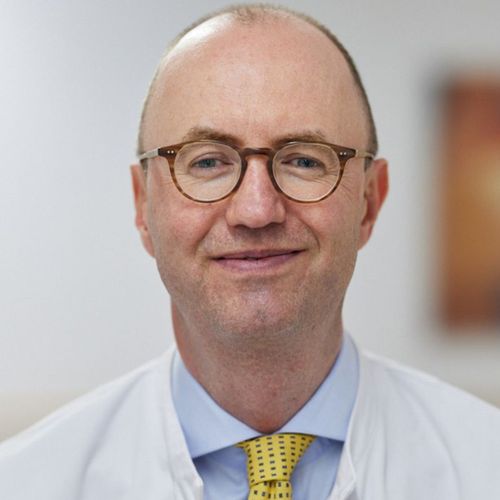
In Mannheim, right next to the Collini Center, Prof. Dr. med. Gerald Zimmermann runs a first-class private orthopedic practice specializing in joint regeneration. With his outstanding expertise, Prof. Dr. Zimmermann has made significant contributions to the development of cartilage cell transplantation and stem cell therapy and is highly regarded in the fields of knee surgery and total knee replacement. The private practice is distinguished by a holistic approach that combines scientific progress with innovative therapies and a patient-centered approach.
Prof. Dr. Zimmermann places great emphasis on promoting the natural regeneration of the joint and has more than two and a half decades of experience in orthopedics, having performed over 12,000 surgeries. As an adjunct professor at Heidelberg University, he also shares his expertise with future generations. Prof. Dr. Zimmermann is internationally renowned for his groundbreaking research findings, particularly in the field of autologous cartilage cell transplantation. His practice is among the leading institutions in Europe in this field and performs more than seventy transplants annually. In addition, he is a pioneer in stem cell therapy, particularly “SVF therapy” (stromal vascular fraction), which is used to treat sports injuries and osteoarthritis and achieves impressive results.
Prof. Dr. Zimmermann’s motto is “Everything for joint preservation and regeneration.” He is committed to exploring all possible treatment options to provide patients with optimal results. Even in cases where surgery is unavoidable, patients can count on excellent results thanks to his expertise and experience. His practice also offers state-of-the-art technologies, such as the use of robotics and ceramic implants, to maximize patients’ mobility. With his broad range of treatment options, Prof. Dr. med. Gerald Zimmermann is a leading provider of orthopedic care in the Rhine-Neckar region.
The editorial team at Leading Medicine Guide took the opportunity to speak with Prof. Dr. Zimmermann specifically about minimally invasive stem cell therapy for natural joint preservation.
Stem cell therapy uses the patient’s own or donated stem cells, which in most cases are derived from bone marrow—a procedure known as a bone marrow transplant. Stem cells are found primarily in bone marrow, but also in the blood, brain, liver, adipose tissue, and muscles. A distinction is made between embryonic and adult stem cells, with embryonic stem cells found exclusively in an embryo and adult stem cells present in the human body throughout a person’s lifetime. Stem cells possess remarkable capabilities, as they can regenerate, divide, and develop into other cell types such as red and white blood cells and platelets. In stem cell therapy, previously isolated and preserved stem cells are introduced into the recipient’s bloodstream via an infusion. This form of therapy has been used successfully for decades, primarily to treat blood cancer (leukemia) and burns, but also for natural joint preservation.
Treatment with the Stromal Vascular Fraction (SVF) differs from conventional stem cell therapies for treating knee problems in several ways.
Conventional stem cell therapies often use stem cells from the patient’s bone marrow and inject them directly or after cultivation into the affected area. In contrast, SVF therapy uses a specific fraction of cells from the patient’s adipose tissue, the Stromal Vascular Fraction (SVF).
“First, it must be clarified that stem cell therapy for knee joints is generally not permitted in Germany. The therapy is established and permitted only for patients with blood cancer—that is, people with lymphomas. In Europe, due to very restrictive legislation by the EMA (European Medicines Agency), treatment with stem cell-like cells is permitted only under pharmaceutical conditions, which would require a massive study involving many patients and costing millions of euros—resulting in a drug with an estimated cost of 50,000 euros per unit. Therefore, this project was abandoned. The rationale behind the 2013 law is that stem cells derived from fat may only be reintroduced into fat tissue and not into any other part of the body. This is justified by the potential risk that cells reinjected into other sites could cause unwanted growth—also known as ‘homologous use’,” Prof. Dr. Zimmermann clarifies right at the start of the conversation and then explains the difference from the stem cell therapy he performs and is authorized to perform:
“You can count on one hand the number of people in Germany who are authorized to perform stem cell therapy (of this specific type). This specific procedure involves the so-called stromal vascular fraction (SVF), for which I also have authorization. This is a stem cell fraction that consists not only of stem cells but also contains additional supporting proteins from fat. Since there is a fat pad in the knee joint, the therapy can therefore be performed legally. So I adhere to the required ‘homologous use’ and administer fat to fat, which is permitted but still requires authorization.”
Treatment with the Stromal Vascular Fraction (SVF) can address a wide range of knee problems and conditions, including osteoarthritis of the knee joint, cartilage damage, inflammation, and meniscus injuries, as well as other degenerative conditions of the knee joint.
“SVF therapy has been used in the U.S. since 2000. I began using it in Germany in 2006. The therapy is applied in three main areas: for osteoarthritis, following accidents, and for prevention. In cases of osteoarthritis, the therapy is often used before implant placement, either because the patient may not be a candidate for surgery or because the patient does not want a prosthesis—or any metal—in their body. In these cases, stem cell therapy is the best treatment available for preserving joint function. Studies have shown that approximately 80% of patients experience significantly greater mobility and markedly reduced pain after therapy, a finding also supported by my own published studies. In cases of accidents, SVF therapy is used when a patient has, for example, a torn cruciate ligament or meniscus—injuries that are always critical in terms of healing and also have a high failure rate, precisely because stem cells are lacking in that joint. Here, SVF therapy can significantly improve the healing rate. There are no concrete figures yet regarding the preventive use of SVF therapy, as this would require an observation period spanning many decades. “However, laboratory results have shown that the degenerative process can be halted through the regular administration of stem cells, about once a year,” explains Prof. Dr. Zimmermann.
These evaluated studies suggest that SVF therapy could be a promising option for treating knee problems, especially for patients for whom conventional treatment methods are not sufficiently effective or who wish to avoid surgery.
“Since 2017, over 90% of the patients I have treated have been included in a follow-up study, and I perform cell counting and characterization on every patient. Only complete data sets are considered for analysis, which are then published nationally and internationally in peer-reviewed journals. The analysis shows a statistically significant improvement in the parameters depicted in the graph. It can be assumed that the results will continue to stabilize as the number of patients increases. “Additional results suggest a correlation between the treatment’s efficacy and the number of cells injected, although this still needs to be confirmed in further phases of the study,” said Prof. Dr. Zimmermann regarding his own findings.
Stromal Vascular Fraction (SVF) therapy has the potential to slow or even halt the progression of knee osteoarthritis by promoting the regeneration of damaged cartilage tissue and exerting anti-inflammatory effects.
SVF therapy offers an innovative approach to treating knee osteoarthritis by harnessing the regenerative properties of stem cells and other cellular components derived from the patient’s adipose tissue. “You can think of it as a kind of battle taking place in the knee when SVF therapy is used for osteoarthritis. The loss of cartilage itself does not cause the patient pain. Theoretically, bone could rub against bone—which would ‘squeak,’ but wouldn’t necessarily hurt. It is the inflammatory response to the wear and tear of the cartilage that triggers pain and causes swelling or even overheating. And that is what the stem cells primarily combat—a very effective anti-inflammatory effect in the knee joint. And if there are still remnants of cartilage in the knee joint, new cartilage can form there bit by bit, though that isn’t even the primary goal. The most important effect is the reduction of inflammation. In contrast, there is also true cartilage cell transplantation, which I also perform, but which is limited in terms of the patient’s age and the area that can be regenerated. Furthermore, there must be no associated damage in the knee joint. For patients with cruciate ligament or meniscus damage, cartilage cell transplantation is no longer as straightforward. And in cases of generalized osteoarthritis, cartilage cell transplantation is no longer possible either. “This form of therapy is therefore more suitable for people under 50 with isolated damage,” says Prof. Dr. Zimmermann, clarifying some differences between SVF therapy and cartilage transplantation.
“For optimal recovery, we recommend having a ‘booster’ injection with PRP (platelet-rich plasma) administered two and four months after the procedure. In over 80% of cases, a significant improvement in mobility and a reduction in pain can be expected between one week and six months after the procedure,” explains Prof. Dr. Zimmermann regarding the additional procedure in Mannheim.
The use of Stromal Vascular Fraction (SVF) as a treatment method for knee osteoarthritis offers a variety of advantages compared to other common treatment options, such as hyaluronic acid injections or cartilage cell transplantation.
Unlike purely symptomatic approaches such as hyaluronic acid injections, SVF therapy aims not only to relieve pain but also to improve the structural integrity of the joint and slow the progression of the disease. A major advantage of SVF therapy is that it is minimally invasive. This means that the treatment can typically be performed on an outpatient basis and is associated with a lower risk of complications and a faster recovery time. Furthermore, it may offer long-term benefits, as it aims to treat the underlying causes of knee osteoarthritis rather than merely masking the symptoms.
“Hyaluronic acid is ultimately just a lubricant; it is not biologically active and has only a slight anti-inflammatory effect. As a result, it does not induce a shift from a catabolic to an anabolic metabolic state in the knee joint. Furthermore, hyaluronic acid must be administered repeatedly, approximately every 1–2 months. For patients with only mild disease, this can certainly lead to temporary relief of symptoms, but it is simply not as effective over the long term as SVF therapy. Cartilage cell transplantation is only suitable for small damaged areas and in cases where the knee joint is otherwise healthy and functioning. In addition, patients can expect a very long rehabilitation period of 3–6 months involving crutches and physical therapy, since two surgeries are required—one for harvesting the cells and another for reimplantation. With SVF therapy, the patient walks in the door and walks right back out. Everything is performed under local anesthesia, and the procedure is quick and complication-free. A clear disadvantage of SVF therapy is, of course, that health insurance companies do not cover the costs because it is no longer financially viable for them; in principle, the therapy would be a good treatment option for anyone at any time. And here, the health insurance companies fear that they will end up having to pay for everything. Also, people with an active tumor should not receive SVF therapy. Otherwise, there are actually no restrictions,” explains Prof. Dr. Zimmermann, adding one more point:
“For me as a doctor, very slim people are a challenge, since it’s difficult to find and harvest fat tissue (90% of the fat is located in the abdomen). I recently treated a Russian ballet dancer who already had significantly degenerative changes in her knees. I couldn’t find any fat anywhere, not even on the inner thighs—which is often the last refuge for fat (in men, it’s on the back, in the so-called ‘love handles,’ the rear part of the hips). I had to tell the patient that she would first have to gain weight, since I couldn’t perform the treatment as it was; she did just that and returned to me for treatment six months later.”
All patients receive an invoice based on the billing codes of the GOÄ. Since SVF therapy is a new treatment not provided for in the fee schedule (which has not been updated since 1995), the codes are applied analogously and, in some cases, increased up to 3.5 times to cover the costs. Patients with public health insurance should expect that the costs of approximately 3,500.00 euros per joint will not be covered. In individual cases, portions of the costs may be covered. Privately insured patients should submit the aforementioned invoice. In some cases, at least part of the cost will be covered.
SVF treatment for knee problems is a complex process involving several steps, beginning with a thorough evaluation of the patient and their suitability for the therapy.
During the consultation, the condition of the affected knee is examined in detail, and the patient’s medical history is discussed to ensure that they are suitable for SVF therapy. Potential contraindications are also taken into account, such as existing medical conditions or previous knee surgeries. If the patient is deemed suitable for treatment, the next phase involves harvesting fat tissue from the patient’s body. This is typically done from areas such as the abdomen, hips, or thighs.
“There are very few contraindications for this therapy. The patient comes to see me (without fasting) and receives a local anesthetic. Using a blunt needle, I extract up to 50 cm³ of fat, which takes about 15 minutes, and the stem cells are then extracted from this. These are mechanically broken down, and no additives are added. The SVF fraction is obtained within about an hour. Various processes are carried out during this procedure. The recovered fraction is reinjected into the knee using a standard syringe, specifically into the so-called “Hoffa’s fat pad,” which is located within the knee joint, thereby completing the cycle required by law. As a rule, SVF therapy is a one-time treatment, unless the patient requests annual preventive therapy. Many patients suffering from pain do not return for years after the therapy is completed, as confirmed by the 2018 study I initiated involving 300 patients. “American studies report a duration of effect ranging from 2 to 5 years, which also corresponds to my personal experience in Germany,” said Professor Dr. Zimmermann regarding the procedure.
After SVF treatment for knee problems, the healing process begins, which can vary depending on the patient’s individual condition.
In the first few days after treatment, some patients may experience mild discomfort or swelling in the treated knee joint. In the following weeks and months, the healing process continues as the SVF exerts its regenerative properties and contributes to the repair of the damaged tissue. During this time, a gradual improvement in knee symptoms can be observed, with many patients experiencing a reduction in pain, stiffness, and inflammation. However, this healing process can vary from person to person and depends on various factors, such as the severity of the knee problems and the patient’s overall health.
Outlook
“My greatest hope is that health insurance companies will cover this therapy. Ultimately, it could also help prevent secondary conditions. But to achieve that, we have to think in terms of decades—and then it would be a very worthwhile endeavor. Unfortunately, the situation here is much like in politics: by the time the benefits are realized, the decision-makers will no longer be in office. That’s a shame, because in the long run, everything would become more affordable. Aside from myself, there are about ten other colleagues in Germany who offer SVF therapy—which isn’t many—but they also know how to do it, and I meet with them regularly. Overall, there are very few specialized lectures like the ones I give abroad—such as recently in Dubai, where the regulations are different. There, for example, I’m allowed to use SVF therapy as an anti-aging treatment. “On my new website, www.cellreg.com, you’ll find all the options for Dubai, publications you can view, and even more information about SVF therapy,” Prof. Dr. Zimmermann recommends in closing, and with that, we conclude our conversation.
Thank you very much, Professor Dr. Zimmermann! This insight into what is likely to be a groundbreaking therapy was incredibly fascinating and offers real hope to patients with knee problems!
Share this article
About the medical author
Alexandra Pfitzmann
Editor
Alexandra Pfitzmann – medical author: expert knowledge, professional articles and medical insights in the Leading Medicine Guide.
More about the medical author →Expert Interviews
Read next
- Expert Interviews
Expert Interview with Professor Dr. Amadeus Hornemann, MPH
Sep 18, 2026
Prof. Amadeus Hornemann on Precision Medicine in Gynecology: Modern Surgery, New Techniques, Better Quality of Life
Read more - Expert Interviews
Expert Interview with Professor Dr. Konstantinos Anagnostakos
Sep 15, 2026
Prof. Anagnostakos on Painful Knee Replacements
Read more - Expert Interviews
Expert Interview with Professor Karl Philipp Kutzner, M.D.
Sep 11, 2026
Prof. Kutzner on Cutting-Edge Endoprosthetics at ENDOPROTHETICUM Mainz
Read more