Expert Interviews
Life Without Glasses – Precise Visual Acuity Thanks to Lasers

Leading Medicine Guide Editors ·
Vision and its preservation are closely linked to the history of our civilization. It was only with the invention of eyeglasses, for example, that people with visual impairments were able to contribute to the common good. It wasn’t until well into the 20th century that suitable surgical techniques for the eye were developed. Today, medical professionals have access to state-of-the-art advancements in refractive surgery. One particularly innovative procedure is TransPRK. Dr. Diego de Ortueta discusses this in an interview with Leading Medicine Guide.
A life without glasses—that is the wish of many people who suffer from nearsightedness or farsightedness. No more carrying around glasses cases, no more changing contact lenses. Wearing glasses, however, is not a new phenomenon associated with, say, working at a computer screen; it was already an issue more than 800 years ago. Glasses have been used to correct vision problems since the 13th century. Of course, they were anything but precise. When the first surgical techniques emerged in the early 20th century, they often resulted in unsightly scarring. Perhaps this is why there is still skepticism today regarding eye surgery. Today, we know from ophthalmologists and eye care specialists that this fear is unfounded.

Dr. Diego de Ortueta, an ophthalmologist, is an expert in the field of laser eye surgery.
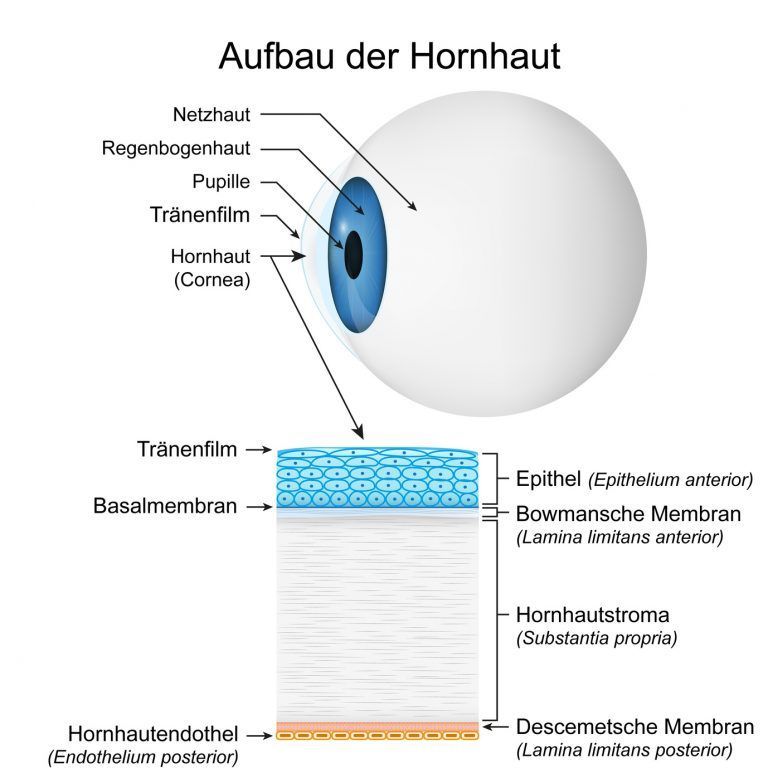
For your information: Surgical planning is based on the individual parameters of the eyes. These include corneal thickness, corneal shape, refractive errors, higher-order aberrations—and then there are individual wishes and expectations. The correction of a refractive error with laser eye surgery is performed on the surface of the cornea, which is reshaped using a laser beam. As a result, light rays converge directly on the retina again, enabling sharp vision without glasses.
Dr. de Ortueta is particularly knowledgeable in the field of “refractive surgery.” “The umbrella term ‘refractive surgery’ encompasses eye surgeries aimed at achieving independence from glasses or contact lenses,” he says. More specifically, “refractive” refers to “pertaining to refractive power,” meaning, of course, the refractive power of the eye. The cornea, which accounts for approximately 75% of the eye’s optical power, and the lens, which accounts for approximately 25%, are the most important components.
The Eye Laser Center offers a laser procedure for vision correction that requires no incisions. This is hard to imagine—after all, the patient regains full vision.
“With the so-called TransPRK laser eye treatment (transepithelial photorefractive keratectomy) , there is no need to make an incision in the cornea, since the correction of the diopter values does not take place as deeply within the cornea as, for example, with LASIK (laser in situ keratomileusis). The LASIK method combines the surgical technique of creating a corneal flap with excimer laser treatment. “TransPRK is performed completely non-contact, takes only a few seconds, and is a novel advancement of the standard surface treatment PRK,” explains Dr. de Ortueta.
For the patient, this means a smaller and smoother wound surface, which accelerates the healing process. Another advantage of this treatment method is that only a single step is required to remove the epithelium (i.e., the outermost layer of cells on the cornea) in order to correct the refractive error. At the end of the procedure, a contact lens is placed on the eye for protection, where it remains for about three days until the epithelium has regenerated. A major advantage of TransPRK is that this laser treatment is particularly safe both during and after the procedure, and secondly, the treatment does not take long.
All the benefits of TransPRK at a glance:
- The PRK method has been in use for more than 30 years and has proven highly effective.
- Only a laser is used; the eye is not touched with any instruments. The procedure is quick, gentle on the tissue, and precise.
- This eliminates any flap-related complications. A flap refers to a thin lamella—that is, a circular, wafer-thin layer of the outer cornea—that is lifted during laser eye surgery (refractive surgery).
Many people who wear glasses or contact lenses wish to regain sharp vision and naturally wonder whether such laser surgery is an option for them. Eye specialist Dr. de Ortueta explains that “laser eye treatments are suitable for all patients with refractive errors who want to see clearly at a distance without glasses or contact lenses. The procedure can correct nearsightedness up to approximately -8 diopters, farsightedness up to approximately +4 diopters, and astigmatism up to approximately 6 diopters.”
Intraocular lens implants are another option and a suitable alternative to laser treatment. There are well-established intraocular lens implants that, using state-of-the-art surgical techniques, enable patients to be free of glasses and contact lenses even with higher degrees of refractive error. Unlike laser treatment, artificial lens implantation does not alter the corneal tissue. This method is particularly suitable for people with very thin corneas.
Dr. de Ortueta also offers this alternative and comments:
“When extreme refractive errors need to be corrected, or the cornea is too thin for laser eye surgery, artificial lenses can be implanted in addition to the eye’s natural lens. For patients who need progressive lenses, the natural lens can be replaced with an artificial lens, thereby achieving the greatest possible lifelong independence from glasses.”
A procedure like this on the eye is quite specialized, and of course, it can make you feel a little uneasy. Will everything go well? What risks might be involved? Dr. de Ortuerta reassures patients: “We inform patients about every step of the process so that, after a thorough preoperative examination, all questions have been answered and any concerns have been addressed. Eye lens procedures are generally performed under general anesthesia at our clinic, but we also offer a gentle, short-acting anesthesia for patients who are anxious about laser eye surgery,” says the specialist, who takes great care to treat his patients with empathy. Thanks to the anesthesia, patients are completely unaware of the procedure and sleep through the entire process.
“With our modern form of intravenous anesthesia, we induce general anesthesia in the patient exclusively through intravenous administration of the anesthetic. Consciousness and the sensation of pain are suppressed during the procedure, and the patient is in a sleep-like state. A prerequisite for administering general anesthesia is an anesthesia consultation following a thorough preliminary eye examination. The anesthesiologist explains the exact procedure and is available to answer any questions. It is also helpful to bring a recent blood test report to the appointment, which is usually prepared by the patient’s primary care physician prior to the preliminary examination. If this is not possible, the anesthesia consultation can also be conducted by phone. In this case, the blood test results can also be sent in advance via email. “It’s important to know that no hospital stay is required, and after only a short recovery period, the patient can be driven home,” Dr. de Ortueta continues.

If you decide to undergo laser treatment, there are several things to keep in mind before the procedure to ensure you are as well-prepared as possible. Light sensitivity, which can occur after the procedure, must also be discussed so you can best protect yourself in the days following the procedure. “Patients must use prophylactic anti-inflammatory eye drops according to a prescribed regimen. Furthermore, all scheduled follow-up appointments should be kept. For the first three days after laser eye surgery, the patient will be sensitive to light. The eyes should be protected with sunglasses during this time. Visits to swimming pools and saunas should be avoided during the first two weeks after surgery,” explains Dr. de Ortueta.
Who actually pays for laser eye surgery? The financial aspect of eye treatment is, of course, a key factor for interested patients. This is because, according to the guidelines of the Federal Committee of Physicians and Health Insurance Funds dated December 10, 1999, statutory health insurance is not required to cover the cost of the treatment. The Recklinghausen Laser Eye Center offers various options. “We’re happy to inform patients about financing options and offer convenient installment payment plans,” reassures Dr. de Ortueta.
“As the window to the world, the eyes play a key role in our daily well-being. The better one’s vision, the higher the quality of life. State-of-the-art diagnostic and laser technology enables the safe treatment of refractive errors at the AURELIOS Laser Eye Center in Recklinghausen,” Dr. de Ortueta concludes.
Dr. de Ortueta, thank you for this very informative conversation!
The AURELIOS Eye Center in Recklinghausen was founded with a focus on innovative healthcare services. The Recklinghausen ophthalmology group practice offers the full range of conservative and surgical ophthalmological treatments, thereby providing the highest level of care with the best possible service for patients in the northern Ruhr region and neighboring areas. The affiliated AURELIOS Laser Eye Center, under the medical direction of Dr. de Ortueta, serves as a reference center for SCHWIND eye-tech-solutions and offers all scientifically recognized methods of refractive surgery using state-of-the-art technology.
By the way, interested parties can contact Dr. de Ortueta directly via the Leading Medicine Guide!
Diego de Ortueta DO297AO, LMG19
Share this article
AURELIOS EYE CENTER Recklinghausen
ProfileExpert Interviews
Read next
- Expert interview
Cardiogeriatrics: Significance and benefits in the context of hospital reform
Sep 21, 2026
Cardiogeriatrics: Significance and benefits in the context of hospital reform
Read more - Expert interview
Expert Interview with Professor Dr. Amadeus Hornemann, MPH
Sep 18, 2026
Prof. Amadeus Hornemann on Precision Medicine in Gynecology: Modern Surgery, New Techniques, Better Quality of Life
Read more - Expert interview
Expert Interview with Professor Dr. Konstantinos Anagnostakos
Sep 15, 2026
Prof. Anagnostakos on Painful Knee Replacements
Read more