Expert Interviews
“A Cornerstone of Our Body” – PD Dr. Steinemann and the Pelvic Floor

Alexandra Pfitzmann ·
The pelvic floor provides support for all the abdominal and pelvic organs and has quite a load to bear. It’s often underestimated that many people have problems with their pelvic floor. Very often, it’s women who have a weak pelvic floor after childbirth and develop incontinence issues. But many people of all ages suffer from pelvic floor issues. Without the pelvic floor—which has a complex structure consisting of muscles, connective tissue, and nerves and primarily supports the bladder and rectum—upright walking would not be possible. The editorial team of the Leading Medicine Guide spoke with Dr. Daniel Steinemann, MD, Senior Lecturer, Chief Physician of Visceral Surgery, and Director of the Pelvic Floor Center at Clarunis – University Abdominal Center Basel, about the pelvic floor, its important functions, and how to maintain or restore its health.
 Gravity alone exerts pressure on the pelvic floor, which provides the necessary support for the abdominal and pelvic organs. In addition, it serves to retain and release urine, control bowel movements, and empty the bowels. It also plays an essential role in sexual function as a pulsating muscle. The pelvic floor is therefore constantly in use. If the strain on the pelvic floor becomes too great—for example, due to childbirth or constantly carrying heavy loads—it can prolapse, leading to health problems and psychological stress.
“The pelvic floor is a muscle that, when subjected to excessive strain, becomes overstretched, loses its tone, and suffers damage to its nerve endings. As a result, the organs anchored there descend,” explains PD Dr. Daniel Steinemann at the beginning of our conversation. “A weakened and prolapsed pelvic floor can lead to constipation, fecal incontinence, urinary incontinence, a feeling of pressure, or even pain during sex,” says the pelvic floor specialist, outlining the possible symptoms.
The pelvic floor muscles weaken with age, and this happens more quickly and frequently in women than in men
As a result, women’s pelvic floors lose their support when, for example, the stabilizing structures of the vagina and uterus weaken. Pregnancies and childbirth further contribute to pelvic floor prolapse. “In more severe cases, this can lead to prolapse of the bowel, the uterus, or the vagina, which over time can result in the vagina or uterus protruding—in some cases completely—beyond the vaginal opening, a condition medically referred to as prolapse,” explains PD Dr. Steinemann. This affects approximately 11–15% of all women.
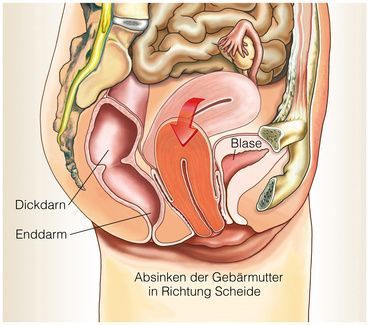
Uterine prolapse resulting from pelvic floor prolapse © Henrie #59249822 | AdobeStock
In the early stages of pelvic floor weakness, a sensation of pressure becomes noticeable, and one may experience a pulling pain in the lower abdomen as well as in the back and groin areas. “An increased urge to urinate and noticeable incontinence—for example, when sneezing, laughing, or lifting objects—are the first warning signs of a weakened pelvic floor, which should then be examined urgently,” says PD Dr. Steinemann regarding the first detectable symptoms. “Women who have given birth are therefore advised to do postpartum recovery exercises and pelvic floor training. It is important to perform the exercises correctly, as many people do them incorrectly. Nowadays, professional physical therapy uses a probe inserted vaginally or rectally to help patients practice the correct movements. This allows the movements during pelvic floor training to be closely monitored on a screen and corrected as needed,” recommends PD Dr. Steinemann.
Fecal Incontinence—Please Don’t Feel Unnecessary Shame
People who suffer from fecal incontinence due to pelvic organ prolapse often don’t dare to see a doctor until very late—or not at all—out of sheer shame. Approximately 5–12% of the population is affected by fecal incontinence. This is often caused by a sphincter injury that occurred decades ago, for example during childbirth or a previous surgery. However, diabetes or neurological disorders can also contribute to fecal incontinence.
“Many patients suffer from fecal incontinence for an unnecessarily long time because they don’t dare to bring up their problem. They resort to using diapers to make sure no one finds out, or they no longer dare to leave the house at all,” laments PD Dr. Steinemann, adding: “Yet there are very effective treatment options available to resolve this dilemma. To diagnose fecal incontinence, a proctological examination and a medical history review are conducted. Endoluminal 3D ultrasound allows for the assessment of the sphincter muscle for injuries, and a functional test—anorectal manometry—performed by a gastroenterologist can determine and objectively assess sphincter function. Depending on the situation, further tests such as an MRI or a colonoscopy may be indicated. Some patients can be helped with conservative treatment alone. Sometimes a change in diet, pelvic floor therapy, or the use of bulk-forming agents in cases of constipation is all that’s needed. “Major surgery isn’t necessary at all,” the specialist explains.
Natural bulk-forming agents include psyllium, wheat bran, and flaxseed, which act like small sponges in the bowel and absorb fluid. This makes the bowel contents softer and more voluminous, triggering the reflex to empty the bowel.
Surgical Treatments
“In the event of a sphincter injury, reconstructive surgery can restore its function. If pelvic floor weakness has led to a prolapse of the bowel, it can be repositioned through the abdominal wall using minimally invasive surgery,” explains PD Dr. Steinemann, describing the surgical procedures.
If the pelvic floor needs to be reconstructed, the prolapsed organs must be repositioned during a laparoscopic or robot-assisted surgery. “To do this, the anterior wall of the rectum or vagina is exposed, and a synthetic mesh is sutured into place. The peritoneum is then closed over the synthetic mesh,” explains Dr. Steinemann. Patients are then advised to allow sufficient time for recovery and regeneration. For the time being, they should avoid lifting heavy objects—no more than five to ten kilograms for about six weeks—and, as a general rule, should avoid activities that put pressure on the pelvic floor.
Sacral neurostimulation is a specialized treatment
“In this surgical procedure, the nerves leading to the pelvic floor and the bowel are stimulated with electrical current, which improves sensation in the bowel and allows the urge to defecate to be felt sooner. This gives patients enough time to reach a restroom. It also improves bowel movement frequency and the ability to control bowel movements, thereby reducing or even completely preventing incontinence,” says PD Dr. Steinemann as he begins to explain this fascinating treatment method.
“In the first step, a thin electrode is inserted under X-ray guidance into the sacral nerves and connected to a battery. The patient then keeps a bowel movement diary for fourteen days. If it is determined that the trial electrical stimulation has a positive effect on the function of the sphincter muscle, a pacemaker—about the size of a car key—is implanted in the buttock. This form of minimally invasive surgery, which is performed under local anesthesia, is not very complex, takes only about an hour, and carries no particular risks. “A significant improvement in continence is observed in about eighty percent of all patients,” explains PD Dr. Steinemann, a specialist in minimally invasive surgery, describing this highly effective surgical treatment.
“In general, movements involving high impact should be avoided. For this reason, I generally advise against jumping on a trampoline, as this has a massive negative effect on the pelvic floor,” warns Dr. Steinemann.
Advantages of Clarunis Basel
Clarunis – University Abdominal Center in Basel is the center of excellence for visceral surgery and gastroenterology/hepatology. State-of-the-art equipment is available for comprehensive diagnostics of pelvic floor and rectal disorders, including, for example, high-resolution manometry and 3D ultrasound examinations. “At our pelvic floor center, interdisciplinary collaboration among all involved specialties is very strong. We have short lines of communication to develop a treatment plan tailored to each individual patient, with surgeons, gynecologists, urologists, gastroenterologists, and physical therapists, among others, working hand in hand under one roof,” says PD Dr. Steinemann, expressing his delight at the excellent collaboration with his colleagues. “For the future, I hope to see more stem cell research so that the muscles can be repaired,” concludes the renowned specialist as we wrap up our conversation.
Dr. Steinemann, we would like to thank you very much for this informative conversation on a topic that affects many of us and, with the right treatment, promises a cure or at least improvement. You can contact our expert directly through his profile page on the Leading Medicine Guide.
Share this article
About the medical author
Alexandra Pfitzmann
Editor
Alexandra Pfitzmann – medical author: expert knowledge, professional articles and medical insights in the Leading Medicine Guide.
More about the medical author →Expert Interviews
Read next
- Expert interview
Cardiogeriatrics: Significance and benefits in the context of hospital reform
Sep 21, 2026
Cardiogeriatrics: Significance and benefits in the context of hospital reform
Read more - Expert interview
Expert Interview with Professor Dr. Amadeus Hornemann, MPH
Sep 18, 2026
Prof. Amadeus Hornemann on Precision Medicine in Gynecology: Modern Surgery, New Techniques, Better Quality of Life
Read more - Expert interview
Expert Interview with Professor Dr. Konstantinos Anagnostakos
Sep 15, 2026
Prof. Anagnostakos on Painful Knee Replacements
Read more