Expert Interviews
“We’re a flu center!” An interview with ENT specialist Prof. Dr. med. Dr. med. habil. Thomas Wustrow

Alexandra Pfitzmann ·
Ear, Nose, and Throat (ENT) clinics are particularly busy during the colder months. Runny noses, colds, and viruses are annoying companions in winter. However, the medical specialty of otolaryngology—or ENT for short—covers a much wider range of diseases, infections, and disorders throughout the entire head and neck region. The field of otolaryngology is fascinating simply because two sensory organs—the ears and the nose—fall within its scope of treatment. The editorial team at Leading Medicine Guide spoke with Prof. Dr. med. Dr. med. habil. Thomas P. U. Wustrow, a specialist in otolaryngology at the Munich ENT Center, to shed light on various aspects of this fascinating medical field. As it turned out, this holistic and extremely dedicated specialist is exactly the right person to talk to on this topic!
Is it a “common cold” or actually the flu?
Viruses are bothersome, persistent, and also contagious. Among them is influenza, also known as “real” flu or viral flu, which affects many people in Germany every year. In addition to a cough, runny nose, and hoarseness, symptoms include headaches and body aches, fatigue, fever spikes, chills, and in some cases, nausea and diarrhea. Of course, if you suspect a flu-like infection, you should determine whether it’s the flu or perhaps “just” a cold. “We are a flu center,” explains Prof. Wustrow, referring to the diagnostic process, “and we can determine within ten minutes, using a swab test, whether the patient is carrying the flu virus.” Such a clear diagnosis is important because the flu is not just a simple cold, but a serious illness that can drag on for weeks and confine the patient to bed.
In the first seven weeks of 2020 alone, the State Office of Health recorded 24,962 cases of influenza in the state of Bavaria alone. That’s about 50 percent more than at the same time last year.
Flu shot—yes or no?
According to the Federal Center for Health Education, a flu vaccine is the most effective and cost-efficient measure to protect both oneself and those around you. At the same time, there are reports in the media of a creeping reluctance to get vaccinated. “There is a general ideological rejection of vaccination in Germany,” says Prof. Dr. Wustrow, but he explains: “In our practice, we’re seeing an increase in the number of people getting the flu vaccine. People have a legitimate fear of catching the flu. A flu vaccine is strongly recommended for older and more vulnerable people.” Of course—one must keep in mind that in the winter of 2017–2018 alone, around 25,000 people died from the flu—and that’s just in Germany. “In addition to the at-risk group of older adults and those with pre-existing conditions such as cancer, getting a flu shot is also a matter of responsibility toward oneself and others for certain professional groups. These include, for example, teachers and doctors—it applies to all professions that involve frequent contact with people. Frequent flyers should also protect themselves!” recommends Prof. Dr. Wustrow.
Persistent Germs in the Nose
If the flu is allowed to drag on, it can lead to life-threatening pneumonia. But even a “completely normal” cold can result in far-reaching complications. “If germs simply won’t go away and an illness has been treated poorly or inadequately and not fully resolved, we refer to this as a lingering illness, which can then become chronic,” warns Prof. Dr. Wustrow.
Sinusitis, for example—which is universally unpopular—is the result of persistent germs. “In the case of sinusitis—known as acute rhinosinusitis—an antibiotic can be taken to treat the condition if it is bacterial in origin and purulent. The inflammation in the sinuses disrupts ventilation, creating an ideal breeding ground for germs,” explains Prof. Dr. Wustrow, adding: “For immediate additional relief, the sinuses can be suctioned out using an endoscope.”
Of particular interest is the comment on the topic of “nasal rinses.” Here, Prof. Dr. Wustrow notes: “Nasal rinses, which are often promoted in television commercials, aren’t bad in and of themselves. But caution is advised if a sinus infection is acute. That’s because germs can easily be flushed deeper into the sinuses.” Germs can also become active again through improper nose-blowing or nose-picking. It’s good to blow your nose to remove secretions. But it’s better to blow your nose gently than to blow it as loudly as an elephant trumpets.

If conservative treatment does not help the patient, endoscopic surgery can be used in cases of chronic inflammation to remove the diseased sinus mucosa and ensure proper ventilation. This involves removing narrowings or obstructions such as nasal polyps. Prof. Dr. Wustrow is additionally qualified in specialized head and neck surgery for such cases—as a patient, you should definitely keep this in mind!
And if the tonsils need to be removed…?
Let’s stay with the topic of surgery. Don’t you remember: In the past, when children had frequent tonsillitis, it was quickly recommended to remove their tonsils. The prospect of lots of ice cream made the idea of a hospital stay at least bearable. When you open your mouth wide, you can see the tonsils on the right and left sides of the throat—but that’s about all most people know about them. And do we even need them, if they can be removed so quickly based on a diagnosis? “Among other things, the tonsils serve as the first line of defense after birth. All germs trigger the immune response in newborns. Tonsils are very important in this early stage of life; they are the first line of defense against germs trying to enter the upper respiratory tract,” explains Prof. Wustrow, who also treats many children at his group practice in Munich.
Many children have enlarged tonsils. This can cause the airways to narrow, leading, for example, to snoring and breathing pauses during sleep. Chronic poor sleep, in turn, can lead to various problems and illnesses.
“Once children reach the age of six months or one year, the tonsils lose their function,” says Prof. Dr. Wustrow. “The latest guidelines always recommend starting with antibiotics for frequent tonsillitis. Severe and persistent inflammation of the tonsils can eventually spread to the bloodstream and release toxins, raising concerns about secondary illnesses. Tonsillectomies have also become less common, as this procedure carries an increased risk of bleeding and requires a doctor to be present at all times to monitor the patient. Enlarged tonsils can be easily reduced in size through a tonsillotomy. “There is no need to expect significant pain or excessive blood loss in this procedure, so it is considered a routine operation,” explains Prof. Wustrow, who always treats parents with great empathy and sensitivity when caring for their child.
The Fascination of the Ear
There is a theory that the ear is the first fully functional organ in humans. Babies can already hear while in the womb and clearly perceive sounds such as speech and music. A lack of responsiveness in a baby after birth may therefore well be related to a hearing impairment or hearing loss. “I have my doubts as to whether the ear is the first fully developed organ; I’m more inclined to think it’s the heart. But today, newborn screening takes place within the first four days of life. This is done using clicking sounds and thus provides an objective measure of hearing,” explains Prof. Wustrow.
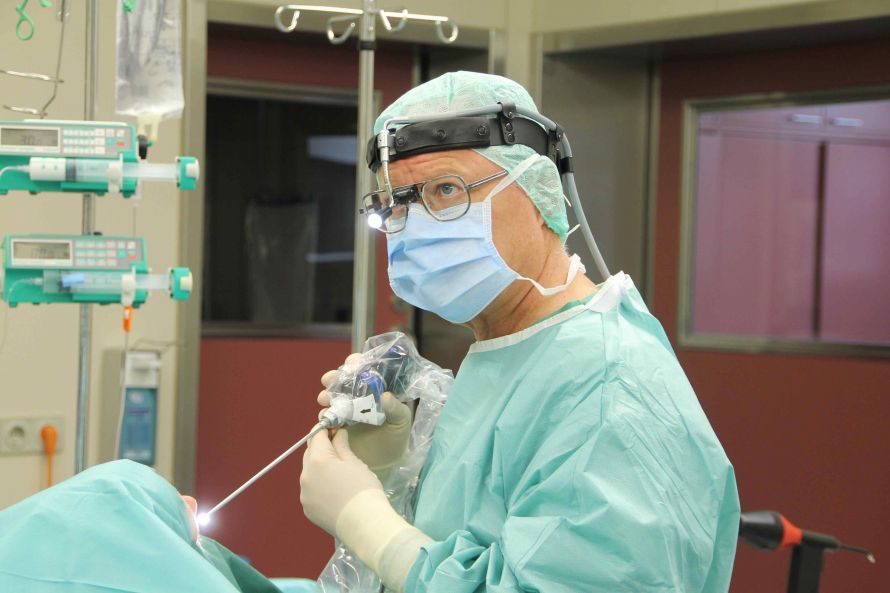
About one to three out of every thousand children in Germany are born with hearing impairments. These must be treated quickly, as they can severely impair the child’s development. During a newborn hearing screening, otoacoustic emissions are measured to assess the function of the inner ear and the outer hair cells. The tests are completely painless and can be easily performed while the baby is asleep.
“The first six weeks of life are crucial. Common causes of hearing loss in babies can include fluid buildup in the ear, enlarged adenoids, or actual congenital hearing loss. In such cases, brainstem audiometry is performed, which measures the brain’s responses—similar to an EEG (electroencephalogram). This allows for the examination of neural responses that occur when the brain processes auditory stimuli,” explains Prof. Dr. Wustrow. Even if deafness is diagnosed, there is still a solution. Thanks to the surgical implantation of a so-called cochlear implant—a hearing prosthesis for the deaf and those who have lost their hearing—hearing becomes possible. Of course, cochlear implants can also be used in adults and are now even being implanted in people with severe hearing loss—that is, patients who still have some residual hearing.
It became clear during the conversation with Professor Dr. Wustrow that he is a truly passionate physician. Since 1996, Prof. Dr. Wustrow has enjoyed an excellent working relationship with his three colleagues at the ENT group practice in Munich, which has been in operation since 1959, and he contributes his expertise there with great dedication. Thank you very much for this fascinating insight into the world of otolaryngology! You can find much more information about the ENT Center in Munich and Prof. Dr. Wustrow here!
Share this article
Expert Interviews
Read next
- Expert interview
Expert interview with Professor Dr Elmar Herbst, PhD
Oct 15, 2026
Patient-centred and personalised knee surgery
Read more - Expert interview
Cardiogeriatrics: Significance and benefits in the context of hospital reform
Sep 21, 2026
Cardiogeriatrics: Significance and benefits in the context of hospital reform
Read more - Expert interview
Expert Interview with Professor Dr. Amadeus Hornemann, MPH
Sep 18, 2026
Prof. Amadeus Hornemann on Precision Medicine in Gynecology: Modern Surgery, New Techniques, Better Quality of Life
Read more