News
Preserving Mobility Instead of Stiffening: Modern Solutions for the Ankle Joint

Sabine Schneider ·
With every step, the ankle joint bears many times our body weight. It is the linchpin of our mobility. When this joint is destroyed by osteoarthritis, every meter becomes torture. For a long time, joint fusion was considered the only option—but modern joint replacement surgery now offers effective alternatives.
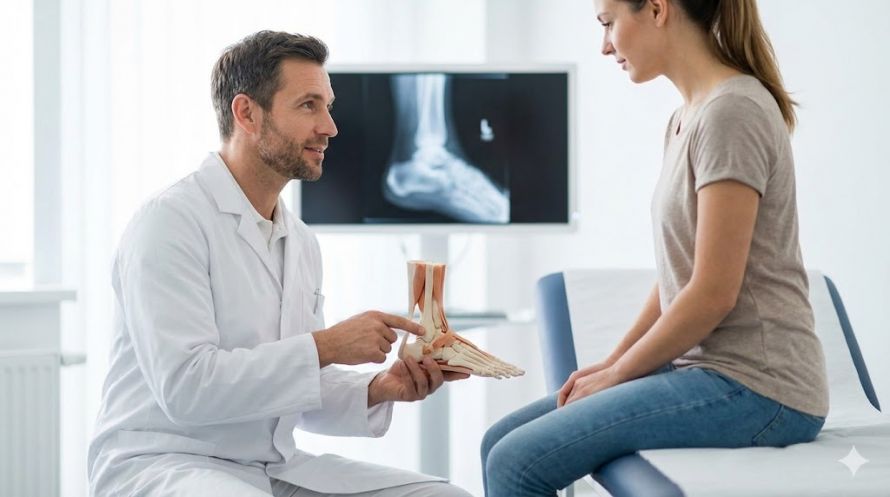
Pain in the ankle often has a long history. Unlike with the hip or knee, simple wear and tear due to aging is rarely the cause here. Often, it is old sports injuries, broken bones, or torn ligaments that lead to post-traumatic osteoarthritis years later. The cartilage wears away, bone rubs against bone, and the foot’s natural rolling motion becomes virtually impossible.
The dilemma: fusion or prosthesis?
For decades, arthrodesis—that is, surgical fusion of the joint—was the gold standard. While it reliably relieves pain, it inevitably leads to an altered gait. The result: the adjacent joints in the foot and knee are subjected to greater stress and wear out more quickly.
This is where the modern ankle prosthesis comes in. The goal of this treatment is not only to eliminate pain but, above all, to preserve the natural range of motion.
How does ankle replacement work?
Modern prostheses are three-component systems modeled after the anatomy of the natural joint. They typically consist of:
- A metal cap for the shinbone (tibia).
- A metal cap for the talus.
- A smooth-gliding core made of high-performance plastic (polyethylene) in between.
This design allows for an almost natural rolling motion. Patients often report that, after rehabilitation, they can walk “normally” again without limping.
Who is a good candidate for this surgery?
Not every patient is a suitable candidate for a prosthesis. The bone quality must be good enough to securely anchor the implants, and the ligaments must be stable enough to support the joint. Severe misalignments may also need to be corrected. For this reason, this procedure should be performed by highly specialized foot and ankle surgeons.
Developments in this field have advanced rapidly. While earlier models often had problems with loosening, current generations of implants show very good long-term results.
Do you suffer from chronic pain in your ankle and want to know if joint replacement is an option for you? Our experts will help you make the right decision for your mobility.
Learn more here about the procedure, the risks, and specialized clinics for ankle replacement.
Share this article
Verified expertise
Recommended specialists
6 specialists
6 results



PD Dr. med. Friedrich Kutscha-Lissberg
Gelsenkirchen



Prof. Dr. Peter Schräder
Seeheim-Jugenheim

News
Read next
- News
Scabies: A contagious skin disease that is easily treatable
Oct 26, 2026
Severe itching and minor skin changes should be taken seriously
Read more - News
Heat Rash: What's Behind the Itchy Blisters
Oct 23, 2026
Heat Rash: Heat and Sweat Can Disrupt the Skin's Balance
Read more - News
Enlarged Prostate – When Medication Is Sufficient and When Surgery Is Recommended
Oct 21, 2026
Why Many Men Ignore Urinary Problems for Too Long
Read more