News
Fall prevention in older people: what the Cochrane review shows

Sabine Schneider ·
A new Cochrane review on fall prevention shows older people and their carers that combined programmes tailored to personal risk factors offer, at most, only a very small additional benefit compared with exercise training or counselling. This does not mean that all approaches are equally effective.
The study was not a single intervention trial. It synthesised randomised controlled trials and categorised various forms of fall prevention. Regular physical activity and exercise remain central approaches.
Key points at a glance
- Large data set: The Cochrane review analysed 110 studies involving 48,919 older people.
- Staying active: Exercise programmes reduce both the fall rate and the number of people who fall amongst older people living at home.
- Targeted risk assessment: Where there is a high risk of falling, a detailed assessment of personal risk factors is recommended.
- Checking the home: Securing cables and ensuring good lighting are among the simple measures that can improve safety at home.
Why are falls so risky as we get older?
Falls in older people can lead to broken bones, severe lacerations or head injuries. Around 5 to 10 out of every 100 falls at home result in such serious consequences.
However, advancing age alone is not a reliable indicator of whether an individual’s risk is increased. Even in old age, the individual situation varies from person to person. Several factors contribute to a person’s risk of falling. Dizziness, for example, can increase an individual’s risk. Previous falls and the fear of falling again should also be discussed.
Such stresses can affect health and independence. After a fall, those affected may feel less steady on their feet. Some restrict their activities, even though their individual capabilities might allow for a more active lifestyle.
What did the new systematic review find?
The Cochrane review on fall prevention investigated the additional benefits of combined interventions compared with simpler programmes. It included 110 randomised controlled trials involving a total of 48,919 participants. In this type of study, participants are randomly assigned to different groups.
Depending on the studies included, the average age ranged from 62 to 85 years. The participants were predominantly women, and most studies lasted around 12 months.
Combined interventions tailored to individual risk factors showed, at most, a very small additional benefit compared with exercise training or advice on fall prevention.
This result does not demonstrate that the interventions are equivalent. The authors assessed the risk of bias in the included studies differently and found evidence of possible publication bias in some comparisons. This may mean that studies with certain outcomes were more likely to be published than others.
How effective are exercises for improving balance?
There is evidence that older people living at home can benefit from exercise programmes. A Cochrane review concluded, with a high level of certainty, that such programmes reduce the fall rate and the number of people who fall. Exercise programmes at home and measures to improve safety in the home can also reduce falls.
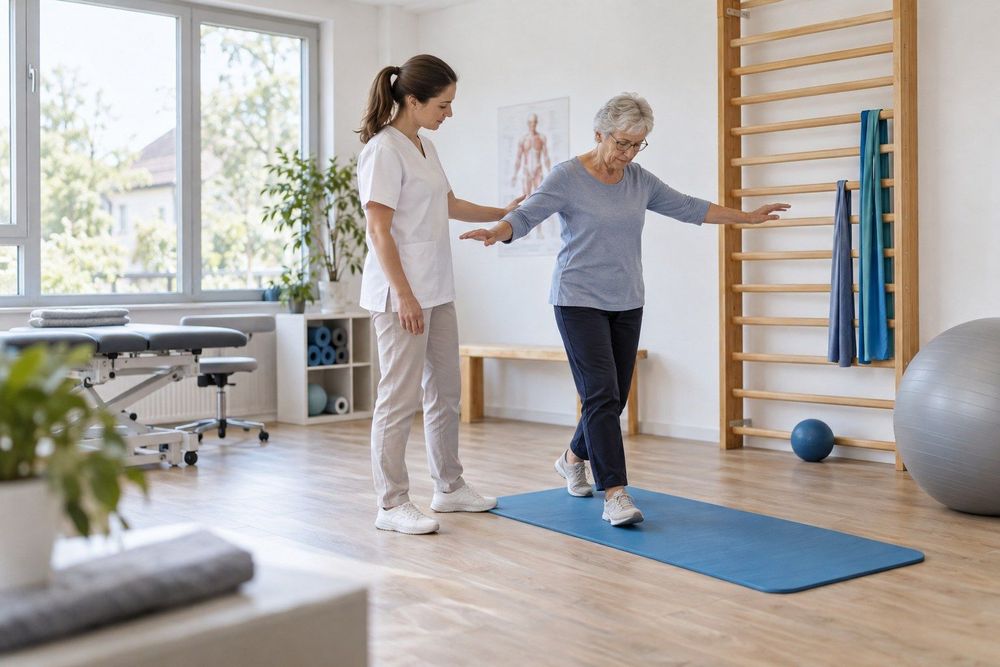
Targeted exercise strengthens the muscles and can improve balance, strength and coordination. The type of exercise suitable for building strength depends on the individual’s initial physical condition. Some older people are able to exercise actively, stand unaided and maintain their balance.
Others require support from specially selected aids whilst exercising. A sturdy chair, for example, which provides a handhold, can be helpful.
During exercise, movements are performed in a regular and controlled manner. This may include muscle-strengthening exercises, standing up slowly or shifting weight from one leg to the other. Such activities can improve stability.
Multi-component programmes usually include physical exercises alongside other elements. They complement physical activity, for example, with an assessment of the home environment. The analysis therefore does not argue against physical activity. It concerns the additional benefits of more complex combinations compared with simpler options.
When are more complex programmes still advisable?
Where there is a high risk of falling, international guidelines recommend a detailed assessment of personal risk factors and measures tailored to these.
The assessment should identify which factors compromise safety. These include symptoms such as dizziness, physical mobility, existing assistive devices and medication taken. A rollator or other walking aid should be suitable for the individual’s situation and be safe to use.
Changes to the home should be based on personal risk. In people who had not been selected in advance based on their risk of falling, targeted measures to address tripping hazards at home did not demonstrably reduce the fall rate. This does not rule out the practical benefit of targeted adaptations for those at particularly high risk.
Behavioural therapy for distressing fear of falling may help to alleviate this anxiety. The aim is to regain confidence in one’s own body and in everyday life.
What tips can help reduce the risk of falls at home?
A short checklist can quickly highlight obstacles and unsafe situations in everyday life. These tips relate to the home environment, assistive devices and regular exercise:
- Secure cables: Remove loose cables from the floor or fix them to the wall using cable clips.
- Light up the stairs: Ensure there is sufficient lighting throughout the stairwell.
- Observe daily life: Make a note of any difficulties with balance, dizziness, coordination, or when getting up slowly and standing.
- Check footwear and walking routes: Watch out for unsuitable footwear, carpets and other obstacles.
To prevent falls, home safety measures can be combined with exercise. If in doubt, a specialist should advise on which exercises and aids are best suited to your personal mobility.
When should fall prevention be supervised by a doctor?
Declining mobility following a fall and anxiety that restricts daily life should also be addressed. Falls in older people can result from a combination of various causes.
Older people at high risk of falling should undergo a thorough assessment and receive appropriate support. Medically supervised fall prevention involves identifying personal risks and selecting suitable measures.
Medication may also be a topic of discussion during your appointment. If you suspect a link between your symptoms and your medication, do not stop taking it without consulting your doctor. Medication that may increase the risk of falls should be reviewed together with your doctor.
Bring a list of your medicines to the appointment and describe when dizziness or other symptoms occur. During the appointment, also ask what support is available to you.
Frequently asked questions about fall prevention
Was the new review a single study?
No. It was a Cochrane review that analysed 110 randomised controlled trials involving a total of 48,919 older people. This type of analysis combines the results of many studies according to established scientific criteria.
Do exercise programmes help prevent falls?
Exercise programmes help prevent falls among older people living at home by reducing the fall rate and the number of people who fall. The programme chosen should be suited to the individual’s mobility and balance.
Can home modifications prevent falls?
Measures to improve safety at home can help when combined with exercise. However, in people who were not selected based on their risk, measures to remove tripping hazards alone did not demonstrably reduce the fall rate. The individual’s personal situation is key.
Should I stop taking any medicines I suspect might be causing falls?
No. Medicines that may increase the risk of falling should not be stopped without consulting your doctor; instead, discuss this with them. Please bring a complete list of your medicines with you.
What can I do about the fear of falling again?
Talk about any persistent anxiety, particularly if it is causing you to avoid physical activity or withdraw from everyday life. If you have a severe fear of falling, behavioural therapy can help to alleviate your symptoms.
Share this article

News
Read next
- News
Enlarged Prostate – When Medication Is Sufficient and When Surgery Is Recommended
Oct 21, 2026
Why Many Men Ignore Urinary Problems for Too Long
Read more - News
Daraxonrasib as a treatment for metastatic pancreatic cancer
Oct 21, 2026
Daraxonrasib: Survival time almost doubled in the study
Read more - News
Orforglipron as a slimming pill: studies and marketing authorisation
Oct 20, 2026
Orforglipron: slimming pill and the status of its EU authorisation
Read more