News
Health Insurance Companies Cover Liposuction for Lipedema: Available for All Stages Starting in 2026

Sabine Schneider · July 21, 2025
Good news for those affected: Starting January 1, 2026, liposuction for lipedema will be covered as a standard benefit by statutory health insurance plans—regardless of the stage of the condition. This eliminates the previous restriction to particularly severe cases. Patients will then be able to benefit from coverage at all stages—both on an outpatient and inpatient basis.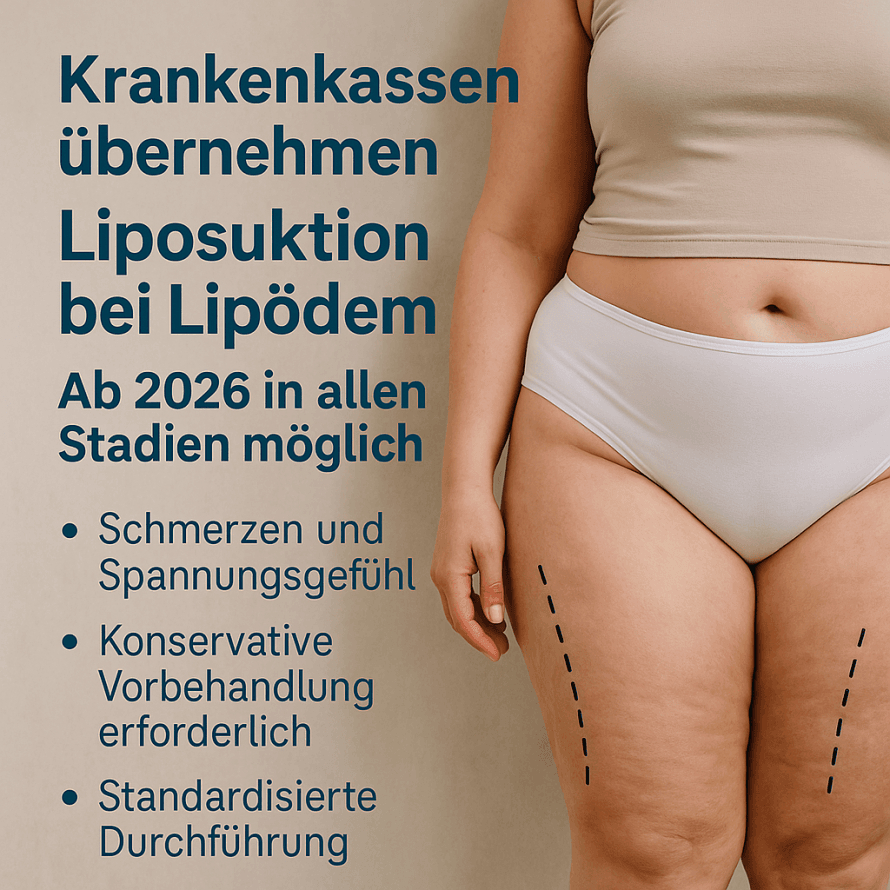
What is lipedema?
Lipedema is a chronic condition in which fatty tissue accumulates abnormally—usually in the legs and arms. Typical symptoms include:
- Pain and tenderness
- A feeling of heaviness and tightness in the limbs
- Tendency to bruise
Almost exclusively women are affected. The condition is progressive and can severely impair quality of life.
Why are health insurance companies now covering the costs?
The decision is based on studies such as LIPLEG, which confirm the long-term benefits of liposuction for lipedema. These studies demonstrated significant improvements in terms of:
- Pain
- Mobility
- Quality of life
The Joint Federal Committee (G-BA) therefore decided to approve liposuction as a medically recognized treatment method.
Requirements for Coverage
For health insurance to cover liposuction, the following conditions must be met:
1. Prior conservative therapy
At least 6 months of treatment with compression therapy and exercise is required—without sufficient relief of symptoms.
2. Weight stability
There must have been no significant weight gain in the past six months. The Body Mass Index (BMI) must not exceed certain thresholds.
3. Specific BMI guidelines
- For a BMI of 32–35: An additional positive waist-to-height ratio is required
- For a BMI over 35: Concomitant obesity treatment is required first
4. Specialist Diagnosis
The diagnosis must be made by two specialists. The surgery may only be performed by specially qualified surgeons.
Procedure and Deadlines
The regulation takes effect on January 1, 2026. By then, the corresponding billing codes will be added to the Uniform Assessment Scale (EBM). Patients will then be entitled to standardized and quality-assured liposuction—covered by health insurance.
Benefits for Patients
- No more out-of-pocket costs
- Medically recognized treatment instead of a cosmetic procedure
- Improved mobility, less pain, and a higher quality of life
What else should be considered?
It remains to be seen how repeat procedures or follow-up treatments will be handled. Long-term results will also continue to be scientifically monitored.
Conclusion
The recognition of liposuction for lipedema as a standard benefit covered by health insurance is an important milestone for affected women. Finally, effective treatment is available without high out-of-pocket costs—provided the medical criteria are met.
Share this article
About the medical author
Sabine Schneider
Editor-in-Chief
Sabine Schneider – medical author: Explore expert articles and medical expertise in the Leading Medicine Guide.
More about the medical author →Verified expertise
Recommended specialists
6 specialists
6 results



Dr. (IR) Ali Tabatabaei
Seeheim-Jugenheim


Dr. med. Dipl. oec. med., FESC Michael Lichtenberg
Chief Physician


News
Read next
- News
When Your Knee Locks Up—Could It Be a Meniscus Tear?
Sep 30, 2026
Why a Meniscus Tear Isn't Always Detected Right Away
Read more - News
Suddenly, your knee makes a popping sound—could it be a torn cruciate ligament?
Sep 28, 2026
Why a torn cruciate ligament isn't always detected right away
Read more - News
Hornet Stings: When a Sting Can Be Dangerous
Sep 25, 2026
Most hornet stings are harmless—but some require immediate action
Read more