News
Why a torn cruciate ligament isn't always detected right away

Melanie Al Tikriti, BSc · September 28, 2026
A sudden change of direction while playing soccer, an awkward landing after a jump, or a fall on the ski slope—suddenly, you hear a distinct popping sound in your knee. A few seconds later, severe pain sets in, the joint swells, and the leg feels unstable. People often assume at first that it’s just a harmless sprain or strain. But these symptoms could actually indicate a torn cruciate ligament. The anterior cruciate ligament, in particular, is one of the most common knee injuries—and it’s by no means limited to professional or competitive athletes.
Today, however, a torn cruciate ligament does not automatically mean the end of athletic activities or permanent limitations. Modern diagnostic procedures, individually tailored treatment plans, and structured rehabilitation programs often enable a full return to work, daily life, and sports. It is crucial, however, to detect the injury early and seek targeted treatment. Not every patient requires surgery. Which treatment offers the best chances of success depends on various factors—including age, physical activity level, personal needs, and any accompanying injuries.
The Cruciate Ligament—A Small Ligament with a Big Job
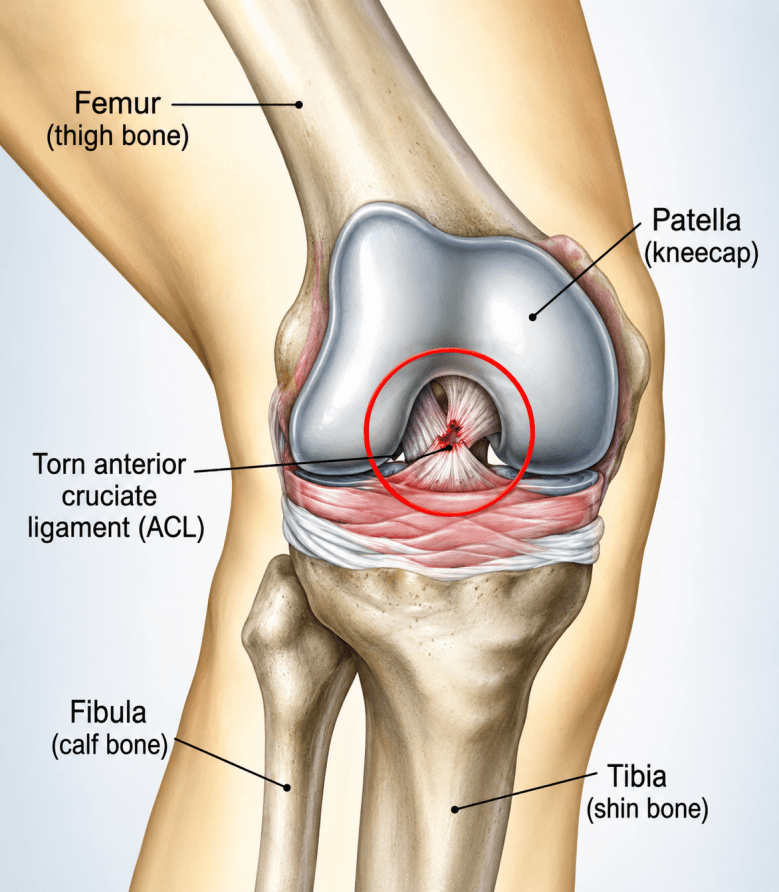
The knee is the largest joint in the human body and must withstand enormous stress every day. To ensure that flexion, extension, and rotational movements can occur in a controlled manner, various ligaments provide stability. The anterior and posterior cruciate ligaments play a particularly important role in this regard. They run inside the knee joint, cross each other in the middle, and connect the thigh to the lower leg.
The anterior cruciate ligament, in particular, prevents the lower leg from sliding forward uncontrollably during movement. At the same time, it stabilizes the knee during rotational movements and quick changes of direction. If this ligament tears, the joint loses a significant portion of its natural stability. Many people who have experienced this describe the feeling that their knee could give way or “slip out” at any moment.
How does a cruciate ligament tear occur?
In most cases, a cruciate ligament tear occurs without direct physical contact. Often, all it takes is an unfortunate combination of rapid deceleration, a twisting motion, and a foot planted firmly on the ground. This happens particularly frequently in soccer, handball, basketball, volleyball, or skiing.
It is not uncommon for other injuries to occur at the same time. For example, the meniscus, collateral ligaments, or articular cartilage may also be affected.
What are the symptoms of a torn cruciate ligament?
A torn cruciate ligament often becomes apparent immediately after the injury. Many people report hearing or feeling a pop in the knee. Pain sets in shortly afterward, and the joint begins to swell significantly within a few hours. This is often caused by bleeding into the knee joint.
Typical symptoms include:
- an audible popping sound at the time of the injury
- severe pain
- rapid swelling of the knee
- a feeling of instability
- Unsteadiness when walking
- Limited mobility
- Repeated buckling of the knee
Not all symptoms need to occur at the same time. Especially in cases of partial tears, symptoms may be significantly milder at first.
How is the diagnosis made?
The circumstances of the injury alone provide the treating physician with important clues. The knee is then carefully examined. Special stability tests can help determine whether the cruciate ligament may have been injured. To confirm the diagnosis, a magnetic resonance imaging (MRI) scan is usually performed. It provides a detailed view of the cruciate ligaments, menisci, cartilage, and other soft tissue structures. X-rays may also be necessary to rule out bone injuries.
Does a torn cruciate ligament always require surgery?
While surgery was often performed quickly in the past, treatment today is much more individualized. Not every patient requires surgical cruciate ligament reconstruction.
Key factors include:
- Age
- athletic activity
- Occupational demands
- Degree of instability
- Concomitant injuries
- Personal treatment goals
For people with lower physical activity levels, intensive physical therapy is often sufficient. However, those who regularly participate in sports involving rapid changes in direction or who suffer from significant instability often benefit from surgical reconstruction of the cruciate ligament.
Here’s how treatment proceeds
If surgery is planned, the torn cruciate ligament is usually not sutured today but replaced with a tendon from the patient’s own body. The goal is to restore stability to the knee joint and prevent secondary damage as much as possible. Regardless of whether conservative or surgical treatment is chosen, physical therapy plays a crucial role. Mobility, muscle strength, and coordination are gradually built up. Only once the knee is sufficiently stable again can the patient resume athletic activities.
Rehabilitation requires patience. Depending on the sport and the individual’s healing process, it may take several months before the knee can once again bear a full load.
Conclusion: Why Early Treatment Is Crucial
An untreated cruciate ligament tear can have long-term consequences. The persistent instability places greater strain on the menisci and articular cartilage, thereby increasing the risk of further injuries and premature joint wear. Early diagnosis and individually tailored therapy help significantly reduce these risks and preserve the long-term function of the knee joint.
A sudden popping sensation in the knee should therefore never be underestimated. The symptoms may indicate a cruciate ligament tear, which requires a thorough medical evaluation. Thanks to modern diagnostic procedures, personalized treatment plans, and structured rehabilitation, there is now a very good chance of restoring the stability of the knee joint and remaining active long-term.
Share this article
About the medical author
Melanie Al Tikriti, BSc
Editor
Melanie Al-Tikriti, BSc – author: Explore expert medical articles in the Leading Medicine Guide.
More about the medical author →Verified expertise
Recommended specialists
6 specialists
6 results



PD Dr. med. Friedrich Kutscha-Lissberg
Gelsenkirchen



Prof. Dr. Peter Schräder
Seeheim-Jugenheim

News
Read next
- News
Hornet Stings: When a Sting Can Be Dangerous
Sep 25, 2026
Most hornet stings are harmless—but some require immediate action
Read more - News
Pacemakers—Who Are They Suitable For?
Sep 23, 2026
Why a Slow Heart Rate Isn't Just a Natural Part of Aging
Read more - News
Hallux valgus: Why the big toe continues to deform
Sep 21, 2026
Hallux valgus: Barely noticeable at first—but later, every step can be painful
Read more