Rheumatological orthopedics is an essential component of the treatment of inflammatory rheumatic joint diseases. The rheumatology orthopedist performs surgical and conservative treatments in close collaboration with internal medicine rheumatologists. The goals are: joint preservation, improvement of function, and removal of inflammatory tissue. In cases where joints are already destroyed, joint replacement is sometimes the only option.
What is rheumatism, and what does treatment in rheumatology and orthopedics involve?
The term “rheumatism” refers to various inflammatory diseases of the connective tissue and joints.
These are classified as follows:
- Rheumatoid arthritis (chronic polyarthritis)
- Spondyloarthropathies (joint inflammation often affecting the spine)
- Inflammatory connective tissue diseases
- Inflammatory vascular diseases
- Metabolic disorders with inflammatory joint involvement (e.g., gout)
These are therefore clinical conditions with varying symptoms and different courses of the disease. Not all of them manifest in the joints or lead to joint destruction.
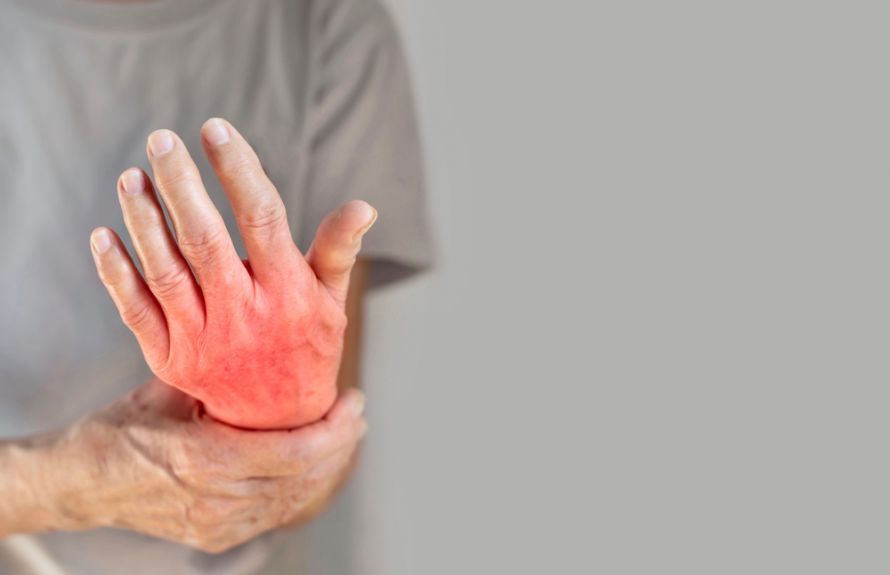 In Germany, an estimated 2% of the adult population and 15,000 children and adolescents suffer from inflammatory rheumatic diseases @ ZayNyi /AdobeStock
The treatment of rheumatic diseases involving the joints is performed surgically by rheumatology-orthopedic specialists.
Most often, inflammatory changes associated with rheumatism (arthritis) are the reason for surgical treatment.
Such therapies are also appropriate for:
- spondyloarthropathies and
- metabolic disorders with inflammatory joint involvement
Working closely with the internal medicine rheumatologist, the rheumatology orthopedic surgeon continues medication therapy. He or she initiates physical therapy, occupational therapy, and the provision of assistive devices.
If joint inflammation persists after conservative treatments, surgical treatment is indicated.
Surgical intervention is also indicated in the following cases:
- Risk of a tendon rupture
- Risk of nerve compression or
- Risk of acute joint instability
What does a rheumatology orthopedist do?
If joint or tendon inflammation persists despite conservative treatments, it is possible to surgically remove the inflamed tissue.
In this procedure, the doctor performs a synovectomy/tenosynovectomy (removal of the inflamed synovial membrane and tendon sheaths).
However, a synovectomy is only advisable if the joint has not yet suffered significant damage. Radiographic classifications help assess the degree of damage.
For this reason, doctors in rheumatological orthopedics distinguish between joint-preserving and joint-replacement surgeries:
Joint-preserving surgeries:
- Synovectomies: arthroscopic or open synovectomy of the joints and tendon sheaths
- Partial joint fusion
Joint-replacement surgeries:
- Implantation of artificial joint endoprostheses (endoprosthetics)
- Replacement of a joint with the body’s own tissue
- Joint fusion
Joint-preserving surgeries in the field of rheumatological orthopedics
If a synovectomy is performed, there are various procedures depending on the location:
Arthroscopic synovectomy
In joints with a large joint cavity, the synovial membrane can be removed without difficulty. This is often done via arthroscopic synovectomy on the knee joint.
This is performed through multiple access points, including an additional access point at the back of the knee.
Arthroscopic synovectomy is similarly successful on the shoulder, ankle, and elbow joints. Each joint has its own specific characteristics.
It is important for all joints that physicians carefully and thoroughly remove the inflamed synovial membrane.
In the shoulder joint, it is also necessary to remove the bursa beneath the acromion arthroscopically, as it is usually inflamed. This, in turn, leads to symptoms and damage to the rotator cuff (the tendon cuff of the shoulder).
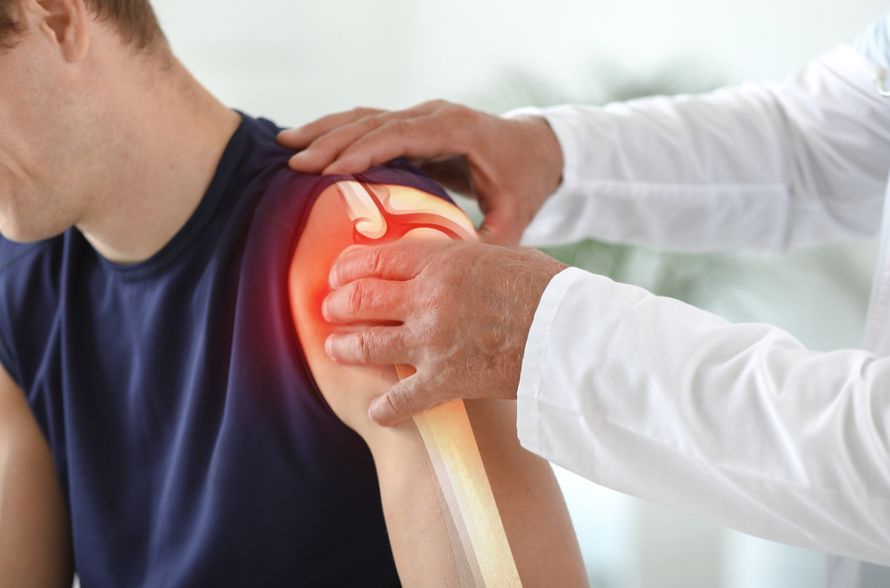 The most important symptom of a rheumatic condition in the shoulder joint is pain @ Pixel-Shot /AdobeStock
Open synovectomy of the joints and tendon sheaths
For smaller joints, such as the wrist, an open synovectomy is usually performed. Here, doctors remove the inflamed tissue through a large incision.
This offers the advantage of also being able to assess the overlying extensor tendons. The wrist can be stabilized again by reinforcing the joint capsule with the body’s own ligaments.
If the joint near the wrist—between the ulna and radius—is destroyed, resulting in functional impairment of forearm rotation, doctors remove the capitulum ulnae.
Reinforcing the joint capsule restores pain-free forearm rotation.
Less commonly, a surgical synovectomy is performed on the finger and foot joints. Alternatively, injections of cortisone or radioactive substances (radiosynoviorthesis (RSO)) may be used. The goal is to reduce inflammatory tissue in the treated joints.
If there are inflamed tendon sheaths in the hand, fingers, wrist, or foot, a synovectomy is performed only as an open procedure via a longer skin incision.
The tenosynovectomy involves the following steps:
- Removal of the inflamed tissue through sutures and reconstruction of the tendons
- Restoration of a functional gliding channel for the tendons
Doctors must also relieve pressure on and expose the nerves that run alongside the tendons. This is achieved through a tenosynovectomy of the flexor tendons in the palmar tunnel. At the same time, pressure is relieved on the median nerve in cases of carpal tunnel syndrome.
Partial joint fusion
If joint destruction is far advanced and poses a risk of increasing instability, a synovectomy alone is no longer sufficient.
In these cases, a synovectomy combined with fusion of a segment of the joint can remove the inflammatory tissue. This stabilizes the joint in the long term and preserves its function.
A prime example is partial fusion of the wrist. In this procedure, fusion is often performed between the radius and the lunate bone.
However, there are also other types of partial arthrodesis of the wrist. Additional partial arthrodesis can be performed on the tarsal joints with only minimal resulting functional impairment.
Joint Replacement Surgery in Rheumatological Orthopedics
Once joints have been destroyed by inflammatory rheumatic processes, the only options remaining are joint replacement (endoprosthetics) or fusion surgery.
Implantation of artificial joint prostheses
Doctors can replace joints with artificial endoprostheses. This type of joint replacement is well known for the hip and knee joints. These procedures are also successful in patients with rheumatic diseases.
However, in patients with rheumatic diseases, other joints—such as the shoulder, elbow, fingers, or ankle—are often affected as well.
Replacing these joints promises pain relief and improved function, particularly in cases of rheumatic diseases. This often helps patients maintain their independence.
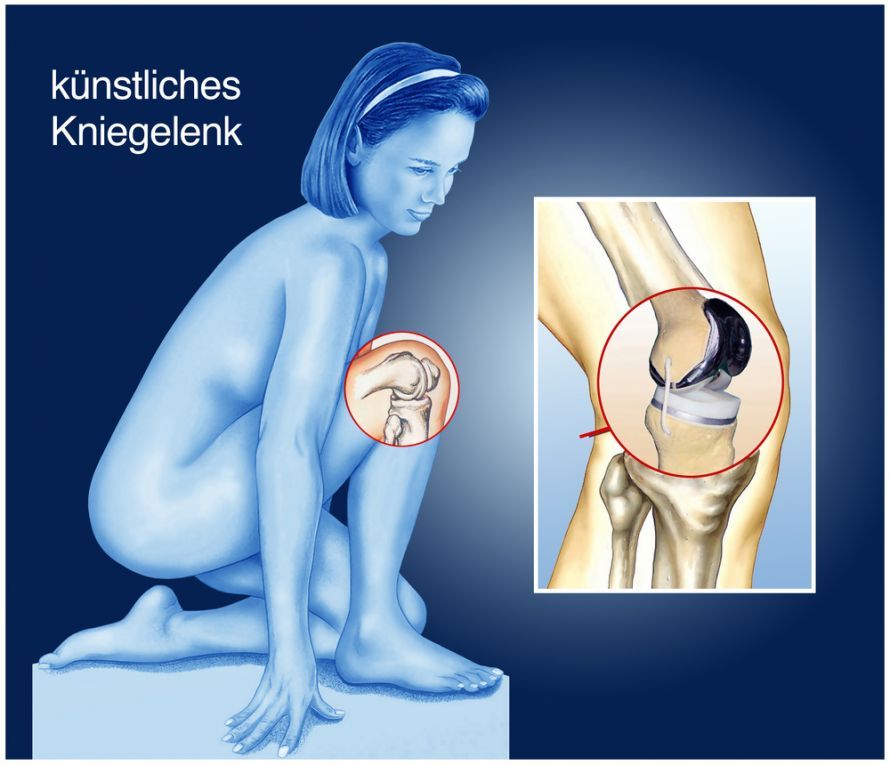
Artificial knee joint @ Henrie /AdobeStock
Joint Replacement Using the Body’s Own Tissue
In cases of arthritic destruction, other joints are best replaced using the patient’s own tendon and capsular tissue.
Joints such as the thumb saddle joint, the acromioclavicular joint, and the metatarsophalangeal joints are best replaced using resection interposition arthroplasty (RIAP).
In RIAP, doctors remove the articular surfaces, including the bone ends adjacent to the joint. They suture tendon and joint capsule tissue into the joint space.
This creates a scar tissue cushion that allows for pain-free movement of the joint.
Joint Fusion
Few joints are better suited for fusion when they have been destroyed by inflammation. For example, fusing a destroyed, unstable wrist leads to pain-free functional improvement.
Although flexion and extension are no longer possible, a firm grip and holding, as well as the important forearm rotation, can once again be performed without difficulty.
Similarly good results following fusion are seen in the thumb metacarpophalangeal joint, the lower ankle joint, and the big toe metatarsophalangeal joint.
Comprehensive Therapeutic Approach in Rheumatological Orthopedics
Treatment in the field of rheumatological orthopedics consists of a comprehensive approach combining medication, physical therapy, physiotherapy, and occupational therapy.
Following surgical treatment, the following goals are pursued:
- Wound care
- Restoration of mobility
- Restoration of function
This is achieved through physical interventions that help reduce swelling and maintain mobility in adjacent joints.
It is important to remember that rheumatic inflammatory diseases are systemic conditions.
In this regard, the therapy plan must include physical therapy aimed at preserving the function, mobility, and strength of the entire musculoskeletal system.
Rheumatological orthopedics is therefore much more than just the surgical treatment of a single joint!
About the medical author
Dr. med. Bernd Stuckmann
Medical writer