What is a forehead lift?
As we age, the elasticity of the tissue decreases. On the face, this leads, among other things, to drooping eyebrows, which then slide over the upper eyelids. In some cases, this can even result in functional limitations of the visual field.
The visual result is a change in the shape of the face. The facial muscles try to compensate for this, which in turn leads to deeper forehead wrinkles. Tension in these muscles can even cause chronic headaches.
A forehead lift is also known as a brow lift and is sometimes referred to as an “upper facelift.” The procedure involves tightening the forehead and lifting the eyebrows.
In the past, a forehead lift had to be performed as an open surgery. During this procedure, doctors removed a wide strip of scalp along the hairline from one ear to the other. Today, this can almost always be avoided. The surgery can usually be performed endoscopically, leaving virtually no visible scars.
At the same time, doctors can weaken the facial muscles of the forehead, which helps eliminate frown lines. Lifting the eyebrows also relaxes the muscles, and any headaches may disappear.
The endoscopic forehead lift is an important complement to aesthetic procedures aimed at rejuvenation, such as an upper eyelid lift. Therefore, this procedure should be considered when undergoing a facial rejuvenation procedure.
Unlike Botox treatment, an endoscopic forehead lift addresses the underlying causes of the aging process. Such an endoscopic forehead lift is often combined with a facelift, which can also be performed endoscopically in some cases.
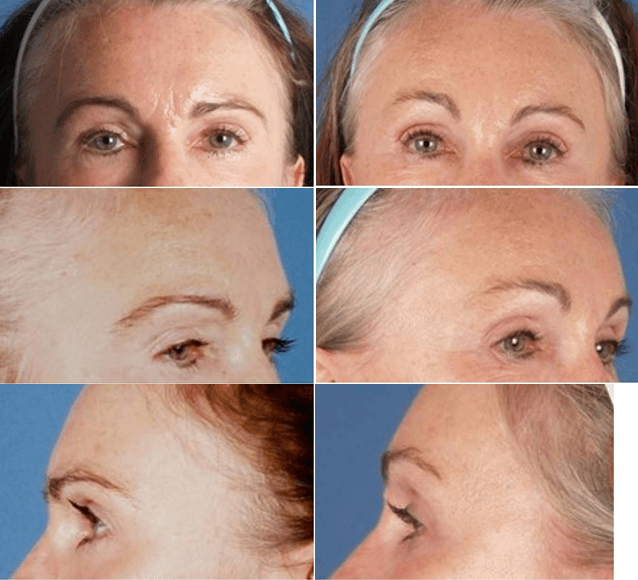
Open vs. endoscopic forehead lift
An open forehead lift results in long and often visible scars. Many patients also experience a permanent loss of sensation in the scalp following an open forehead lift. Nevertheless, the open forehead lift is still commonly performed today.
These side effects can be avoided using endoscopic surgical techniques that minimize scarring. The endoscopic technique requires only 3 to 4 skin incisions, each about 2 cm long, made within the hairline.
An endoscopic forehead lift requires equipment consisting of specialized fiber-optic devices with a camera and monitor.
The goal is not to lift the eyebrows excessively, but rather
- to achieve a natural contour and
- relaxation of the forehead muscles and skin.
For women, the goal is a soft brow arch that slopes slightly outward and upward.
For men, long scars are even harder to conceal due to the often higher hairline or baldness. Therefore, men also benefit greatly from an endoscopic forehead lift.

Before the forehead lift
Before a forehead lift, a thorough examination must be conducted, which also assesses the function of the eyelid-lifting muscles.
The process begins with the medical history, i.e., the doctor-patient consultation. The doctor asks about
- the patient’s medical history, including any pre-existing conditions,
- any previous surgeries,
- medications taken, and
- allergies.
It is also important to inform the patient about possible complications and side effects of the procedure.
Aspirin and other blood-thinning medications must not be taken before the procedure.
Standard photographs are required for surgical planning. A blood transfusion should never be necessary. Shaving the scalp is generally not required.
How is a forehead lift performed?
The surgery can be performed
- be performed under twilight sedation with local anesthesia or
- more commonly under general anesthesia
.
However, since the procedure is often combined with an upper eyelid lift or a facelift, it is more commonly performed under general anesthesia. The procedure is followed by a short hospital stay.
The endoscopic procedure is performed through two small incisions (on both sides in the crown or temporal region). During the procedure, the surgeon holds a special camera with a light in his left hand, while his right hand guides the specialized surgical instruments.
The surgeon proceeds from above and from the side, working directly on the bone toward the edge of the eye socket, while exposing the nerves. There is virtually no bleeding, as there are no major blood vessels in this surgical layer.
The surgeon then detaches the periosteum from the entire upper rim of the bony orbit and notches it. This allows the forehead skin and eyebrows to heal in their new position after the lift.
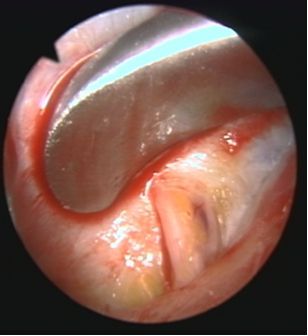
After complete mobilization, all layers of the forehead are gently lifted upward.
There are various techniques for fixation:
- Securing the suture to a drill hole in the outermost layer of the skull. A small protruding titanium screw can additionally secure the suture for a few days.
- Plastic clips that dissolve over time.
- Sutures between the different tissue layers to secure the brow and forehead regions.
Clips are usually used to close the scalp and are removed after one week. The insertion of drains is usually not necessary.
Since the wounds in the scalp heal very quickly, a bandage is not necessary. Patients can wash their hair and shower as early as the following day.
Healing Process and Postoperative Care After a Forehead Lift
The acute phase generally lasts 7 to 10 days. During this time, bruising and swelling are clearly visible. The severity of these symptoms can vary from person to person.
In the first two days, inpatient care at a clinic may be recommended. Here, the patient receives
- personalized pain management,
- cooling, and
- wound care
. Intensive cooling of the surgical site accelerates the reduction of swelling. The head should also be elevated.
Pain is generally mild and should be easily managed with mild pain medication. Lymphatic massages may be recommended to help reduce swelling.
Strenuous physical activity should be avoided for one to two weeks, and it is recommended that you take two weeks off work for the procedure.
Immediate postoperative effects that cannot be completely avoided include swelling and bruising. These extend down to the lower eyelids and may be clearly visible for 1 to 2 weeks.
Minor residual swelling may persist for several weeks afterward. The surgical scars also take several weeks to mature. In most cases, however, they are well concealed by the hair. The skin staples are removed after just one week.
Risks and Aftereffects of a Forehead Lift
A serious complication would be injury to the frontal branch of the motor facial nerve (facial nerve). This would lead to paralysis of one of the two forehead muscles, which in turn would cause one eyebrow to droop.
Temporary weakness of this nerve—even without it being severed during surgery—is quite common. This is not cause for alarm, as the nerve often recovers within a few days.
A temporary sensation of numbness in the forehead region is common. However, this generally subsides in the short to medium term. The crown of the head is usually the last area to feel completely normal again. This is due to the stretching of the large, sensitive frontal nerve, which emerges at the upper edge of the eye socket. If this nerve were to be completely severed, such sensory disturbances would be permanent.
The scalp, which is pulled upward, is generally secured through small drill holes in the skull. It is virtually impossible for the special drills used in this procedure to penetrate the eye. Likewise, an experienced surgeon should not accidentally injure the eye.
Although the surgical scars are very small (less than 2 cm), localized hair growth disturbances may occur in these areas. However, these can be easily corrected under local anesthesia.
In addition, of course, all other surgical risks apply in principle, as they do for any operation, namely
- infections,
- bleeding,
- and healing complications.
Even with an experienced surgeon, the outcome of the surgery is not always 100% predictable. It depends on many factors.

About the medical author
University Professor, MD G. Björn Stark
Medical Author