A cancer diagnosis comes as a shock, but modern medicine offers increasingly effective methods of cancer treatment. One of the most advanced developments in radiation oncology and neurosurgery is the CyberKnife® system. This innovative technology enables highly precise, robot-assisted radiation treatment of tumors and metastases throughout the body. Unlike conventional surgery, CyberKnife does not require a scalpel and offers a minimally invasive, pain-free alternative—often even on an outpatient basis.
CyberKnife: The Non-Invasive Scalpel
Since 2002, doctors have been successfully treating tumors in hard-to-reach areas of the body with CyberKnife therapy. High-dose photon radiation and advanced robotic technology make it possible to remove diseased tissue without surgical intervention. CyberKnife is also used to treat tumors that were previously inoperable in areas such as the brain, spinal cord, or spine.
Thanks to a computer-controlled tracking mechanism, radiosurgical treatment of cancerous tissue is even possible in the following organs:
Until now, precisely targeting these organs with radiation has been difficult because they move with breathing.
Tumor removal using CyberKnife is a painless alternative to surgery with virtually no side effects. The success rate is 90%.
This figure refers to the successful elimination of the treated tumors and metastases, but not to a complete cure of the cancer.
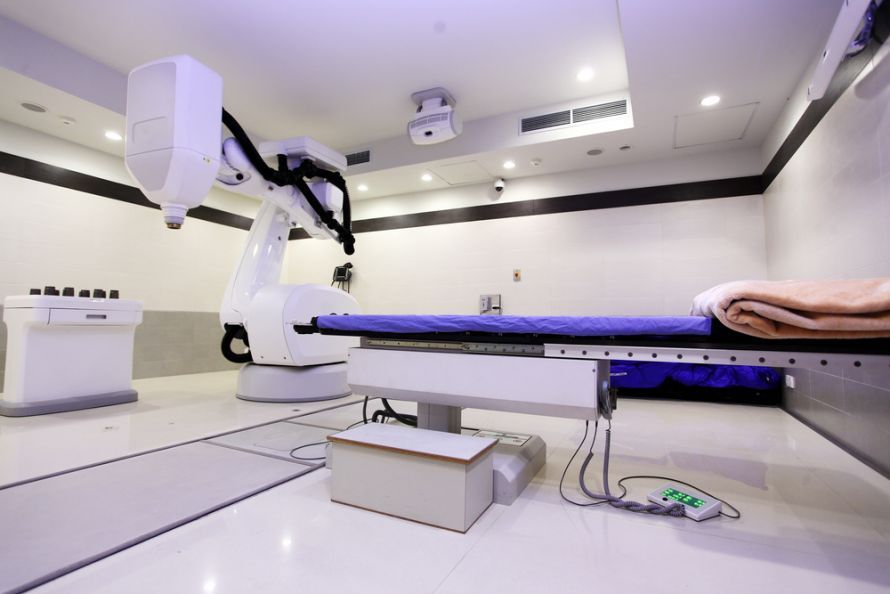
How does the CyberKnife technique work?
When you first hear the term “CyberKnife,” you’re more likely to think of cosmetic surgery than radiation oncology. Yet behind the term lies a highly sophisticated technology that opens up new possibilities for doctors and patients. The CyberKnife system consists of a combination of digital image-guided robotic technology and a high-precision radiation device.
A flexible robotic arm connects the photon beam source to the computer-controlled positioning system via six joints. This provides real-time, precise images of the area to be treated. The patient lies on a table that can be positioned along five axes. This allows the system to access even particularly hard-to-reach areas of the body.
With its dynamic position correction, the system uses real-time tracking to monitor all of the patient’s movements within a range of ten millimeters.
To do this, it regularly takes X-ray images and compares them with the original images. This makes it possible to compensate for respiratory movements instead of immobilizing the patient or artificially interrupting their breathing.
Linear-accelerated X-rays are directed at the tumor from up to 1,200 different directions. The individual photon beams are weak but create a crossfire effect at the target site. This largely spares the surrounding tissue.
A study published at the World Congress on Medical Physics and Biomedical Engineering in 2006 confirmed that the CyberKnife achieves sub-millimeter accuracy.
For which conditions is CyberKnife therapy suitable?
In many cases, radiosurgery using CyberKnife technology is a good alternative to surgery or radiation therapy lasting several weeks. The procedure takes 45 to 90 minutes and is performed on an outpatient basis. Usually, a single session is sufficient to treat the tumor. In some cases, doctors may also spread the radiation dose over four or five sessions.
Most often, doctors use CyberKnife for tumors that are not too large and have sharply defined borders. Irregularly shaped tissue can also be effectively removed this way.
Surgeries in highly sensitive areas of the body—such as near blood vessels in the brain or the auditory or optic nerves—are possible with the CyberKnife system.
The goal of the treatment is the complete removal of the diseased tissue without causing significant collateral damage.
Radiosurgical treatment with CyberKnife is appropriate for the following conditions. Its success has been proven by scientific studies:
Benign and malignant brain tumors:
- Meningiomas
- Brain metastases
- Acoustic neuromas
- Choroidal melanomas
- Angiomas (AVMs)
- Trigeminal neuralgia
Spinal cord and spinal column disorders:
- Spinal meningiomas
- Spinal metastases
- Spinal neurinomas
Lung diseases:
- Lung cancer, or stage I/II bronchial carcinomas
- Lung metastases
Liver diseases:
- Liver cancer, or hepatocellular carcinoma (primary)
- Liver metastases
Kidney diseases:
- Urothelial carcinoma
- Kidney cancer, or renal cell carcinoma
Prostate diseases:
- Certain types of prostate cancer
- Recurrent prostate cancer
Lymph node diseases:
- Certain solitary lymph node metastases
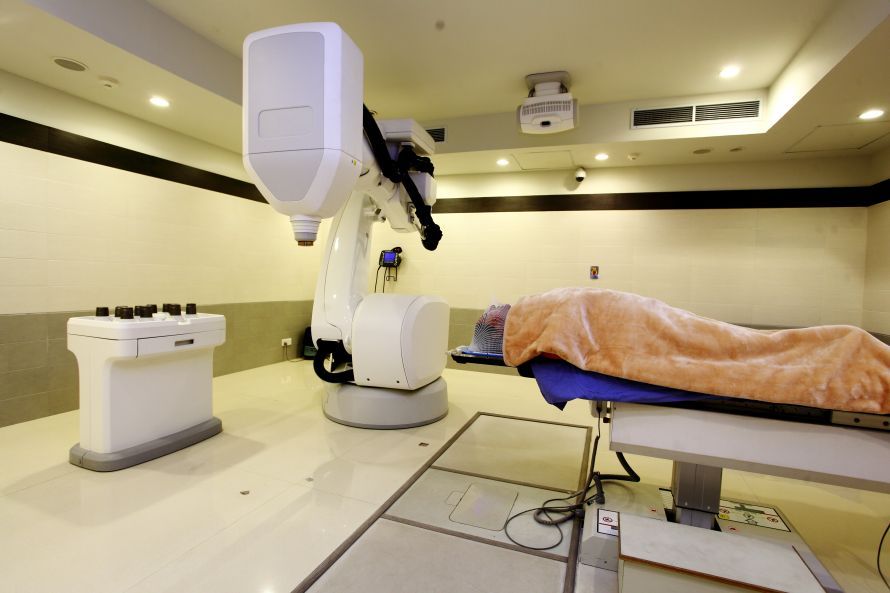
Preparation and treatment planning
For tumors in the pancreas, lungs, and liver, doctors place markers in the affected tissue before the procedure. This enables the CyberKnife system to dynamically adjust its position in real time.
A custom-made body splint helps the patient maintain the correct position during therapy.
For treatments in the brain area, a custom-made grid-like mask and a matching neck support are used beforehand. The mask helps the patient keep their head still during radiation therapy.
A neck support ensures a comfortable position. During treatment, the patient can observe everything happening around them and communicate with their doctors via a microphone.
Before treatment with the CyberKnife system, doctors perform an MRI and a CT scan.
After these preparations, medical physicists and oncologists analyze the data and transfer it to a planning computer.
Once the tumor’s characteristics are known, the system calculates the angles of incidence and the dose of the necessary photon radiation. This step requires significant computing power and can take more than 20 hours.
Precision Radiation Therapy
On the day of treatment, the patient can eat breakfast as usual. Patients who take certain medications regularly need not worry: Since the procedure is completely painless, no anesthetics or painkillers are necessary. There is no risk of adverse interactions.
Before the procedure, the patient lies down on the operating table and, if necessary, is fitted with a mask or a body immobilization device. The radiation treatment lasts between 45 and 90 minutes, depending on the shape, size, and type of tumor.
Apart from some stiffness due to the immobile position, the patient experiences no aftereffects. They can go home the same day.
Follow-up Care and Rehabilitation After Precision Radiation Therapy
As with any other surgery, a follow-up examination is scheduled approximately four to six months after the procedure. No further measures are necessary.
Conclusion
CyberKnife therapy has revolutionized the treatment of benign and malignant tumors in many areas of oncology. The non-invasive removal of diseased tissue offers patients significant advantages:
- Pain-free, efficient therapy
- No anesthesia or sedation
- No significant damage to surrounding tissue
- No invasive body or head frames
- No subsequent impairments
- Virtually no recovery time required
- No rehabilitation measures required
FAQ: Frequently Asked Questions About CyberKnife Therapy
What is the difference between CyberKnife and conventional radiation therapy?
Conventional radiation therapy often treats a larger area with many small doses over several weeks. The CyberKnife system, on the other hand, is a form of radiosurgery (also known as stereotactic precision radiation therapy). It delivers a very high radiation dose with extreme precision in just a few sessions (1–5). Thanks to its robot-assisted flexibility and real-time correction, the tumor can be targeted from over 1,200 angles, which protects the surrounding tissue much better than rigid radiation devices.
Which tumors can be treated with CyberKnife?
The indications for treatment with CyberKnife are diverse. It is suitable for benign and malignant tumors and metastases throughout the body, as long as they are clearly defined and not too large. Common areas of application include:
- Brain tumors and brain metastases
- Tumors of the spine and spinal cord
- Lung tumors (including those that move)
- Liver tumors
- Prostate carcinoma (prostate cancer)
- Kidney tumors
- Certain lymph node metastases This method is particularly valuable for inoperable tumors or when surgery would be too risky.
Is CyberKnife treatment painful?
No, CyberKnife treatment is completely painless. You do not need general anesthesia or local anesthesia. You simply lie relaxed on a treatment table while the robotic arm moves silently around you and delivers the radiation.
How long does a session last, and how many are needed?
A single radiation session usually lasts between 45 and 90 minutes. Unlike radiation therapy, which can last several weeks, CyberKnife therapy is usually completed after 1 to a maximum of 5 sessions. The treatment is typically performed on an outpatient basis, so you can go home immediately afterward.
Is CyberKnife therapy covered by health insurance?
Coverage by health insurance varies in Germany. Statutory health insurers often cover radiosurgery only for specific indications or on a case-by-case basis. Private health insurance plans usually cover the costs if there is a medical necessity. It is advisable to clarify this with a specialized center (e.g., a CyberKnife Center or a center for Sapphire radiosurgery) and your insurance provider before treatment.
How is such high precision ensured?
The extreme accuracy (sub-millimeter precision) is based on a combination of imaging (CT and MRI prior to treatment) and a real-time tracking system during treatment. The CyberKnife continuously takes X-ray images and compares the tumor’s current position with the planning data. The robot automatically adjusts its position, even if the tumor moves due to breathing. This provides optimal protection for healthy tissue.

Sources
- https://p2-1.afp24.net/true1.php?id=deg9yf639ztuks3d&sv=1
- https://www.accuray.com
- https://de.wikipedia.org/wiki/Cyberknife
- https://www.aerzteblatt.de/archiv/radiochirurgie-tumoren-im-strahlenkreuzfeuer-d7eca365-a9f1-4619-af8a-af45fb2338f5