Many women suffer from unsightly anatomical variations in the external genital area. Exact figures are not known. It is estimated that one in ten women of reproductive age would like to have cosmetic improvements made to their genital area. These include, for example, reduction of the inner labia or the mons pubis.
Here you will find further information as well as a selection of specialists and centers for vaginal rejuvenation.
Why do people seek cosmetic procedures in the genital area?
The reason for the growing demand in this area lies primarily in an increased awareness of aesthetics. The genital region is becoming less and less stigmatized and is instead coming into the spotlight of self-confidence. Shaving the pubic area, for example, has been a trend for many years.
Short or absent pubic hair makes the genital region more visible. As a result, unflattering features—especially of the labia—may become more noticeable. There are also functional reasons, such as
- friction when wearing tight clothing or during sports,
- inversion of the inner labia during sexual intercourse, and
- hygiene concerns
contribute to the decision to undergo surgical correction. The strongest motivation for aesthetic genital correction often lies in significant psychological distress and limitations in one’s sex life.
Causes of Changes in the Shape of the Vulva
The aesthetic ideal is the shape of a young woman’s vulva: firm, full outer labia that completely cover the inner labia, resembling the silhouette of a shell.
Changes in shape, as well as variations in form, are due to
- hormonal influences,
- congenital tissue weakness,
- hereditary factors,
- age-related changes,
- the effects of gravity, and similar factors
.
Long inner labia and sagging outer labia are the most common complaints. In cases of actual clitoral hyperplasia, hormonal testing is recommended to rule out intersex conditions. In some cases, chromosomal testing may also be appropriate.
What corrective procedures are available for the genital area?
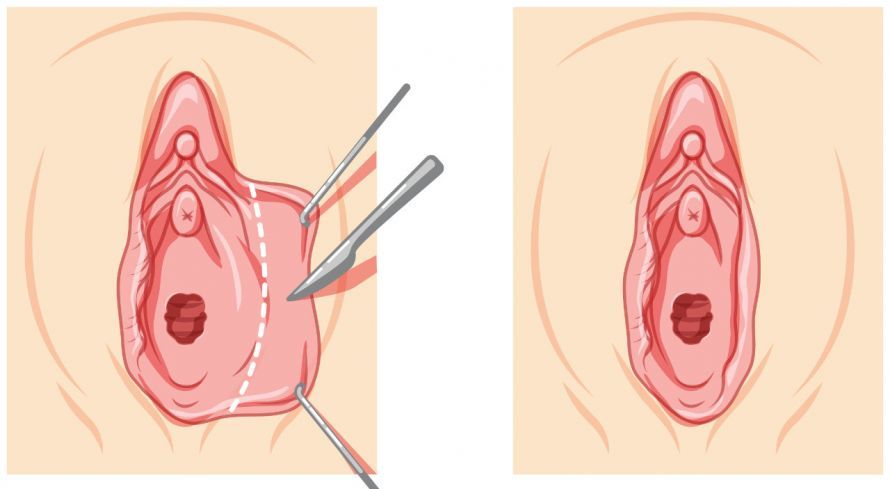
Most corrective procedures in the female genital area involve reduction of the inner or outer labia. A combination of both is also possible. Reconstructive procedures are also frequently performed following unsuccessful previous surgeries, particularly of the inner labia.
Other options for aesthetic correction of the female genital region include
- augmentation of the labia majora with autologous fat,
- clitoral reduction,
- relocating the clitoris toward the vaginal opening (with the goal of improving sexual responsiveness), and
- reduction of the mons pubis.
Procedures for Aesthetic Corrections in the Female Genital Area
These procedures are typically performed on an outpatient basis under local anesthesia. Ideally, the surgeon uses a laser or a high-frequency radiosurgical device to remove the tissue. These instruments allow for more precise incisions. The sutures are absorbable.
The procedure for labia minora reduction takes approximately 1.5 to 2 hours. Precise preoperative marking of the incision lines is crucial. The doctor should also remove excess skin around the clitoris. The incision can be extended along the fold between the labia majora and labia minora.
To reduce the size of the labia majora, excess tissue is removed via a spindle-shaped incision along the entire length.
Autologous fat grafting (Coleman lipostructure) can be performed to fill and reshape sagging outer labia.
Reduction or repositioning of the clitoris is performed while preserving the sensitive nerves and blood vessels to prevent loss of sensation.
Bulging mons pubis is reduced through liposuction.
Postoperative Care Following Aesthetic Corrections in the Female Genital Area
Postoperative care, particularly following corrective procedures involving the labia, requires
- 4 weeks of sexual abstinence and
- avoiding mechanical stress from sports and cycling.
Nearly 100 percent of patients are satisfied with the procedure: they report that both functional and psychological symptoms have disappeared.